Technology relations
Contractors and distributors discuss CAD systems, BIM modeling and reliance on eCommerce.
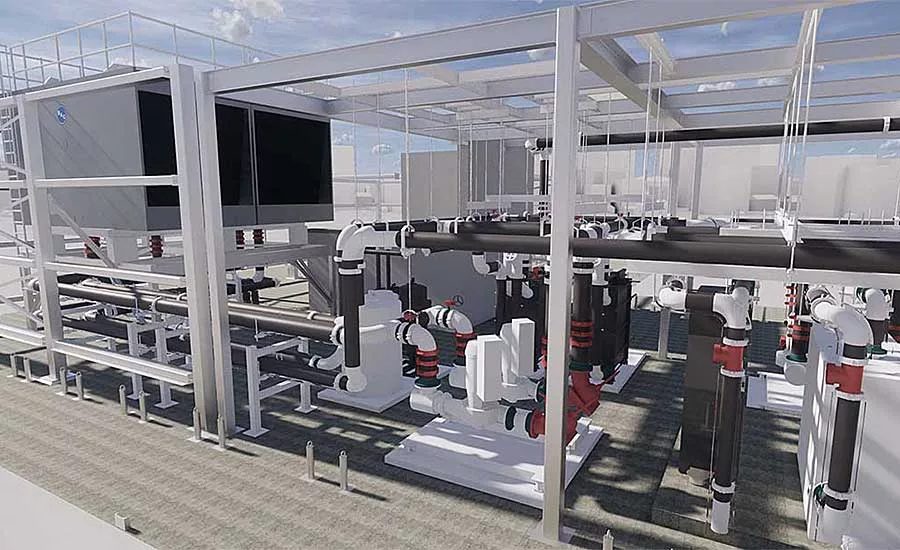
BIM drawing from Duggan Mechanical’s fabrication and design services.
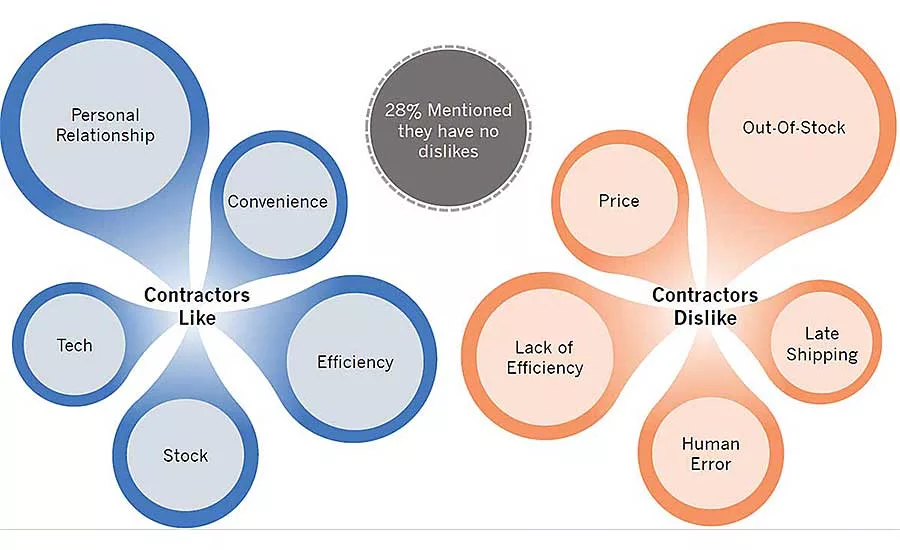
In an effort the help distributor members better understand the needs and adapt to evolving expectations of contractor customers, the American Supply Association’s D.NEXT Lab team at the University of Illinois Urbana-Champaign conducted research focused on contractor purchasing habits, ordering and receiving preferences at distributors, big-box retailers and online. The full detailed report is available for ASA members here.
One positive, standout finding is that contractors report they conduct 89% of their business with distributors. This leaves a mere 8% of their business at big-box stores and 3% of business to online retailers.
When it comes to ordering methods, the top ways contractors place orders are by walk-ins and phone calls. Following those methods are orders placed via email and eCommerce. Perhaps the most surprising finding from this research is that 14% of the respondents report they never order in-person; not a huge percentage, but more than most expect to hear.
While the DNEXT Lab research reflects that contractor buying habits have not yet made huge transition to eCommerce, some contractors note the shift is expected to continue, and there are many other ways the distributor-contractor relationship can strengthen in terms of technology to prepare.
Brian Helm, former MCAA president and current president and CEO of Mechanical Inc. — part of The Helm Group Companies and one of the largest plumbing and HVAC contractors in the Midwest — says the majority of his contractors order via email and phone calls, but eCommerce is a growing desire.
“I do think there is a shift ahead toward eCommerce,” Helm notes. “Specifically, I’d love to have access to more real-time inventory availability and even be able to integrate that with our databases so we can easily source material in the most efficient way.
“I think some distributors think offering eCommerce takes away from their value add, but I think it adds to it; if we can see up-to-date inventory information online it adds huge value,” he adds.
When speaking to reliance on eCommerce, Jeff Elwell, director of innovation and technology for E.M. Duggan, a Massachusetts-based mechanical contractor, says contractors are willing to use eCommerce. “Most MEP contractors are willing to depend on eCommerce for their purchasing,” he says. “I think the big change will come when BIM models begin to be used as a digital bill of materials, and orders are taken 100% from the model. I think the industry is willing, it’s just waiting for everyone to catch up with the wave of technology that’s swept over the last decade.”
BIM, CAD and data-exchange
The industry is adopting BIM and 3D modeling, but it’s important for all parties involved — contractor, distributor and manufacturer — to be actively engaged in and continuously updating information within these platforms.
Elwell says the most important thing distributors can do in terms of technology is to start using the technology and platforms their customers are using.
“The industry has adopted BIM and 3D modeling, but it is still hard to put that information to good use after its drawn,” Elwell explains. “The ability to order, track and receive materials pulled directly from a model is one of the biggest changes I see coming in the near future. We are seeing it change slowly, but in the coming years, I expect most ordering to make its way to the digital and even automated landscapes.”
Especially when contractors are fabricating, it is important they have dimension information readily available for drawings and designs.
“The most important thing for us is being able to get product dimensional data into our CAD systems,” Helm explains. “We do installation drawing for almost all of our projects, so it’s key to have ITM data in order to use certain materials.”
Elwell agrees, explaining ITM data libraries are vital to the contractor. “Currently, one of the best ways to get in the good graces of a contractor is to provide full Revit and ITM libraries of your products,” he says. “We also love to see ease of ordering from a modeling or BIM program. These are the things that set distributors apart and get customers excited.”
So what’s stopping distributors from diving in and providing this data to contractor customers? Nick Porter, CEO at Adison, Indianapolis-based Porter Pipe and Supply, explains opening up APIs, along with information from manufacturer partners are the main roadblocks.
“The big roadblock in exchanging data freely and removing manual-entry aspects is opening up APIs,” Porter says. “The contractor has to be technologically able to engage in and open up to API platforms.”
There are many elements of data that need to be exchanged throughout a project, and Porter notes the best way for contractors and distributors to work together is by eliminating manual data exchange. “Contractors and distributors each have their own systems and programs, and the best way to bridge the gap, allowing the systems to communicate, is through APIs,” he says. “Instead of having parties on both ends manually entering product or price information, we should be using our ERP software to populate this information, eliminating manual data-entry.”
Perhaps the most vital piece of the CAD system puzzle is the product dimension information. MCAA has implemented its WebELM platform — a labor estimating tool where manufacturers can link their product information database so that contractors have the most up-to-date product size information available.
Helm explains vendors may lose business if they aren’t in that database while a competitor is because it is easiest for contractors to draw in products when they have dimension info on-hand.
“While we as a distributor will do everything we can to help with this, the product information side of the supply chain relies on the manufacturer,” Porter says. “In terms of bridging this gap, it’s a shared pull from both the contractor and distributor; the more information we can get out there about why it’s important for contractors to have this information available, the more pressure manufacturers will be under to provide it.”
Elwell explains if embraced industry-wide, BIM modeling can provide value for the distributor, not just the contractor.
“Our models are our source of truth. We, as an industry, have moved from modeling with lines and assigning value to them to modeling with real elements that contain value,” he says. “This has essentially turned our models into a data-rich environment in which we hope to do all of our building. That includes ordering materials and interactions with distributors. If BIM is as valuable as we believe it to be, then it's not just the GCs and subs that can benefit, but the distributors as well.”
Inventory and pricing pain-points
Commodity pricing and supply chain disruption continue to present challenges. Contractors agree the more transparency, the better.
“We want as much information as possible to be able to accurately and efficiently receive and track materials throughout the entire building process,” Elwell explains. “From Revit families with UPC information to model ordering and active tracking through install. The more data we have and can use the better. “
Steel pricing has eclipsed heights the industry saw back in 2008, and commodity prices continue to fluctuate. Porter explains that while pricing transparency is incredibly important, it’s just a snapshot in time. “Project quotes are only good for about five days right now in commodities,” he says. “The more contractors can forecast when they will actually need the material, and when that job will actually be awarded, the better we can work with them to get the best pricing possible.”
When it comes to available product, Helm says distributors that are bulking inventory are gaining business during this time when certain products are hard to come by. “In some situations we are going to those distributors that we may not normally buy from if they have plenty of inventory available,” Helm explains.
Technology relations
Overall, it seems a slow shift is occurring in consumer buying habits, and while data available today shows eCommerce isn’t a primary source of ordering, contractors are thinking ahead to a time when they may rely on eCommerce solutions; especially if they integrate with CAD systems and BIM models.
Whether it be inventory availability, pricing or ordering options, the key for technology use between distributors and contractor customers is open communication.
“The ability to know what’s coming when and to efficiently and accurately order what we need has always been the goal. Now with the adoption of tech in the industry over the last 10 years, the ability for us all to work out of one model and be able to order, track and inventory materials and parts is the next big step,” Elwell says. “Larger distributors seem to have jumped the line and gotten on the bandwagon, but as with all technology, it’s open to all to improve their processes and accessibility to their products.”
Looking for a reprint of this article?
From high-res PDFs to custom plaques, order your copy today!