Distributor elements of value
Deep dive into distributor relationship with contractor customer.

halbergman / Creatas Video via Getty Images
As B2B offerings become increasingly commoditized, it has become more important than in any previous time in history to have a clear picture of the value proposition of your distributorship. The last 20 years - and in particular, the last two - have seen the slow but steady growth of industry behemoths that are driving commoditization of the PHCP industry.
Compounding the pressures posed by this commoditization, the number of active contractors is likely to further decline in the near future. By 2025, the youngest of the baby boomers will be 65 years old, and the ‘birth dearth’ following the Great Recession will begin a reduction in the number of new high school graduates entering the workforce. Combine this shrinkage in your customer base and the increasing difficulty in differentiating your place in the industry, and one can see that this is a critical time for distributors to have a clear, strategic, vision of the elements of value that attract, delight and retain their contractors and customers.
From the inception of D.Next, distributors have claimed there exists a unique value in the relationship that distributors have with their contractors. However, when asked to define or describe the components of this differentiating and valuable relationship, many are flummoxed. We have attacked this question from multiple angles throughout our research for the industry, and we believe that we have found the beginning of an answer.
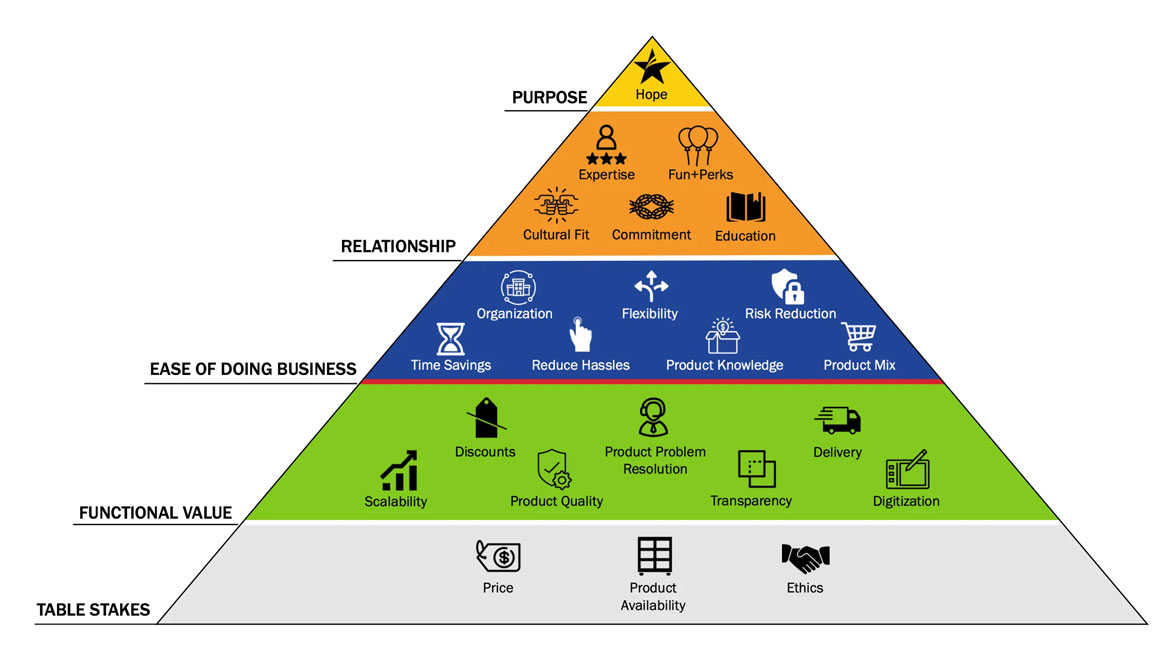
The following diagram depicts elements of a distributor’s relationship with their contractors. We took inspiration from research performed in 2018 by Bain consulting, and refined it specifically for our members. The concept is that of a hierarchical pyramid of value, where each layer acts as the foundation and support for the higher levels of the pyramid. The lower layers are more quantitative and objective, and each subsequent layer becomes more subjective and qualitative as the value provided becomes less transactional and more experiential or personalized.
Our framework for distributors describes 23 distinct ‘elements of value’. They fall into five levels: Table Stakes, Functional Value, Ease of Doing Business, Relationship, and Purpose.
THE BASE: TABLE STAKES
The base of the pyramid contains elements of value that are the foundation of any business relationship: Price, Product Availability, and Ethical Business Practices. These elements are the bare minimum for contractor customers to consider doing business with a supplier - they can almost be understood as needs rather than elements of value, unlike the other levels of the pyramid.
That said, you cannot compete exclusively on price and availability alone - Amazon and big-box stores will always win for the products that they sell. If the decision of where to go for materials was dictated exclusively by price and availability, then distributors would have shaky ground to stand on. But there is more to business than price alone. One need only have sufficiently low pricing, sufficiently regular availability, and sufficiently forthright business practices to remain in business. Once this foundation is laid, research indicates that additional resources invested in these elements will see diminishing returns compared to the higher levels of the pyramid.
SECOND LEVEL: FUNCTIONAL VALUE
The second level of elements of value represents things that provide quantitative value to the contractor, but how much value they provide and how they are seen by each contractor can be more subjective. The way we differentiate between functional value and table stakes is whether weakness in one area will bring business to a halt. For example, a poor delivery network or lacking digitization can be frustrating, but unreasonable stock shortages are crippling.
Functional value is composed of seven elements: Scalability, Discounts, Product Quality, Product Problem Resolution, Transparency, Delivery, and Digitization. We wish to clarify a few of these, as our usage of these terms is slightly unconventional.
Scalability does not refer to the scalability of the distributor, but rather the ability of the distributor to support the growth of contractor companies, in terms of both material and organizational demands.
Product Quality refers to having products that are of a sufficient quality for the contractor’s or end customer’s purposes - this can, but does not necessarily, mean the highest possible quality.
Product Problem Resolution means dealing with all forms of post-sales support - installation, warranty, exchanges, returns, etc.
Transparency refers to actively providing contractors with a clear view of the distributor’s ordering, processing, timelines, and capabilities. A key point is the actively in actively providing - even if the information is technically available, if it takes a great deal of effort for the contractor to access it, that information is of no more use than not being available at all.
We do not believe that the elements found here have become commoditized in the same way that table stakes have, in part due to the more subjective nature of their impact on the contractor, but we are seeing the beginning of this process. In particular, the pandemic and the resultant significant investment in digitization by big-box stores has drastically accelerated the rate at which these elements are becoming non-negotiable to contractors.
YOUR OPPORTUNITY TO BE DIFFERENT
On the graphic, we have a red line between the lower two levels and the upper three. This is to represent the division between what every supplier is capable of doing - and every supplier does, to some extent - and the things that big-box stores do not do.
The first two levels provide material benefits to your contractors, and quantifiable benefits to a business. The three higher levels are more subjective, and at times can seem ephemeral. Although the first two layers are significant, we believe that a distributor only needs a solid enough foundation to support their efforts in the higher layers. Once that foundation is secured, our research indicates that you should focus the remainder of your time and energy on the highest three layers.
We believe that the three higher levels represent an opportunity for distributors to differentiate themselves from competitors, personalize contractor experience and reveal competitive advantage. The higher levels do not necessarily provide obvious or immediate returns, and this means that efforts towards these elements may at times feel misplaced. It is not our intention to discount the time and investment that improving these elements will require, but we believe that an opportunity for truly cementing your relationship with your contractors lies in Ease of Doing Business, Relationship and Purpose .
Lastly, there are two connected reasons to focus on these higher elements of value. The first is that we do not currently see big-box stores focusing on these elements, meaning that your efforts here may help you differentiate yourselves from the more commoditized giants. The second, and the more important reason, is that we believe that they likely never will. These national giants are under pressure to show consistent short-term returns. Investments in their business are publicly scrutinized by shareholders. Most distributors have the blessing of not being forced to respond to shareholder pressures, and this gives you the freedom to invest in building long-term resilience over near-term returns.
 structuresxx / iStock / Getty Images Plus via Getty Images
THIRD LEVEL: EASE OF DOING BUSINESS
The third level contains elements that make doing business with a supplier more personalized and pleasurable, things that improve the contractor experience in a way that is tangible and marketable but may be difficult to isolate.
Ease of Doing Business is composed of seven elements: Time Savings, Organization, Reduce Hassles, Flexibility, Product Knowledge, Risk Reduction, and Product Mix. We’ll define each element here, as our operating definitions can and do vary from common usage.
Time Savings is reducing contractors’ time spent during any stage of the purchasing journey. Examples include picking orders before contractors arrive and charging to a contractor’s account instead of paying at the counter.
Organization embodies providing services & resources to help contractors get their stock and business organized. To clarify, this is helping the contractor organize, not organizing your own business.
Reduced Hassles means reducing the friction that exists when purchasing supplies. Reducing Hassles is about reducing the amount of effort contractors have to expend, while Time Savings is about reducing the amount of time spent.
Flexibility is being willing and able to deviate from written or established processes to accommodate different contractors’ needs, including providing extension of credit terms and support of custom projects with protracted timelines.
Product Knowledge is providing technical details and getting product information from the manufacturer on the contractors behalf. This includes conducting research and acquiring information from manufacturers and their representatives.
Risk Reduction means helping contractors reduce their business risk. This includes offering tool rental services to reduce financial risks by keeping funds available, avoid tool/equipment storage costs and complete jobs efficiently.
Product Mix refers to offering a wide variety of products, including convenience and expendable items, so that contractors don’t have to go to multiple locations to get everything they need.
We think of this layer as the elements that improve and strengthen the relationship between two businesses - the contractor’s and the distributor’s. This is the first layer that truly represents “relationship”, and this layer focuses on the business side of the relationship. It may be the case that this layer is more foundational than the fourth because a lack of a personal relationship is acceptable, so long as there are business reasons to stay with a distributor. On the other hand, a strong personal relationship that isn’t founded on value-added business principles will eventually lead to the contractor asking themselves hard questions.
Now is a pivotal time for thought-leading distributors to get curious, innovate and purposefully engage in developing, communicating, and operationlizing a clear vision of their elements of value.
FOURTH LEVEL: RELATIONSHIP
The fourth level contains the elements of value that build and maintain the personal, human relationship between the contractors and the employees of a distributor. Importantly, this is not the relationship between management and the contractors - these elements foster the development of interpersonal relationships between your employees and your contractors. These elements compel people to want to interact with the expectation of a better day. The fourth level is composed of five elements: Cultural Fit, Expertise, Commitment, Fun & Perks, and Education.
Cultural Fit is all about providing contractors with a sense of community during the process of purchase, i.e., distributors and contractors share the same values and ways of doing business. Note that preferences for what this culture should look like will vary from person to person. The point of focusing on Cultural Fit is to make your contractors comfortable and welcome, to make them feel like they are on the same team as the distributor’s own staff.
Expertise means having staff that possess practical or applied knowledge in the industry, and using that knowledge to help their contractor customers. The way we differentiate Technical Knowledge in the third level from Expertise here is that Technical Knowledge is book learning, whereas Expertise is applied knowledge. It’s the difference between having the specs for a product memorized and understanding the difficulties that come with installing said product and knowing how to work with or around them. Expertise is particularly relevant for less experienced contractors who may need to rely on the knowledge of the distributor’s staff for help.
Commitment means demonstrating commitment to the contractor’s own success. Employees should be given license to demonstrate that customers’ problems are taken as their own problems. This means the distributor purposefully acknowledges that a contractor’s commitment to remain loyal to distributors comes with certain responsibilities, and the distributor needs to commit to the necessary work to maintain that loyalty.
Fun & Perks is offering experiences and incentives for contractors to get involved with the distributor’s business, including giving away snacks, drinks, merch, etc. This is both about improving the contractor’s lives on a day-by-day basis by doing the little things that show every customer matters as well as the big events that reinforce a sense of community between the contractors and the distributor’s employees.
Education means offering training opportunities for ongoing education, new products, and new technologies (occasionally in cooperation with manufacturers and their representatives). Making it easy for plumbers to learn new installation techniques, helping them keep their license through education credits, and even providing access to industry conferences all help support your contractors’ livelihood and business success.
These elements provide opportunities to develop a sense of community between people, of belonging in the same tribe and having a bond with one another. They are all things that cannot be forced or they will feel fake; they are also extremely difficult to overtly measure without hindering their authenticity.
Broadly, efforts in these elements of value may consist of identification and reduction of organizational culture barriers and supporting the growth of your people. In particular, a significant place where culture, expertise and commitment are experienced is at the counter. This is a core interaction with contractors, a primary mode of business, and the place where two people can interact face-to-face most often. All of these elements are applicable throughout the company, but their implementation is relevant and highly impactful at the counter.
 Drazen Zigic / iStock / Getty Images Plus via Getty Images
FIFTH LEVEL: PURPOSE
The fifth level contains a single element of value, Purpose. All organizations exist to make people’s lives better, sometimes in major, transformational ways and oftentimes in smaller, subtle ways. This element shares recognition, inspiration, love of and hope for the future of the industry and the community of tradespersons. Purpose goes beyond providing products and building relationships and extends to include strengthening the future of a contractor’s business, as well. Purpose will not necessarily provide a distributor recognition or differentiation but it should provide clarity on how to help contractors succeed.
D.Next has observed an example of the Purpose value element. A distributor we interviewed described the potential for inventory management software integration with their contractors. The software would track inventory of pipes, valves and other supplies at the contractors shop. When the inventory fell below a predetermined threshold, an order would be transmitted to the distributor who would pick, pull and deliver replenishment stock directly to the contractor’s shop. Digitization of this business process offers near-term benefits: organized buying behavior, relieves contractors of manually counting inventory and supports having enough product inventory at the right time. However, in the long game, it supports a contractor’s strategy to grow and scale their business by creating inventory data to feed into reports that support monitoring, forecasting, job costing, quoting and fiscal discipline.
Partnering with your contractors at this level is certainly mutualistic and somewhat altruistic. It enables a distributor to discern where to increase or decrease their efforts and customize supporting services for each contractor customer. In this way, you become more than adjacent members in a value chain, you contribute ‘a how’ to a contractor’s future and strengthen the community of trades as well as the industry, overall.
OPPORTUNITY: YOUR TIME IS NOW
The last two years have seen disorienting waves of business chaos as well as a volume of change equivalent to the preceding ten years combined. More than ever, distributors should be asking themselves what relationship opportunities lie within their grasp. Chaos has reshuffled the deck and has dealt the savvy player an opportunity to push beyond the way business is being done, toward the way business will be done.
What elements of value will resonate with the contractor customers of today and the upcoming Generation Z? How will your distributorship choose to prioritize elements of value within your strategy in support of your employees, community, contractors and customers? Now is a pivotal time for thought leading distributors to get curious, innovate and purposefully engage in developing, communicating, and operationalizing a clear vision of their elements of value. Your time is now.
Looking for a reprint of this article?
From high-res PDFs to custom plaques, order your copy today!