Supply House Times logo Supply House Times
search
cart
facebook instagram twitter linkedin youtube
  • Sign In
  • Create Account
  • Sign Out
  • My Account
Supply House Times logo Supply House Times
  • NEWS
    • ASA NEWS
    • Company News
  • PRODUCTS
    • Interactive Spotlights
  • COLUMNS
    • Natalie Forster: From the Editor
    • Alicia Branham: Marketing Matters
    • Brad Williams: Succession Planning
    • Melissa Rasico: Luxury Plumbing Lounge
    • Letter from ASA President
    • Guest Columnists
    • Safety Columnists
  • MARKETS
    • Codes & Legislation
    • Heating & Cooling
    • Industrial PVF
    • Plumbing
    • Radiant & Hydronics
    • Solar Thermal | Geothermal
    • Technology
    • Women in Industry
  • BATH & KITCHEN PRO
    • Bath & Kitchen News
    • Bath & Kitchen Products
  • SPECIAL EDITIONS
    • B.I.G. Book Directory
    • Premier 150
    • Rep Locator Directory
  • MEDIA
    • Podcasts
    • Videos
    • eBooks
    • Webinars
  • RESOURCES
    • Radiant Comfort Report
    • Industry Calendar
    • Industry Links
    • Custom Content & Marketing Services
    • Market Research
    • Supply House Times Store
  • EMAG
    • EMAGAZINE
    • ARCHIVE ISSUES
    • CONTACT
    • ADVERTISE
  • SIGN UP!
Heating & Cooling

Three ways radiant floor heating promotes indoor environmental quality
By Kim Bliss
Radiant floor heating
August 5, 2021

Indoor environmental quality (IEQ) is all about improving how we breathe, see, hear and feel inside a space. And this trend is becoming more important in residential structures, with our workforce moving from commercial buildings into homes — either partially or permanently.

This work-from-home lifestyle shift has brought a renewed focus on the clean, energy-efficient comfort of radiant floor heating. In addition to the comfort that radiant floor heating provides, there are three other important benefits that help promote a superior IEQ.

No. 1: Radiant is more comfortable than forced air

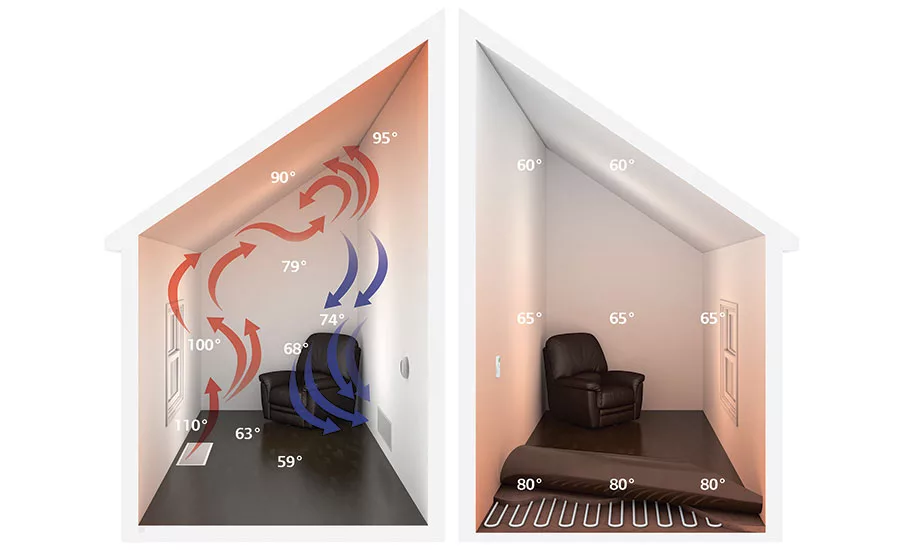
In a hydronic radiant floor heating system, warm water flows through flexible, durable PEX (crosslinked polyethylene) tubing, which can either be embedded in a concrete slab or placed on top of the subfloor or under the floor between the joists. As the warm water circulates through the tubing, the latter radiates heat up from the floor. This warms people as well as furniture to provide greater comfort.

Because radiant keeps the heat near the floor where people are located, it is in stark contrast to traditional forced-air HVAC systems, through which hot air blows into a room and quickly rises up to the ceiling.

Radiant heat is also an even heat. There are no hot or cold spots in a room, which are very common with traditional forced-air HVAC systems.

Another comfort factor with radiant is the zoning of the system. Because radiant systems are installed in zones, occupants have a separate thermostat for each radiant-heated space. This provides custom comfort control in any room. It also makes the system much more energy efficient, because rooms not in use don’t require a lot of heat.

Another reason radiant heat is so comfortable is because it most closely aligns with the ideal heating curve for the human body. In fact, people in a radiant-heated space will actually feel warmer and more comfortable at a lower thermostat setting than people in a forced-air space at a higher thermostat setting. This is because forced-air HVAC systems are the most divergent from the ideal heating curve for the human body.

No. 2: Radiant provides cleaner air

Because hydronic radiant heating systems use pumps to move water — instead of fans or blowers to push air — they do not circulate viruses, allergens, or odors throughout the indoor space. This means indoor air is much cleaner and easier to breathe.

In fact, people with severe allergies tend to have solid-surface floors with radiant, as opposed to carpet with forced-air heat. Carpets are a known breeding ground for dust mites, mold, and other microorganisms that wreak havoc on those with allergies. If a forced-air system is constantly circulating those allergens into the air, it’s easy to see why homes with solid-surface floors and radiant floor heating are vital for allergy-prone individuals.

In addition to the air-quality benefits, hydronic radiant floor heating systems also do not require ductwork. That permits greater architectural freedom, including expansive ceilings with open spaces.

No. 3: Radiant is quieter

Traditional forced-air HVAC systems and the ductwork associated with them are noisy. Most people are familiar with the loud sounds of forced-air equipment turning on and running. There is also the sound of the ductwork expanding and contracting as the hot air blows through the system and then cold air enters when the system is off.

Hydronic radiant floor heating is quiet. The water running through the tubing in the floors silently distributes warmth throughout a space. The mechanical-room parts, such as a boiler, pumps, manifolds, and actuators, also work quietly.

Best of all, radiant systems are practically maintenance-free. Beyond occasional boiler maintenance, the rest of the system does not require any annual work. Traditional HVAC systems, on the other hand, need regular replacement of air filters and equipment tune-ups, whose costs can really add up over time.

Radiant installation methods

Now that it’s clear how radiant helps to promote a superior IEQ, it’s good to know some high-level concepts for installing it. Several options are available, depending on the application.

  • For embedded tubing in concrete slabs, using wire ties with rebar or stapling the tubing to foam-board insulation is a typical method.
  • For structures with joists below, there are aluminum heat-transfer plates that fasten to the underside of the floor. The radiant tubing simply snaps into the plates, whose aluminum composition is an excellent heat-transfer medium to warm the floors above.
  • For the tops of subfloors, there are a few good choices. One option is to staple the tubing to the wood subfloor. Another is to use radiant wood panels that feature a groove down the center for the tubing and an aluminum sheet on the underside to help transfer the heat.

There are also knobbed mats that adhere to concrete floors. These knobbed mats make it easy to simply “walk” the tubing into the mats for a quick, easy method that does not require a lot of bending down.

To learn more about the design and installation of radiant floor heating systems, look to radiant tubing manufacturer training for online or in-person instruction. In addition, check out industry resources at radiantprofessionalsalliance.org, heatinghelp.com, or healthyheating.com.


KEYWORDS: heating radiant and hydronics radiant flooring radiant heating

Share This Story

Looking for a reprint of this article?
From high-res PDFs to custom plaques, order your copy today!

Kim Bliss is the technical and marketing content manager at Uponor.

Recommended Content

JOIN TODAY
to unlock your recommendations.

Already have an account? Sign In

  • Stock financial index show successful investment on property business and construction industry with graph and chart for presentation and report background.

    2025 predictions: Twelve trends supply houses should know

    As 2024 ends, I’ll review last year’s predictions and...
    Market Sectors
    By: Brad Williams
  • Background of aerial view of Industrial container port part of shipping in nighttime with a blue overlay.

    2025 Next Gen ALL-STARS: Top 20 Under 40 PHCP-PVF Professionals

    The future of the PHCP-PVF industry is being shaped by a...
    Market Sectors
    By: Natalie Forster
  • Premier 150: The top PHCP-PVF Distributors of 2026

    Premier 150: The Top PHCP-PVF Distributors of 2026

    Combined revenue across this year’s Premier 150 once...
    Plumbing
    By: Natalie Forster
Manage My Account
  • eMagazine
  • Newsletters
  • Manage My Preferences
  • Online Registration
  • Subscription Customer Service

More Videos

Popular Stories

Rob Micklus, Chris DellaSala, John McKeown and Bob DellaSala

2026 Manufacturers Rep of the Year: Keystone Sales & Associates

Commercial outlook tech looking at pipes

Commercial Market Outlook: Retrofit Projects Lead the Way

Price Increase Image

PHCP-PVF Price Increases: June 2026

2026 Premier Rankings

Events

December 30, 2030

Webinar Sponsorship Information

For webinar sponsorship information, visit www.bnpevents.com/webinars or email webinars@bnpmedia.com.

View All Submit An Event

Poll

Identifying Daily Time Loss Areas for Your Team

Where does your team lose the most time each day?
View Results Poll Archive

Products

The Water Came To A Stop

The Water Came To A Stop

See More Products

Download the FREE 2025 Water Conservation, Quality & Safety eBook

Download the Fifth annual Bath & Kitchen Pro eBook

Related Articles

  • Vote for your favorite Warmup radiant floor heating thermostat design

    See More
  • Watts Radiant announces radiant floor cooling design services

    See More
  • Nuheat celebrates first International Floor Heating Day

    See More

Related Products

See More Products
  • Classic Hydronics - How To Get The Most From Those Older Hot-Water Heating Systems

  • lost art steam heating.jpg

    The Lost Art of Steam Heating Revisited

  • Lessons_Learned_Serv_Cover_.gif

    Lessons Learned Servicing Boilers

See More Products

Related Directories

  • Johnson Bros. Roll Forming Co.

    Roll-formed metal, including towel bars, cable trays, shower and closet rods, frames, rings, clamp rings, lavatory legs, channels, railings, shade rollers, special-shaped copper tubing for radiant floor heating, heat transfer plates, open seam and lock seam tubing.
  • KAST Marketing / Midwest Environmental Products

    We are a 12-salesperson stocking Plumbing, PVF, HVAC and Hydronics rep agency in the Midwest based in Chicago. Our warehouse is centrally located in the Chicago suburbs.
  • Sterling HVAC Products

    Sterling HVAC, the most recognized name in the game, has been producing industry leading high efficiency heating products for over 50 years. From traditional Unit Heaters to Rooftop and Indoor Make-Up Air units, Sterling HVAC has the solution to fit every residential, commercial or industrial application.
×

Stay in the know on the latest PHCP-PVF industry trends.

Get tailored content delivered your way.

JOIN TODAY!
  • RESOURCES
    • Advertise
    • Contact Us
    • Directories
    • Store
    • Want More
    • Plumbing & Mechanical
  • SIGN UP TODAY
    • Create Account
    • eMagazine
    • Newsletter
    • Customer Service
    • Manage Preferences
  • SERVICES
    • Marketing Services
    • Reprints
    • Market Research
    • List Rental
    • Survey/Respondent Access
  • STAY CONNECTED
    • LinkedIn
    • Facebook
    • Instagram
    • YouTube
    • X (Twitter)
  • PRIVACY
    • PRIVACY POLICY
    • TERMS & CONDITIONS
    • DO NOT SELL MY PERSONAL INFORMATION
    • PRIVACY REQUEST
    • ACCESSIBILITY

Copyright ©2026. All Rights Reserved BNP Media, Inc. and BNP Media II, LLC.

Design, CMS, Hosting & Web Development :: ePublishing