Barbara Higgens points to PMI's leadership role in water-efficiency standards
Plumbing industry groups must work together.

Retired PMI Executive Director and CEO Barbara Higgens. Photo courtesy of PMI
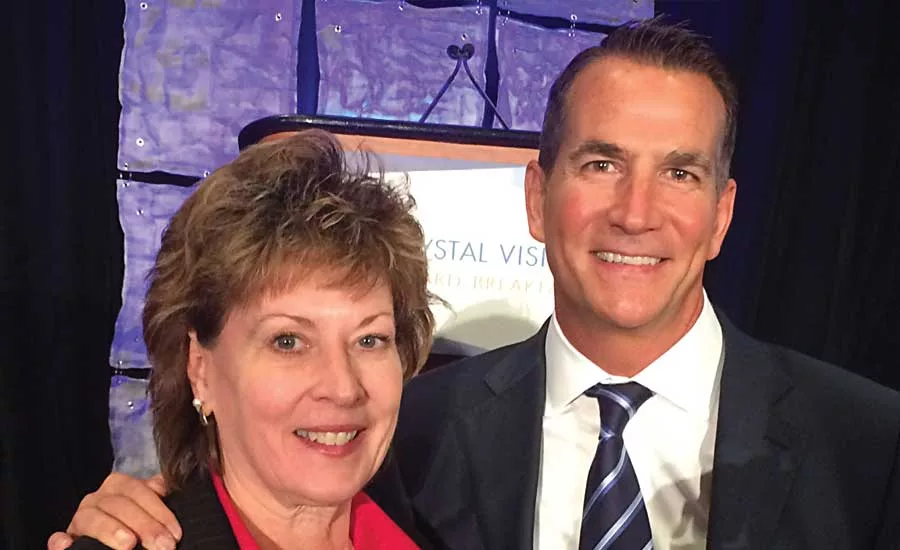
Higgens is shown with Kohler President and CEO David Kohler at the International Builders’ Show earlier this year. “PMI and its members must continue to engage with regulatory bodies at the state and federal levels,” Higgens says. Photo By Bob Miodonski
Supply House Times recently interviewed Barbara Higgens, who retired earlier this year as executive director and CEO of Plumbing Manufacturers International. Before joining PMI in 1998, Higgens was marketing director for Switchcraft, a division of Raytheon Co. Together with IAPMO and ASPE, she is co-founder of the Plumbing Industry Leadership Coalition, a group of organizations that includes PMI, American Supply Association and Plumbing-Heating-Cooling Contractors – National Association.
What was your greatest accomplishment during your time leading PMI?
BH: Visibility would be one of them. My background is in journalism and marketing, and that served PMI well. PMI was a bit under the radar two decades ago, and when it did come up on the radar, it sometimes was in a negative way as the “just say no” bunch. So, we’ve enhanced our visibility. PMI’s involvement in plumbing-related events such as Flint, Mich., and Orme, Tenn., did that and showed the humanity of our industry Increasing PMI’s visibility internationally was an initiative the PMI Board of Directors and I felt strongly about to the point of changing PMI’s name from Plumbing Manufacturers Institute to Plumbing Manufacturers International in 2010.
What else did you accomplish at PMI?
BH: Stabilization in membership and finances. I started right after an exodus of members and now membership is stable. We have a healthy reserve that provides financial stability and the ability to do extra projects such as research. We restructured dues with the help of our strategic advisory committee to better align them with the sizes of the member companies.
Another accomplishment is industry leadership. We’re much more proactive today than we had been in the past. Writing and introducing legislation like the federal lead content bill is an example. I think we’ve done a really good job of building consensus to establish PMI as the voice of the industry. We build relationships and now embrace people who have different views and work together to find solutions.
On what plumbing industry issues did PMI make its biggest impact with you at the helm?
BH: Harmonization of the lead content law was the biggest. It started in California with AB [Assembly Bill] 1953. Then we saw states such as Louisiana, Massachusetts, Michigan and Vermont allowing differing levels of lead content in plumbing products. It was getting to the point of “how low could you go?” We took the parameters of the California law and in the name of harmonization created a national lead content bill that was signed into law in 2010 by President Obama. It’s hard to top that one.
How has PMI changed as an organization in the last 19 years?
BH: There’s been a great deal of consolidation of U.S. plumbing manufacturers since I first started in 1998, which has had an impact on PMI. I think equally important has been the return of the CEOs of member companies being engaged in PMI. We’ve initiated executive level fly-ins for meetings on Capitol Hill. What happens when the chief executives get involved is they’re able to get meetings with the legislators and policymakers themselves. That’s really critical to pushing PMI’s initiatives and is a great return on the investment of time by PMI member CEOs.
What has been the biggest change in the plumbing industry in the last 19 years?
BH: One change in the industry from PMI’s perspective is the notion of U.S. manufacturing. From the time of its founding, the bylaws and structure of PMI were focused on U.S.-based manufacturing with a real trepidation about international influences, especially from China. Today, we’ve embraced an international perspective and changed our bylaws to reflect the changes around us. If someone from 1998 were to come back to PMI today, I think they’d be shocked by the face of our membership, which is about one-third internationally based.
And then there’s just the incredible pressure on water efficiency. We’ve seen the continued ratcheting down of water consumption to where we’re reaching the tipping point. Both PMI and independent studies have shown there’s not much lower we can go. We need to partner with all constituents to work together for other solutions to the water crisis. It’s not only about manufacturers and products.
What is the greatest challenge plumbing manufacturers will face in the next five years?
BH: PMI and its members must continue to engage with regulatory bodies at the state and federal levels and come up with creative solutions together. It’s not acceptable to resist change and fight progress. When the California Energy Commission was looking for more efficiency in flow rates, we couldn’t just push back and hope that would go away. As part of our dialog, we put together a timeline to help CEC understand how long it takes to comply. Our approach wasn’t, “We can’t do this.” Our approach was, “We need time to do this, including time to purge non-compliant inventory.” Partnering in the spirit of collaboration is a completely different and more effective mindset to resisting change.
What must an industry association do to remain successful in 2017 and beyond?
BH: The big key with any trade association is that it can’t be complacent. It must stay relevant and keep one step ahead to see what’s coming next. It really has to be a business partner for its members and stay engaged, whether internationally or with the environmental community. That’s where new PMI Executive Director and CEO Kerry Stackpole will be outstanding. He’s an idea guy and I can’t say enough good things about him. PMI has established a reputation as being a player at the table and not sitting back. That will continue to be the case.
It’s also important for members to help PMI move forward by staying engaged and participating. Even as a member, you can’t be passive. You have to actively partake of the value PMI and other associations provide.
How has PMI’s relationship with the American Supply Association changed?
BH: The two groups are very distinct and they have very different constituencies. There’s some overlap with our manufacturer members, but the mission and scope are very different between the two. And yet I think it’s essential that where we find common ground, we work closely together. The California Energy Commission example is a good one in that we reached out to the channel to find out how long it would take from the perspective of retailers and wholesalers to purge inventory of non-compliant products from their shelves. We’re inextricably connected and the key is to collaborate. We both participated in the Get the Lead Out Coalition to pull the industry together to understand how to comply with the new lead laws, not the least of which was how to install them and how to stock and purge inventory. There’s a place for separate and distinct organizations to effectively work together.
How are plumbing contractors, engineers and wholesalers different today than when you came into the industry?
BH: They all feel the pressure of fewer individuals in the workforce. Everybody is overloaded, multitasking and looking for qualified workers to fill the void. But the reality is we’re never going to have the full rosters we had in the 60s, 70s and 80s. I remember when just-in-time inventory happened and some people thought it was just a phase; the idea for some was that once we got over it, we would go back to bulging inventories. As we’ve seen, that never happened. Slimmed-down, efficient inventories are the norm. I think the same change will apply to the issue of a shortage of talented workers, which may indeed be the new normal. That leads me to a blatant commercial for associations. Whether it’s PHCC, ASA, ASPE or PMI – trade associations sift through all the clutter to help their members focus on what’s really going to affect their businesses and extend the effectiveness and productivity of the workforce.
What progress has been made on consolidating trade shows in the plumbing industry, which used to be a frequent topic at PMI meetings?
BH: PMI could only advocate the position of our members. Because of anticompetitive laws, we couldn’t take any action other than to make suggestions. And, ultimately, our members’ voices were heard and consolidation happened. The Kitchen & Bath Industry Show has co-located with the International Builders’ Show. The North American ISH trade show no longer exists. It’s similar to association work in that your customers are telling you what they want, and you really can’t ignore them.
As a co-founder of the Plumbing Industry Leadership Coalition, what do you think PILC needs to do to make a bigger impact on our industry?
BH: I’m a communications person, so that’s No. 1 on my list. We’re making great strides and doing all this great stuff but often we’re so busy doing it that we don’t tell anybody. We need to keep communicating among the groups and work together. Each of the members of PILC has its own unique niche. The key is to not to duplicate our efforts but to enhance what each other is doing through communication.
This article was originally titled “Industry groups must work together” in the November 2017 print edition of Supply House Times.
Looking for a reprint of this article?
From high-res PDFs to custom plaques, order your copy today!