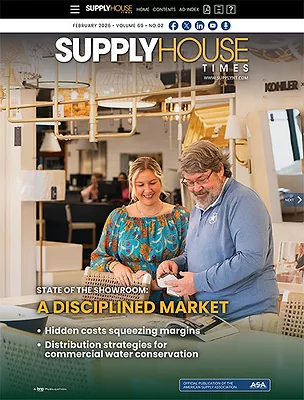
The February 2026 issue of Supply House Times features our cover story on the 2026 State of the Showroom: NKBA's 2025 Kitchen & Bath Market Outlook predictions for the U.S. market. Also inside: The hidden costs squeezing plumbing & PVF distribution margins, distribution strategies for commercial water conservation, the latest columns, and much more!
The NKBA's 2025 Kitchen & Bath Market Outlook predicts the U.S. market will reach $235 billion, with growth in repair and remodeling despite slower new construction. Homeowners see kitchens and baths as valuable investments, especially with professional help.
Incentive programs such as the federal Inflation Reduction Act tax credits and expanding state-level rebate structures have increased interest among building owners, engineers, and facility managers, nudging contractors to evaluate heat pump solutions more seriously.
Water conservation in commercial and multifamily buildings has traditionally been seen as an engineering or ownership issue, focused on codes and sustainability. However, with rising water costs, aging infrastructure, and complex systems, conservation now also emphasizes system performance, risk reduction, and operational intelligence, engaging plumbing distributors in the discussion.
Wholesale distribution has always operated on relatively thin margins. Public benchmarks typically place gross margins anywhere from the high single digits to the low-30% range depending on product mix, with net margins often falling between 3% and 10%. In plumbing and PVF, those margins vary even more dramatically by category — with commodity products leaving far less room for error than engineered or value-added offerings.
There are clear warning signs that your business has outgrown DIY marketing. Here are seven ways to know when DIY marketing is no longer serving your business — and may hold it back.
Emerging leaders are motivated but often struggle to understand what senior leaders want before assuming more responsibility. In plumbing distribution, credibility is crucial; senior leaders prioritize those who execute well, communicate clearly, and make sound decisions under pressure.
ASA members stayed busy in 2025, taking full advantage of ASA University’s tools and training to boost employee performance and drive profitability across their businesses. This year also marked a return to some familiar training trends, with members gravitating back toward foundational product knowledge.
Customer Relationship Management systems are often sold as a technology decision. In reality, CRM success or failure has far more to do with people, processes, and organizational readiness than with software features.
ASA members have consistently identified attracting talent as one of their most pressing concerns. National labor studies conducted by ASA confirm what members experience, including retirements outpacing new hires, and traditional recruiting methods alone are no longer enough. These concerns were reinforced during ASA’s 2025 LEAD Strategic Leadership Summit in early 2025, where volunteers emphasized the need for stronger outward-facing efforts to elevate the industry’s profile and attract new talent.
AI is helping women streamline complex or time-consuming tasks, such as preparing commercial quotations, entering sales orders, managing email and calendars, and organizing large volumes of product information. It is also becoming part of daily life, supporting everything from cooking and budgeting to travel planning and quick problem solving.