And So It Flows Podcast
AI adoption in distribution starts with action, not perfect data
Brooks Hamilton says speed, decision-making and sales impact will define winners in the next wave of AI
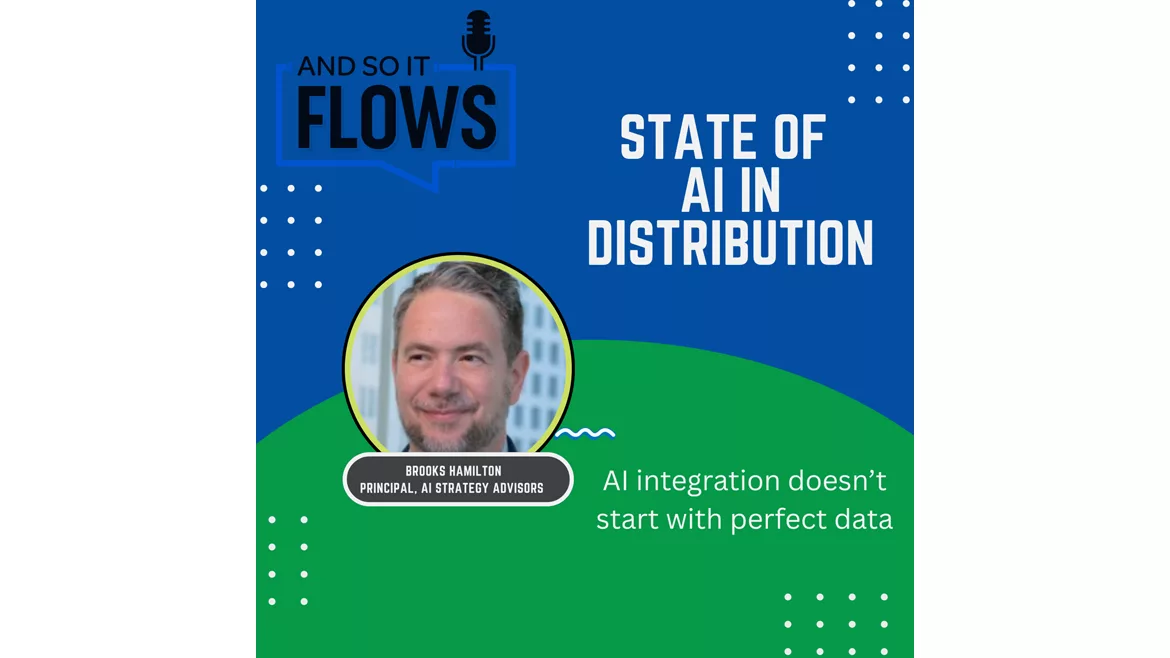
Artificial intelligence has quickly moved from buzzword to boardroom priority across PHCP-PVF distribution, but for many companies, adoption still feels stalled before it even begins. According to Brooks Hamilton, principal at AI Strategy Advisors, that hesitation often comes down to a long-standing misconception: that AI requires perfectly clean data before companies can get started.
Listen to the episode below
“That’s become a really comfortable response,” Hamilton explains. “For vendors, data cleanup is a meaningful project. For distributors, it’s a way to delay doing anything on the AI side.”
In reality, the latest generation of AI tools, particularly large language models, are designed to work with imperfect, unstructured data. Rather than waiting for systems to be “bright and shiny,” Hamilton argues the improvement cycle now begins after adoption, not before.
“These AI systems learn from watching what they’re doing,” he says. “It’s a virtuous improvement loop that starts by using them.”
That shift fundamentally lowers the barrier to entry, opening the door for distributors of all sizes to begin experimenting with AI today.
A window for smaller distributors
Perhaps the most significant implication for the channel is how AI is reshaping competitive dynamics. Historically, scale in distribution has been defined by purchasing power, branch networks and capital-intensive technology investments. But Hamilton says that equation is changing rapidly.
“The organizations that are going to win aren’t necessarily the ones with the biggest budgets,” he notes. “It’s the ones that can make decisions quickly and follow through.”
With AI-driven tools becoming dramatically more affordable, smaller and mid-sized distributors now have access to capabilities that were previously reserved for large enterprises. Projects like pricing optimization, routing or advanced quoting systems, once requiring hundreds of thousands or even millions of dollars, can now be implemented at a fraction of the cost.
That accessibility creates a rare moment of opportunity.
“The window is open,” Hamilton says. “The order and the projects that organizations take on now are going to matter as the competitive question gets resolved.”
From cost-cutting to growth
While much of the early AI conversation has centered on automation and labor reduction, Hamilton urges distributors to rethink where the real return lies. The most impactful use cases, he argues, are those tied directly to revenue growth and customer experience.
“If you put $50,000 toward improving your sales process and get a 1% increase in sales, versus using that same amount to automate customer service, it’s about a 50x difference in margin return,” he explains.
In practice, that means focusing on tools that enhance how sales teams operate, from prospecting and meeting preparation to product knowledge and quote turnaround times. These are areas where AI can accelerate performance without replacing the relationship-driven nature of the business.
One example Hamilton highlights is quote acceleration. By using AI to quickly analyze incoming quote requests, identify inconsistencies and structure responses, distributors can dramatically reduce turnaround times.
“If we’re first back with a reasonable quote, our likelihood of winning is much higher,” he says.
Notably, many of these capabilities are available today with minimal investment, sometimes as little as a basic subscription to an AI platform.
Preserving relationships, enhancing value
For an industry built on relationships, concerns about AI replacing human interaction remain top of mind. But Hamilton sees the opposite outcome when AI is applied strategically.
“These tools should focus on things customers aren’t going to pay more for but that improve the experience,” he says. “They make you easier to work with.”
By automating lower-value, time-consuming tasks, distributors can free up resources to focus on the high-value interactions that strengthen customer loyalty and drive long-term growth.
A rapidly closing gap
Even as adoption becomes more accessible, the pace of innovation continues to accelerate. Hamilton warns that the current generation of AI, largely defined by chat-based tools, may soon give way to more autonomous systems capable of executing complex tasks independently.
“The next phase will feel very different,” he says, pointing to emerging technologies that can operate with minimal human input.
For distributors, the takeaway is clear: waiting for clarity may no longer be a viable strategy.
Instead, Hamilton emphasizes a simple starting point: begin using the tools, focus on practical applications and build momentum through action.
In a market defined by tight margins and increasing competition, those early steps could ultimately determine who leads and who follows in the next era of distribution.
Looking for a reprint of this article?
From high-res PDFs to custom plaques, order your copy today!