Guest Column | Patrick Hanrahan
Rethinking warehouse design for labor savings and optimization
A data-driven look at how engineering smarter workflows.
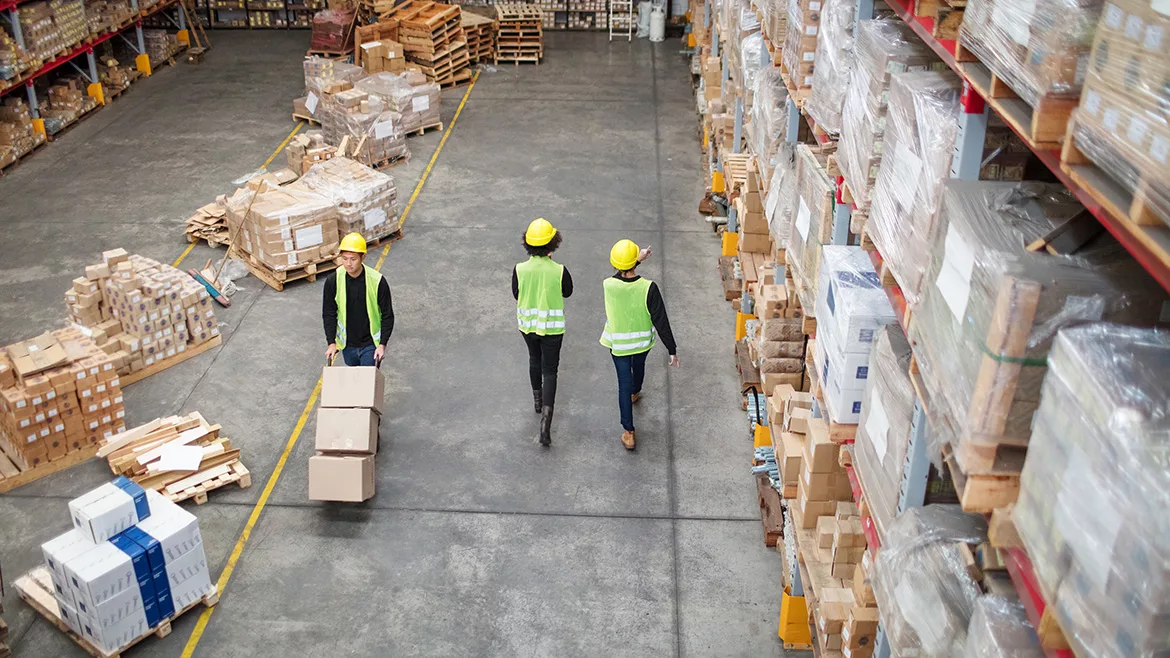
Warehousing has a labor problem, one that consumes 50% to 70% of an operation’s total budget, according to a Bostontec study. Manual order picking is among the single biggest drivers on the floor, consuming roughly half of total warehouse operating expenses.
That’s no surprise. Hiring costs continue to skyrocket, the labor pool is shrinking, and the work itself is demanding and dangerous. In 2023, the warehousing and storage industry recorded 4.7 nonfatal injuries and illnesses per 100 full-time workers (BLS).
When your operational success depends on how well you move people and product throughout your facility, how do you fix this growing problem?
Many warehouse managers try to bridge the labor gap by relying on existing employees, but that comes at a cost: higher burnout rates and turnover, increased risk of injury and inflated payroll costs. Hiring temporary staff is just as expensive.
What if the solution isn’t more hiring, but intelligent automation design?
Rethinking the role of labor
Too often, the conversation around warehouse labor focuses on headcount, where to find it, how to retain it and how to pay for it. But the issue isn’t really who is working and who isn’t.
It’s how the work is structured.
Legacy workflows demand too much manual effort, are error-prone and don’t allow for scalability. On top of the manual strain of picking, packing and shipping, warehouse workers often spend up to 60% of their day walking on hard concrete, with some covering as much as 12 or more miles per shift.
Other hidden labor drains can include redundant touchpoints, unorganized aisle layouts, poor slotting strategies, ineffective WMS or ERP software, and non-value-added processes. These are not just inefficient practices; they’re exhausting and strenuous.
When most of your operating budget is tied to labor, every unnecessary step erodes profitability. You can have the most proficient team in the world, but if the work itself isn’t designed effectively, it’s wasted energy.
It’s not that your team is underperforming. The truth is that most of the inefficiencies you are facing were baked into warehouse design right from the start.
Warehouse engineering as the first step
The smartest move for optimizing labor is to engineer workflow to be more effective.
To reduce labor dependency and increase throughput in your distribution center or warehouse, it’s simple math. You have to eliminate non-value-added human intervention and optimize existing warehouse processes.
Essentially, you need to eliminate wasted efforts.
Engineering studies are ideal for benchmarking end-to-end order flow and identifying opportunities for improvement. Taking this data-driven approach to system design can uncover hidden inefficiencies and “engineer out” these wasted steps via:
- Operational studies to identify high-labor, low-value tasks
- Value mapping to pinpoint wasted touchpoints in pick, pack, and ship
- Streamlining workflow to reduce unnecessary movement and manual processes
One example of streamlining warehouse workflow is to re-slot high-volume items closer to packing stations to reduce picker travel.
Another? Supporting your employees with automation and software for smarter workflows.
Designing work around people — Not the other way around
Introducing automation to your warehouse design is not about replacing workers.
Rather, it’s rethinking how they can work more safely and effectively. When focused on human-centered design principles, automation can be a labor-enabling strategy.
Think about your warehouse.
As businesses tap new markets, higher order volumes and faster fulfillment deadlines put added strain on existing employees. Higher levels of fatigue lead to increased workplace accidents and injuries. Higher order rates lead to more order errors, returns and dissatisfied customers.
Using data from engineering studies, you can assess your warehouse processes and define clear objectives to address these challenges. That means fixing what matters most to your people, things like improved safety, reduced physical strain and fewer frustrating bottlenecks.
Using data from engineering studies, you can assess your warehouse processes and define clear objectives to address these challenges. That means fixing what matters most to your people, things like improved safety, reduced physical strain and fewer frustrating bottlenecks.
Support warehouse personnel with smarter workflows
Automation and software support rather than replace humans by creating smarter workflows. By designing the work around people, you can make the workload faster and easier for warehouse personnel, while improving accuracy and throughput.
People remain central to your business but are no longer burdened by inefficiencies that were never theirs to solve.
Here are some ways you can design a smarter warehouse with automated technologies and intelligent software:
- Voice-directed picking to replace manual methods
- Autonomous Mobile Robots (AMRs) to eliminate walking, heavy lifting and cart-pushing
- Goods-to-Person (G2P) systems to reduce operator travel time, improve space utilization and increase putaway and picking rates
- Conveyor and sortation automation to eliminate manual touches and human errors
As a result, your warehouse employees will experience greater job satisfaction, leading to less turnover and better performance. Additionally, automation pays for itself as costs per order fulfilled decrease and customer satisfaction increases.
It’s not just employees who reap the benefits. When better design is combined with automation, your warehouse can experience:
- Improved order fulfillment
- Reduced labor
- Increased productivity and accuracy
- Supported growth without adding labor
- Lowered cost per order delivered
- Exceeded customer service level expectations
- Real-time DC operational data
- More market share
- Higher perfect order practices
- Positive cash flow
Optimizing workforce efficiency starts with better design, not bigger payrolls. If you’re looking for a solution to counter a limited labor force and amplify productivity, automated technology is the way to go.
Looking for a reprint of this article?
From high-res PDFs to custom plaques, order your copy today!