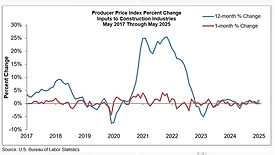
While contractors remain optimistic about their margins, according to ABC’s Construction Confidence Index, higher input costs will likely weigh on profitability during the second half of 2026.
The latest report from the U.S. Bureau of Labor Statistics shows the construction sector added 33,000 jobs in January, bringing total construction employment to more than 8.3 million workers nationwide. The gain represents one of the largest monthly increases since mid-2023 and was driven largely by hiring among nonresidential specialty trade contractors.
According to ABC, the labor market remains resilient as construction unemployment falls.
July 3, 2025
The U.S. construction sector continued to grow in June, adding 15,000 jobs despite mixed performance across nonresidential categories. With unemployment in the industry dropping to 3.4%, economists say momentum remains strong, but rising material costs and interest rates could challenge margins in the months ahead.
Nonresidential construction spending is projected to grow modestly by 2.2% in 2025 and 2.6% in 2026, with commercial construction expected to rise 1.7% this year and 4.6% in 2026, according to the American Institute of Architects.
Construction backlog hits 20-month high despite tariff pressures.
May 13, 2025
ABC’s latest data shows construction backlog rose to 8.7 months in April, the highest since September 2023, even as contractors face rising material costs and uncertain sales outlooks.
During a webinar in late May, Dr. Kuehl gave his mid-year economic review, focusing on five key issues distributors should be monitoring: Inflation, consumer behavior, “normal” business, the global economy and market reaction.
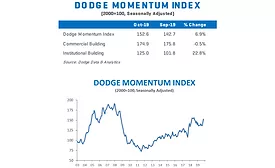
The Momentum Index, issued by Dodge Data & Analytics, is a monthly measure of the first (or initial) report for nonresidential building projects in planning, which have been shown to lead construction spending for nonresidential buildings by a full year.
The Q4 2019 Houzz Renovation Barometer tracks residential renovation market expectations, project backlogs and recent activity among businesses in the construction sector.