Supply House Times logo Supply House Times
search
cart
facebook instagram twitter linkedin youtube
  • Sign In
  • Create Account
  • Sign Out
  • My Account
Supply House Times logo Supply House Times
  • NEWS
    • ASA NEWS
    • Company News
  • PRODUCTS
    • Interactive Spotlights
  • COLUMNS
    • Natalie Forster: From the Editor
    • Alicia Branham: Marketing Matters
    • Brad Williams: Succession Planning
    • Melissa Rasico: Luxury Plumbing Lounge
    • Letter from ASA President
    • Guest Columnists
    • Safety Columnists
  • MARKETS
    • Codes & Legislation
    • Heating & Cooling
    • Industrial PVF
    • Plumbing
    • Radiant & Hydronics
    • Solar Thermal | Geothermal
    • Technology
    • Women in Industry
  • BATH & KITCHEN PRO
    • Bath & Kitchen News
    • Bath & Kitchen Products
  • SPECIAL EDITIONS
    • B.I.G. Book Directory
    • Premier 150
    • Rep Locator Directory
  • MEDIA
    • Podcasts
    • Videos
    • eBooks
    • Webinars
  • RESOURCES
    • Radiant Comfort Report
    • Industry Calendar
    • Industry Links
    • Custom Content & Marketing Services
    • Market Research
    • Supply House Times Store
  • EMAG
    • EMAGAZINE
    • ARCHIVE ISSUES
    • CONTACT
    • ADVERTISE
  • SIGN UP!
ColumnistsHeating & CoolingJim Wheeler: HVAC

The efficiency differences between resistance-style electric heaters

What does it really mean?
By Jim Wheeler
The efficiency differences between resistance-style electric heaters
November 28, 2016

One of the things many people don’t understand is there is little or no difference between the efficiencies of resistance-style electric heaters.

That’s because they all put out 3,414 Btu per watt, per hour. A 1,000-watt wall baseboard heater or an oil-filled electric radiator puts out exactly the same amount of heat per hour (3,414 Btu/hr.) as a 1,000-watt electric hair drier, a 1,000-watt electric range element, a 1,000-watt motor or even 1,000 watts of efficient light-emitting diodes (LEDs).

And the only way to get anything more out of an electric device beyond just heat is to also put it to work making light, sound or magnetism to run motors. In other words, electric-resistance heaters of any kind probably are the least efficient way to use electricity.

On the other hand, when it comes to heating, heat pumps also use electricity’s power of magnetism to very efficiently drive compressors and motors in order to take the heat out of even very cold outdoor air and then move it inside. How efficient are heat pumps at doing this? Well, that’s what one of the ratings tells us.

I’m currently looking at a news release Carrier Corp. sent me about a new product it says has a Heating Seasonal Performance Factor (HSPF) up to 10.5. What this means is the particular unit will average putting out 10.5 Btu of heat for every watt of electricity it uses per hour of operation during a normal heating season, which is about three times more efficient that an electric resistance heater — or you can get the same amount of heat using a third of the electricity.

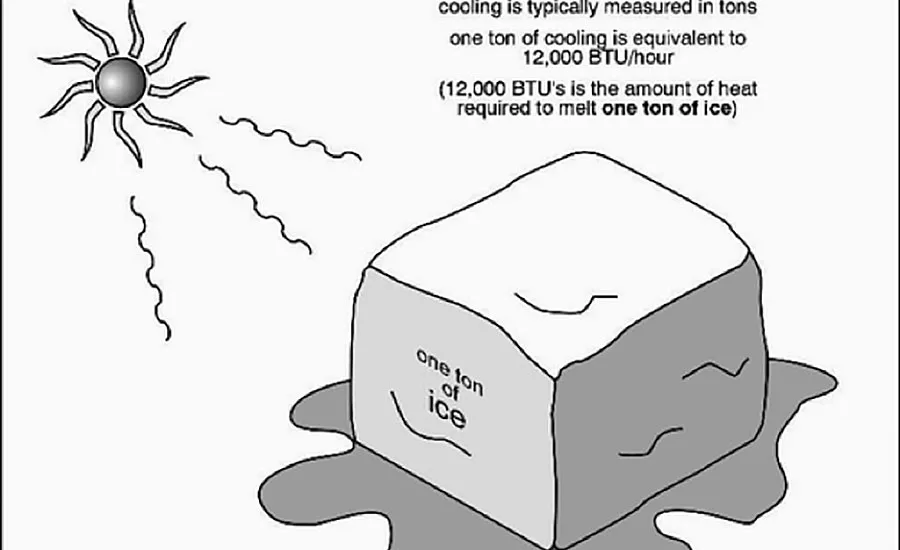
On the air-conditioning side, what the industry always has used as a measurement of comparison is the amount of cooling you can get out of a one-ton block of ice if it were defrosted over exactly 24 hours. That is, 12,000 Btu/hr., or a one-ton air conditioner.

But when it comes to cooling efficiency, the unit of measure is the Seasonal Energy Efficiency Ratio (SEER), which is roughly how many Btu of cooling the unit will squeeze out of every watt of electricity per hour of operation across a cooling season. The rating for the unit Carrier advertised in its press release is pretty impressive — 23.8 SEER. Considering the current “builder model” air conditioner usually is rated at
13-SEER, you can see this system, theoretically, probably will use about a third less energy. Why theoretically? Well, that’s the rest of the story.

Understand that these advertised efficiencies are reached on test stands in laboratories under the rated conditions with the proper refrigerant charge, with perfectly matched components (piping, etc.), with the exact amount of airflow distributed evenly across the coils and located in areas that provide the optimal environment. As you can see, whether the units actually achieve their ratings out in the field is heavily influenced by the quality of the installation, the commissioning and the servicing, which is more “real world.”

Nevertheless, assuming that a higher-efficiency unit is being installed to replace a lower-efficiency unit in the same environment, the net result still should produce an impressive energy savings.


This article was originally titled “What does it really mean” in the November 2016 print edition of Supply House Times.

KEYWORDS: air conditioning forced air plumbing and HVAC wholesale distributors

Share This Story

Looking for a reprint of this article?
From high-res PDFs to custom plaques, order your copy today!

Jim Wheeler has been in the HVACR industry for more than 25 years. He has worked in contracting, for supply houses, and for national equipment manufacturers. He has served as an industry teacher on technical topics, and as a writer and editor. He has conducted seminars on building control standard protocols. He is currently available to speak or teach at industry events. You may contact him via e-mail at jimwheeler@ij.net.

Recommended Content

JOIN TODAY
to unlock your recommendations.

Already have an account? Sign In

  • Stock financial index show successful investment on property business and construction industry with graph and chart for presentation and report background.

    2025 predictions: Twelve trends supply houses should know

    As 2024 ends, I’ll review last year’s predictions and...
    PHCP and PVF Technology & Operations
    By: Brad Williams
  • Background of aerial view of Industrial container port part of shipping in nighttime with a blue overlay.

    2025 Next Gen ALL-STARS: Top 20 Under 40 PHCP-PVF Professionals

    The future of the PHCP-PVF industry is being shaped by a...
    Heating & Cooling
    By: Natalie Forster
  • Premier 150: The top PHCP-PVF Distributors of 2026

    Premier 150: The Top PHCP-PVF Distributors of 2026

    Combined revenue across this year’s Premier 150 once...
    Market Sectors
    By: Natalie Forster
Manage My Account
  • eMagazine
  • Newsletters
  • Manage My Preferences
  • Online Registration
  • Subscription Customer Service

More Videos

Popular Stories

Jeff Dice

Built to Scale, Designed to Stay Local: Lessons From Winsupply at 70

Commercial outlook tech looking at pipes

Commercial Market Outlook: Retrofit Projects Lead the Way

A graphic showing an arrow moving upward, with "PHCP-PVF Price Increases" written above it.

PHCP-PVF Price Increases May 2026

2026 Premier Rankings

Events

December 30, 2030

Webinar Sponsorship Information

For webinar sponsorship information, visit www.bnpevents.com/webinars or email webinars@bnpmedia.com.

View All Submit An Event

Poll

Identifying Daily Time Loss Areas for Your Team

Where does your team lose the most time each day?
View Results Poll Archive

Products

The Water Came To A Stop

The Water Came To A Stop

See More Products

Download the FREE 2025 Water Conservation, Quality & Safety eBook

Download the Fifth annual Bath & Kitchen Pro eBook

Related Articles

  • Bosch Thermotechnology electric water heaters

    See More
  • Bradford White commercial electric water heaters

    Bradford White commercial electric water heaters

    See More
  • American Standard Water Heaters electric heat pump water heaters

    American Standard Water Heaters electric heat pump water heaters

    See More

Related Products

See More Products
  • Classic Hydronics - How To Get The Most From Those Older Hot-Water Heating Systems

  • lost art steam heating.jpg

    The Lost Art of Steam Heating Revisited

  • lessons-learned1.gif

    Lessons Learned: Connecting New Boilers to Old Pipes

See More Products

Related Directories

  • PVI Industries

    PVI’s commercial water heaters are right-sized to provide optimal balance between BTU input and storage. Available in gas, electric, steam, boiler water and oil, our Dynamic Water Heaters feature energy inputs 199–7000 MBH and are fabricated from durable, corrosion resistant AquaPLEX duplex stainless steel (no linings or anodes needed).
  • AERCO International

    AERCO manufactures reliable commercial electric and condensing boilers and high-efficiency water heaters that deliver superior performance, energy savings and the lowest cost of ownership. New and retrofit applications for education, hospitality, healthcare, multifamily, offices and more.
  • Thermal Solutions

    High-efficiency condensing and non-condensing commercial boilers and water heaters from 399mbh to 6,000mbh. Unique ability to package and control multiple units and different technologies use in space or domestic water applications.
×

Stay in the know on the latest PHCP-PVF industry trends.

Get tailored content delivered your way.

JOIN TODAY!
  • RESOURCES
    • Advertise
    • Contact Us
    • Directories
    • Store
    • Want More
    • Plumbing & Mechanical
  • SIGN UP TODAY
    • Create Account
    • eMagazine
    • Newsletter
    • Customer Service
    • Manage Preferences
  • SERVICES
    • Marketing Services
    • Reprints
    • Market Research
    • List Rental
    • Survey/Respondent Access
  • STAY CONNECTED
    • LinkedIn
    • Facebook
    • Instagram
    • YouTube
    • X (Twitter)
  • PRIVACY
    • PRIVACY POLICY
    • TERMS & CONDITIONS
    • DO NOT SELL MY PERSONAL INFORMATION
    • PRIVACY REQUEST
    • ACCESSIBILITY

Copyright ©2026. All Rights Reserved BNP Media, Inc. and BNP Media II, LLC.

Design, CMS, Hosting & Web Development :: ePublishing