A Game Changer For Showerheads?
The plumbing industry is voicing widespread objection to DOE’s new showerhead flow definition.
Philadelphia-area plumbing contractor Jim McStravock is seeing one major trend when it comes to installing bathing systems.
“Everybody seems to be going away from the whirlpool tubs and going to shower systems with the rainheads and body sprays,” says McStravock, owner of McStravock Plumbing and Heating. “What I’m finding is people don’t have time to wait for a tub to fill up.”
McStravock also has noticed a common theme when it comes to a customer’s initial reaction to the increasingly popular rainheads.
“A lot of people want to put them in and then they expect to get blown over with a deluge of water,” he laughs. “I tell them you get 2.5 gallons out of the showerhead no matter how big it is.”
But if a recent Department of Energy interpretive rule change defining showerheads is passed, customers, manufacturers and contractors like McStravock will have much larger issues to deal with.
In early June, the DOE, without advance notice to stakeholders, proposed to re-define showerheads as shower valves, which would allow only a single showerhead using no more than 2.5 gallons of water per minute per showering compartment.
“All components that are supplied standard together and function from one inlet (i.e., after the mixing valve) form a single showerhead for purposes of the maximum water-use standards,” is how the DOE’s new interpretation of the Energy Policy and Conservation Act’s maximum water-use standard reads.
Thus, if a showerhead’s standard components, operating in their maximum design flow configuration, taken together use in excess of 2.5 gpm when flowing at 80 psi - even if each component individually does not exceed 2.5 gpm - it would be ruled noncompliant based on the DOE’s new interpretation of EPCA.

“We were caught off guard,” said Plumbing Manufacturers Institute Executive Director Barbara Higgens. “We were never contacted as a stakeholder. It was buried in the Federal Register. We stumbled across it in a 1,000-page register notice. It was not a terrific way to handle this.”
DOE spokeswoman Jen Stutsman said the new interpretation came about after several complaints were received alleging certain showerhead products were exceeding the federal water-conservation standard.
“In the course of investigating these complaints, (we) discovered some confusion as to how the department’s definition of ‘showerhead’ for water-conservation purposes applied to new showerhead designs being marketed under names such as waterfalls, shower towers, rainheads and shower systems,” Stutsman told PM.
Shortly after the initial furor arose, Higgens met with DOE officials and came back only slightly encouraged by the fact that DOE’s initial directive contained clumsy language. The new definition does not impose an outright ban on multiple showerheads, as originally feared. However, the ruling would require manufacturers to restrict water flow to one outlet at a time and add additional valves for multiple outlet operation. Higgens said “these restrictions are still quite onerous.”
This is where things stood as of June 18, the final day of DOE’s comment period. In the days leading up to June 18, Higgens was busy issuing “Action Alerts” to PMI members urging them to speak out against the new interpretation
“We have received a number of comments providing feedback on the draft interpretative rule from the industry and the public,” Stutsman said.
“People like multifunction showers,” Hansgrohe-North America President Russ Wheeler says. “They would be illegal going forward if this goes through. People love a good shower. The guys like showerheads and the women like hand showers. I don’t know if the DOE is thinking there are these huge, lavish showers of the rich with 10 showerheads running at the same time. I don’t believe the DOE had any idea what it is proposing would have as big an impact as it will.”
“Studies have shown the average shower lasts eight to 12 minutes and we hear from people all the time they are concerned about getting the shampoo out of their hair,” says Lee Mercer, PMI president and Moen’s director of product compliance. “Showering has to be effective.”
Moen Group Product Manager Mike Reffner says consumer choice could fall on the proverbial sword if the definition change goes through.
“People don’t have every outlet on in the shower every day, wasting thousands of gallons of water,” he says. “It would be like telling everybody they have to change every lightbulb to flourescents or say we all have to drive hybrids. People will pick and choose areas they want to be green. As long as the products are good, they will do that.
“I recycle papers and have low-flow fixtures in my house. I want a hand shower and now you are telling me I can’t have it? In effect, you are taking away people’s choices.”
Some manufacturers also fear a drastic legislative shift such as this one, if passed, also could result in the prevalence of unhappy consumers altering flow-restrictors in showerheads in order to achieve a higher flow rate. They may also turn to renegade product manufacturers that are not compliant with mandated flow rates.
“When consumers believe certain laws inconvenience them in whatever way, you are actually encouraging them to break the law,” notes American Standard Director of Design Gray Uhl, “and then we’re right back where we were. To fill a tub in three minutes or 10 minutes, you still have the same amount of water. This could be unacceptable to the end user. We don’t want what was done in the past with the notion of routinely taking out any restrictor to get the maximum flow. Our goal is to make responsible products, but we have to make sure we’re meeting the expectations of the consumer.”
The proposal would also impact the commercial sector (hotels, nursing homes, schools and health clubs where systems like gang showers and multifunction showerheads are prevalent) and would also have an especially negative consequence for the aging-in-place population and persons with disabilities who, for instance, may rely on using a hand shower on a multihead system while sitting on a shower stool.
“The elderly and disabled use these types of showers and in one swoop of the pen they are going after them,” Higgens says. “The unintended consequences are that it will hurt groups like the disabled and the elderly who use a hand shower to take a shower.”
The Plumbing-Heating-Cooling Contractors-National Association feels the new interpretation would hit the plumbing contractor particularly hard.
“This will have an impact on the installation of higher-end bathrooms, such as spas and showers that have both a showerhead and hand shower or shower towers,” PHCC Government Relations Director Kevin Schwalb says. “PHCC believes this will have an adverse effect on the plumbing industry, especially the plumbing contractor who is responsible for the sales and installation of the defined products.”
Kevin Grabill, a third-generation plumber and owner of Grabill Plumbing in Kansas City, KS, frequently installs residential shower systems.
“It would definitely cut into what we do,” Grabill says. “We install more dollars in the master shower than anywhere else in the house. We’re seeing a lot of money going into that master shower. It would have a dramatic impact.”

“Clearly the intent with water conservation is laudable,” Mercer says. “But the DOE did not give good, thorough thought to what the consequences would be. Clearly, this would impact a lot of people in a lot of different categories.”
But Schwalb cautions water savings may not be ultimately realized under the proposed new definition.
“In order to maintain compliance with unique codes and regulations dealing with commercial buildings such as hospitals, retirement homes, school and special-needs locations, this definition will require installation of additional mixing valves, which defeats the DOE’s intended purpose for this interpretation,” Schwalb notes. “This would not result in the intended water savings this rule is trying to accomplish.”
“As we proceed, we will be mindful of manufacturers’ production decisions that may have been based on a misunderstanding of the definition of the term showerhead and how it related to the department’s conservation standards,” Stutsman says.
Stutsman notes if the draft interpretation is implemented, it would not outright ban fixtures like hand nozzles and fixed nozzles.
“It makes clear that the full range of available showerhead products, including products with a hand nozzle and fixed nozzle, must meet the federal water-conservation standard on the books since 1998 - 2.5 gallons per minute at 80 pounds per square inch,” she explains.
While manufacturers and organizations like PMI and PHCC have submitted comments, there are those who wonder why the two sides can’t simply sit down and craft a workable solution that benefits all parties involved.
“We need to get together and look at this and determine what is in the best interests of everybody,” Reffner says. “You have manufacturers willing to collaborate with agencies. The precedent is there.”
Reffner wouldn’t mind seeing uniform flow rates established throughout the country.
“You have national and local legislation all over the board,” he notes. “You’ve got some with 1.6 (gpm) and 1.75 and 2.0. For example, Miami-Dade County is 1.5. Being uniform would be ideal.”
“You would be limiting the ability to give the consumers the type of experience they tell us they want,” says Rob Zimmerman, Kohler’s senior staff engineer for water conservation.
Adds Delta Faucet Senior Product Development Manager Paul Patton: “Customers tell us, ‘I want a good shower.’ Nobody wants to wake up and take an angry shower. More and more people are putting in showers. The challenges for this industry are to deliver on the customer experience and at the same time deliver water conservation.”
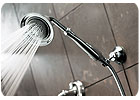
Hand-held showers are
extremely popular in residential shower applications, but may be in peril.
Photo courtesy of Kohler Co.
Philadelphia-area plumbing contractor Jim McStravock is seeing one major trend when it comes to installing bathing systems.
“Everybody seems to be going away from the whirlpool tubs and going to shower systems with the rainheads and body sprays,” says McStravock, owner of McStravock Plumbing and Heating. “What I’m finding is people don’t have time to wait for a tub to fill up.”
McStravock also has noticed a common theme when it comes to a customer’s initial reaction to the increasingly popular rainheads.
“A lot of people want to put them in and then they expect to get blown over with a deluge of water,” he laughs. “I tell them you get 2.5 gallons out of the showerhead no matter how big it is.”
But if a recent Department of Energy interpretive rule change defining showerheads is passed, customers, manufacturers and contractors like McStravock will have much larger issues to deal with.
In early June, the DOE, without advance notice to stakeholders, proposed to re-define showerheads as shower valves, which would allow only a single showerhead using no more than 2.5 gallons of water per minute per showering compartment.
“All components that are supplied standard together and function from one inlet (i.e., after the mixing valve) form a single showerhead for purposes of the maximum water-use standards,” is how the DOE’s new interpretation of the Energy Policy and Conservation Act’s maximum water-use standard reads.
Thus, if a showerhead’s standard components, operating in their maximum design flow configuration, taken together use in excess of 2.5 gpm when flowing at 80 psi - even if each component individually does not exceed 2.5 gpm - it would be ruled noncompliant based on the DOE’s new interpretation of EPCA.
Pictured is wheelchair tennis champion Beth
Arnault. Photo courtesy Jean Tessmer/Space Options.
No Warning
The new definition proposal was included with other directives in the Federal Register. No plumbing industry executives PM spoke with were directly informed of the new proposal and several plumbing contractors PM talked to either had no idea of the possible change or heard very vague details about it.“We were caught off guard,” said Plumbing Manufacturers Institute Executive Director Barbara Higgens. “We were never contacted as a stakeholder. It was buried in the Federal Register. We stumbled across it in a 1,000-page register notice. It was not a terrific way to handle this.”
DOE spokeswoman Jen Stutsman said the new interpretation came about after several complaints were received alleging certain showerhead products were exceeding the federal water-conservation standard.
“In the course of investigating these complaints, (we) discovered some confusion as to how the department’s definition of ‘showerhead’ for water-conservation purposes applied to new showerhead designs being marketed under names such as waterfalls, shower towers, rainheads and shower systems,” Stutsman told PM.
Shortly after the initial furor arose, Higgens met with DOE officials and came back only slightly encouraged by the fact that DOE’s initial directive contained clumsy language. The new definition does not impose an outright ban on multiple showerheads, as originally feared. However, the ruling would require manufacturers to restrict water flow to one outlet at a time and add additional valves for multiple outlet operation. Higgens said “these restrictions are still quite onerous.”
This is where things stood as of June 18, the final day of DOE’s comment period. In the days leading up to June 18, Higgens was busy issuing “Action Alerts” to PMI members urging them to speak out against the new interpretation
“We have received a number of comments providing feedback on the draft interpretative rule from the industry and the public,” Stutsman said.
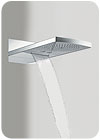
Fixtures like rainheads in a multihead showering
system would likely be noncompliant. Photo courtesy of Hansgrohe.
The Ramifications
While manufacturers acknowledge they will be affected in varying degrees from a compliance, financial and production standpoint if the new definition becomes law, there is much greater concern about another segment of the equation - the consumer.“People like multifunction showers,” Hansgrohe-North America President Russ Wheeler says. “They would be illegal going forward if this goes through. People love a good shower. The guys like showerheads and the women like hand showers. I don’t know if the DOE is thinking there are these huge, lavish showers of the rich with 10 showerheads running at the same time. I don’t believe the DOE had any idea what it is proposing would have as big an impact as it will.”
“Studies have shown the average shower lasts eight to 12 minutes and we hear from people all the time they are concerned about getting the shampoo out of their hair,” says Lee Mercer, PMI president and Moen’s director of product compliance. “Showering has to be effective.”
Moen Group Product Manager Mike Reffner says consumer choice could fall on the proverbial sword if the definition change goes through.
“People don’t have every outlet on in the shower every day, wasting thousands of gallons of water,” he says. “It would be like telling everybody they have to change every lightbulb to flourescents or say we all have to drive hybrids. People will pick and choose areas they want to be green. As long as the products are good, they will do that.
“I recycle papers and have low-flow fixtures in my house. I want a hand shower and now you are telling me I can’t have it? In effect, you are taking away people’s choices.”
Some manufacturers also fear a drastic legislative shift such as this one, if passed, also could result in the prevalence of unhappy consumers altering flow-restrictors in showerheads in order to achieve a higher flow rate. They may also turn to renegade product manufacturers that are not compliant with mandated flow rates.
“When consumers believe certain laws inconvenience them in whatever way, you are actually encouraging them to break the law,” notes American Standard Director of Design Gray Uhl, “and then we’re right back where we were. To fill a tub in three minutes or 10 minutes, you still have the same amount of water. This could be unacceptable to the end user. We don’t want what was done in the past with the notion of routinely taking out any restrictor to get the maximum flow. Our goal is to make responsible products, but we have to make sure we’re meeting the expectations of the consumer.”
The proposal would also impact the commercial sector (hotels, nursing homes, schools and health clubs where systems like gang showers and multifunction showerheads are prevalent) and would also have an especially negative consequence for the aging-in-place population and persons with disabilities who, for instance, may rely on using a hand shower on a multihead system while sitting on a shower stool.
“The elderly and disabled use these types of showers and in one swoop of the pen they are going after them,” Higgens says. “The unintended consequences are that it will hurt groups like the disabled and the elderly who use a hand shower to take a shower.”
The Plumbing-Heating-Cooling Contractors-National Association feels the new interpretation would hit the plumbing contractor particularly hard.
“This will have an impact on the installation of higher-end bathrooms, such as spas and showers that have both a showerhead and hand shower or shower towers,” PHCC Government Relations Director Kevin Schwalb says. “PHCC believes this will have an adverse effect on the plumbing industry, especially the plumbing contractor who is responsible for the sales and installation of the defined products.”
Kevin Grabill, a third-generation plumber and owner of Grabill Plumbing in Kansas City, KS, frequently installs residential shower systems.
“It would definitely cut into what we do,” Grabill says. “We install more dollars in the master shower than anywhere else in the house. We’re seeing a lot of money going into that master shower. It would have a dramatic impact.”
The DOE has proposed to
re-define showerheads as shower valves. Photo courtesy of Moen.
All For Saving Water
Yes, manufacturers are perturbed by the proposed definition change both from the wording and how it was presented to constituencies, but they understand the water conservation aspect of the proposed new definition.“Clearly the intent with water conservation is laudable,” Mercer says. “But the DOE did not give good, thorough thought to what the consequences would be. Clearly, this would impact a lot of people in a lot of different categories.”
But Schwalb cautions water savings may not be ultimately realized under the proposed new definition.
“In order to maintain compliance with unique codes and regulations dealing with commercial buildings such as hospitals, retirement homes, school and special-needs locations, this definition will require installation of additional mixing valves, which defeats the DOE’s intended purpose for this interpretation,” Schwalb notes. “This would not result in the intended water savings this rule is trying to accomplish.”
The Solution
The DOE comments period closed just prior to press time. Stutsman said after the comments are reviewed, DOE intends to issue a final interpretative rule to clarify the showerhead definition as used in DOE rules.“As we proceed, we will be mindful of manufacturers’ production decisions that may have been based on a misunderstanding of the definition of the term showerhead and how it related to the department’s conservation standards,” Stutsman says.
Stutsman notes if the draft interpretation is implemented, it would not outright ban fixtures like hand nozzles and fixed nozzles.
“It makes clear that the full range of available showerhead products, including products with a hand nozzle and fixed nozzle, must meet the federal water-conservation standard on the books since 1998 - 2.5 gallons per minute at 80 pounds per square inch,” she explains.
While manufacturers and organizations like PMI and PHCC have submitted comments, there are those who wonder why the two sides can’t simply sit down and craft a workable solution that benefits all parties involved.
“We need to get together and look at this and determine what is in the best interests of everybody,” Reffner says. “You have manufacturers willing to collaborate with agencies. The precedent is there.”
Reffner wouldn’t mind seeing uniform flow rates established throughout the country.
“You have national and local legislation all over the board,” he notes. “You’ve got some with 1.6 (gpm) and 1.75 and 2.0. For example, Miami-Dade County is 1.5. Being uniform would be ideal.”
Meeting Two Needs
But at the end of the day, manufacturers are extremely mindful of the delicate balancing act that faces them - one that could be thrown out of sync if the new interpretation takes hold.“You would be limiting the ability to give the consumers the type of experience they tell us they want,” says Rob Zimmerman, Kohler’s senior staff engineer for water conservation.
Adds Delta Faucet Senior Product Development Manager Paul Patton: “Customers tell us, ‘I want a good shower.’ Nobody wants to wake up and take an angry shower. More and more people are putting in showers. The challenges for this industry are to deliver on the customer experience and at the same time deliver water conservation.”
Links
Looking for a reprint of this article?
From high-res PDFs to custom plaques, order your copy today!