College of Product Knowledge: Supply Piping - Part II

COPPER TUBE
Copper tube is the most common type of supply piping material used in the U.S. today. Unlike steel, which is an alloy of iron and carbon, copper is made from just one ingredient - copper itself. Manufacturers of copper tube give a number of reasons for its success and popularity:
Advantages Of Copper Tube
- Resistant to corrosion and scaling: Unaffected by "bad water" conditions.
- Lightweight: Installers can carry and handle long lengths with ease.
- Easily bent and formed: Can be curved around corners and obstructions without need for elbows in many cases.
- Compact: Requires less storage and transport space.
- Easy to join: Versatile system can be joined using several methods.
- Availability of long lengths: Enables long runs without need for couplings.
- Ductility (stretchability): Can withstand some expansion without bursting.
- Saves on labor
Joining Options
Copper tube is one of the most versatile piping systems from the standpoint of methods used to join sections. Among these are solder, compression and flare connections. As a rule, soldered joints are required for "behind-the-wall" applications (the basic piping system of the building), whereas compression is used outside the wall (typically joining faucets and toilet ballcocks to stop valves). Flared joints are more often used in refrigeration applications than for plumbing.Solder (often referred to as "sweat"): As in the case of steel pipe, you are dealing with a "male-female" relation of parts here, the difference being that with copper tube, there are no threads involved. Instead, the thing that holds the mating components together is an external metallic substance called "solder." Soldered joints require a slight gap between the tube end and mating socket to permit the free flow of molten material between surfaces for a good overall bond. The flow of heated solder into this gap is called "capillary action" (pulling the material into the gap regardless of the up or down orientation of the parts).
Compression: Compression fittings provide easy assembly by eliminating most of the preparatory steps involved with other systems. With this approach, a coupling nut is inserted over the tube end, followed by a ferrule (small brass ring). After the tube end is inserted into the female opening of the fitting, the nut is tightened, and in so doing, compresses the ferrule around the tube. This tight compression of the ferrule onto the tube results in a mechanical lock to keep the tube in place, as well as a water seal to prevent leaking.
Flare: Essentially, the concept here is one of forming a slight flange or lip at the end of the tube, which allows a nut (inserted onto the tube before flaring) to secure and seal it to a mating fitting. A special tool is used to prepare the tube for this. The most common type clamps onto the tube and has a screw shaft with a conical tip that moves down into the tube opening to flare it.
Copper Tube Tempers
When used in reference to copper tube, "temper" is a term that refers to its "bendability." You will see copper tube designations of "drawn" and "annealed" types, and in true industry fashion, these terms could have been given more thought, since both varieties start out as drawn (the basic extruding process). But while both are drawn, both are not annealed, and that's the distinction to understand. Tube that is not annealed ("drawn") remains relatively stiff, comes in straight lengths, and is not intended for bending. Annealing is a secondary application of heat that softens the material, making it bendable and available in coils. In common usage, you will often hear these two options referred to as "hard" (drawn) and "soft" (annealed).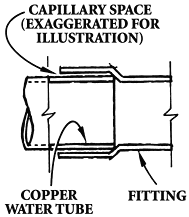
Weight Classes
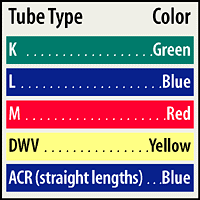
The term "weight" refers to the wall thickness of copper tube, and there are several options here, each representing a relative strength to withstand internal pressure. For water supply applications, the designations are K, L and M, with K representing the heaviest or strongest. There are two other weight designations used for classifying copper tube, both of these based on their application - DWV for drain, waste and vent usage and ACR for air conditioning and refrigeration. Since differences in wall dimension are not easily distinguished at a glance, each weight class of copper tube is color coded by the manufacturer (by imprinting on the tubing itself or by tagging).Copper Tube Sizes
We told you last month that the system of sizing for steel pipe was confusing. It's even more so with copper tube. Like steel pipe, you need to understand that the nominal designations of copper tube are not the same as actual (what we call 1/2-inch actually measures 5/8-inch across the outside diameter, for example). But the confusion doesn't stop there. Tube and fittings used for compression connections are designated by actual tube dimensions. Thus, a 3/8-inch riser used for connecting a faucet to a stop valve actually measures 3/8-inch across the outside diameter. And still one more exception to remember: ACR tube is also designated on the basis of the actual outside diameter. Clear as mud?Looking for a reprint of this article?
From high-res PDFs to custom plaques, order your copy today!


