College of Product Knowledge: Supply Pipe - Plastic - Part I
Advantages of these types include:
- Resistance to corrosion and chemical attack (the latter varies, depending on the specific material involved)
- Smooth inner walls, providing a low friction factor
- Self-insulating (will not conduct heat as readily as metal piping)
- Light weight for easy handling
- Available in coils in some cases
- Ease of installation and versatility of method
- Relatively low cost
- Savings on labor
When it comes to analyzing the specific options available, this category is harder for most of us to understand than steel or copper, since the materials involve some pretty convoluted chemical compositions. Without getting in over our heads here, let's just say that plastics experts evaluate the suitability of various plastics for plumbing applications on the basis of criteria such as strength, resistance to impact, resistance to chemical attack, extreme temperatures and exposure to UV rays.
Following is a brief description of the most common plastic materials used for supply piping today (there are other types of plastic piping, such as ABS, not covered here because they are not used for water supply applications):
PVC (Polyvinyl Chloride): One of the first materials used for indoor supply piping, this has high strength, good weathering characteristics and high resistance to chemicals such as acids and alkalis. It loses some of its properties when used with high temperature fluids, however, and for that reason, it is limited to use as cold water lines. PVC piping is rigid, and comes in straight lengths only.
CPVC (Chlorinated Polyvinyl Chloride): This material has properties that are generally the same as PVC, with the exception that it has higher temperature capabilities, and thus can be used with hot water systems. Where installers once used PVC for cold water and CPVC for hot, the general practice today is to use CPVC for both.
PEX (Cross-linked Polyethylene): One of the fastest growing options today, this material is popular because it is both flexible (furnished in coils) and able to handle hot and cold water temperatures. It has largely replaced polybutylene in the market.
PEX-AL-PEX: It is a variation of PEX that is made with a thin layer of aluminum buried in the wall section (PEX on the inside, aluminum in the middle, PEX on the outside). Like plain PEX, this type bends easily, but unlike PEX, it retains a precise bend when released (most flexible plastic piping materials have a mind of their own when it comes to their exact bent form - this type acts more like copper tube).
PB (Polybutylene): Largely discontinued today, this flexible hot/cold material has been the subject of widespread problems over the past 20 years. While a portion of these failures were the fault of the acetal fittings and the over-crimping of retaining rings, the material has nonetheless fallen from favor and use.
PE (Polyethylene): This is used primarily for outdoor applications involving the connecting of buildings to mains, farm irrigation, lawn sprinkling, etc. It is flexible, has high impact resistance and is resistant to stress cracking and weathering. It is not suitable for high temperature use.
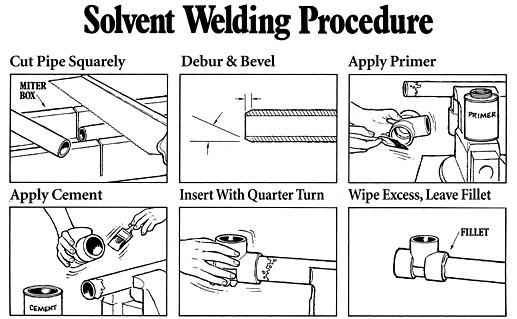
How Plastic Pipe Is Joined
The means by which plastic pipe is joined depends largely on the specific material involved. Not all systems can be used with all types.Solvent Weld - PVC and CPVC: By applying a coating of solvent cement to the male-female surfaces of the pipe end and fitting, and inserting these parts together, the joint fuses together into a hard, solid state. This is not a glue or filler - the mating surfaces flow together and harden as an actual "weld." The compound contains both solvent and a portion of the piping material being joined. It is recommended that hard surface piping materials such as these be "primed" first with straight solvent, to give the mating surfaces a head start on "melting" properly.
Mechanical Joining - PEX and PE: The two basic methods of connecting PEX and PE are called insert and compression. An insert fitting (usually metal) is pressed into the connecting tube ends, and a metal ring is then crimped over the assembly to make a secure, leak-free joint. A compression fitting is similar to the type used with copper tube, involving the use of a ferrule (grip ring) that is compressed into the wall of the piping material by the tightening of a nut. Prior to assembly, a metal stiffener is inserted into each tube end to assure a uniformly round profile for sealing the joint. Compression joints have the advantage of allowing disassembly, if needed.
Thermal Weld - PE: This involves the use of a special heating tool that essentially melts the mating surfaces of the pipe and fitting before their assembly. Here again, the flowing of like materials together results in an actual weld.
Sizing And Marking
Plastic pipe follows the sizing systems of the metal varieties - either as IPS (iron pipe size) or CTS (copper tube size). Properly labeled plastic pipe will always indicate which it is. Typically, each length or coil of plastic pipe is identified with several key points of information at measured intervals. This information includes the following:
- The manufacturer's name or trademark
- The standard to which it conforms
- Pipe size (including IPS or CTS designations)
- Resin type or cell class according to ASTM D-1784, e.g. CPVC 23447
- Pressure rating
- SDR number or Schedule number
- Laboratory seal or mark attesting to suitability for potable water.
Looking for a reprint of this article?
From high-res PDFs to custom plaques, order your copy today!


