Dan Holohan: Divvying up the bill
Multifamily heating: Who pays?

fizkes / iStock / Getty Images Plus via Getty Images
There’s long been talk about how to divvy up the heating expenses in buildings that have tenants. Should each tenant have their own meter? Their own boiler? Boilers are a lot smaller than they used to be, right? In Europe, you’ll often see those little ones hanging around in the kitchen. I remember seeing those wall-hung boilers at the big ISH show in Frankfurt, Germany the first time I visited there in 1991. I had to ask what they were because, to me, a boiler was something that hunched on the basement floor and weighed more than a compact car. The ones at the show looked more like medicine cabinets.
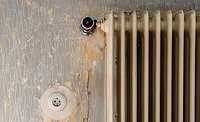
On that visit, I also saw evaporative Btu meters for the first time. I was in the basement restroom of a tiny bar and looking at the white (well sort of) flat-panel radiator that hung over the urinal. It had what looked like a mercury thermometer stuck to it.
With the exception of my buddies, who were all from America, no one spoke English in that bar so I wasn’t able to find out what the thing on the radiator was. I did try, though.
“Radiator?” I said to the barmaid.
“Ich verstehe nicht,” she said, shaking her head.
“Downstairs?” I pointed toward the spiral staircase.
“Ya?”
“Ouch!” I pantomimed touching a hot radiator and shaking my burnt hands. She looked from me to my buddies. Raised an eyebrow.
“He likes heating things,” Bob said.
“Ich verstehe nicht,” she shook her head. Shrugged.
“She doesn’t understand,” Bob said.
“Radiator! Ouch!” I said louder this time because that’s what Americans will always do. I held my palms over an imaginary radiator.
“Ahh, der heizkörper?” she said, mimicking my hand motion.
“Yes! Radiator. Has thing stuck on it?” I made a small rectangle with my fingers. Pretended to stick it to der heizkörper.
She shrugged. Pointed at my half-empty glass. I nodded. She left to get me another beer.
But now I really needed to know. I was seeing thermometer-like devices everywhere. Isn’t it funny how when you start looking you actually start seeing? They were in every store we went into. I would point at them and wonder. Were these there to show the individual room temperature? If not that, what else could they be doing?
And then I decided to ask an English-speaking engineer at the ISH show, which is what I should have done in the first place, and probably would have had there not been beer involved. He laughed and told me that what I was seeing was an evaporative Btu meter.
“They’re on just about every radiator in a rental space, both stores and apartments,” he said. “German law demands it.”
The only solution is to replace the steam heat with something else, and these days, that’s looking more and more like heat pumps.
I asked how they work and he explained that the landlord mounts one on each radiator at the start of the heating season. They contain a fluid that evaporates in the presence of heat. At the end of the heating season, the landlord collects them all and compares one to the other. How much of the fluid is gone from each? That will determine how much each tenant will pay for that winter’s heat. It’s beautifully simple.
“Do people try to cheat?” I said.
“That’s difficult,” he said. “Each is put on with a seal, and if someone breaks the seal then they pay for the entire content of the device. Most people just go along and pay their fair share. This is Germany. We wait for red lights to turn green before crossing streets. Even if there are no cars coming.”
“We don’t do that in New York,” I said. “The traffic lights are just suggestions.”
“Ya.”
Two years later, when I was back at ISH, I started to see electronic versions of the Btu meters. I thought about the evaporative ones for years, though, because in New York, where there was so much steam heat, you could have sold those stick-on meters by the millions. They sense heat and only heat. If a tenant chooses to have the radiator on, the meter will know it and the fluid will evaporate. If the tenant closes the radiator’s supply valve when the room gets too warm, the meter will also know that. I thought this would be the perfect way to meter steam usage in individual apartments.
But no one ever brought them to the American market and now no one makes them. What a missed opportunity that was. I suppose the Europeans didn’t see it because there’s no steam heat over there. Alas.
The electronic versions are, of course, much more accurate because they measure the temperature difference across the radiator as well as the flow rate through the radiator. From there, it’s easy to see how many Btu each person is using. But those fancy meters are more expensive than the throw-away, stick-on ones. There’s no stopping progress, though.
Speaking of which, someone showed me a photo of an old, coin-operated gas meter. These also used to be big in European rental properties and you had to keep a stack of coins on hand if you wanted gas for cooking, bathing, or heating, and in an earlier time, for lighting.
But I’m told there were a lot of problems with those meters. If the person who collected the coins didn’t come around enough the tenants would keep shoving coins into the meter until the collection box filled. The coins would then get stuck in the mechanism and that meant no heat or hot water.
An old-timer told me that many people used ice-cube trays made in the shape of the coin that their gas meter accepted. The meters weren’t smart enough to tell the difference between metal and frozen water so it would open wide and pass gas. You could feed the meter a bit of round ice and leave no evidence behind. The only problem was that the meter then filled up with water, which was not good for the meter.
“Those meters typically supplied gas lights or small cook stoves,” that old-timer told me. “The capacity was built into the unit’s model name. You had a five-light meter for five gaslights, and a 10-light meter for 10 gaslights, and so on.”
He told me that those units were still around when he joined the industry in the mid-‘60s, but they no longer took coins.
Another guy told me that he stayed a week in a furnished London flat back in 1995. It had a wall-mounted gas boiler that took care of both the heat and the domestic hot water.
“One morning we had no heat or hot water and I could not light the boiler,” he said. “My traveling companion was steaming and wanted to call the rental agent, but I told him to wait a second.
“I found the gas meter behind an access panel in the kitchen. It had a magnetic- stripe card slot. The LCD display read £0.0. There was a new card sitting on top of the meter. I stuck it in, heard a click and the display now read “£50.0”. Presto! We were back in business.”
I asked how he knew to look for that. He said he was a fan of old English novels. That’s where he learned about coin-operated meters. See? It pays to be a reader.
There are no such meters in New York City, where most of the older apartment buildings include steam heat as part of the monthly rental. Short of those evaporative Btu meters I saw in Germany that never made it to America, I’ve never heard of a viable way to measure how much steam each tenant uses. And besides, most of those tenants open their windows on wintry days because the radiators are putting out way too much heat. I know the landlords could install thermostatic radiator valves on those old radiators. That would save fuel and make their apartments more comfortable, but they don’t show how much steam each tenant uses. And they cost money.
So who pays?
The landlord doesn’t want to pay because he can’t get any more money out of the tenants. Their monthly rent is tied to a lease, and many of those leases have rent-control laws attached to them.
The tenants don’t want to pay because it’s just easier (and cheaper) for them to open the window when it gets too hot.
The only solution is to replace the steam heat with something else, and these days, that’s looking more and more like heat pumps.
But who pays?
Looking for a reprint of this article?
From high-res PDFs to custom plaques, order your copy today!