Eye on Safety: Slips, trips and fall season
Safely slide through winter with a safety moment.
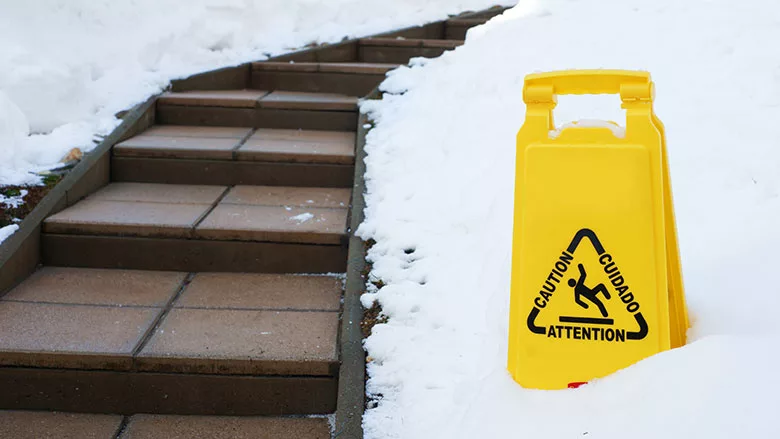
While people fall year-round, the freezing season is the perfect time to think about fall prevention. Fall hazards such as slippery leaves, wet pavement and frozen water are common in the colder season. They can't be ignored, even when businesses are extremely busy.
The injuries sustained from a fall can range from the bruised ego to death. According to the Bureau of Labor Statistics, there were 5,333 fatal occupational injuries in the United States in 2019. Out of the 5,333 fatalities, approximately 900 or 17% of the total were the result of slips, trips and falls. In fact, OSHA’s top-cited violation in the federal FY 2020 year was fall protection (Commonly Used Statistics | Occupational Safety and Health Administration (osha.gov).
The good news is that falls are entirely preventable.
Preventing falls in the workplace
Awareness of the potential for a fall-related accident during this time of year can identify weaknesses in a safety program. It provides a moment to reassess associate habits and beliefs and shift any unwanted behaviors, as well as create a reliable plan to avoid these risks.
While using a few safety precautions and ensuring that equipment is up to standard will solve most issues, here are some basic guidelines:
- Utilize good housekeeping;
- Wear slip-resistant shoes when on a ladder or scaffolding;
- Determine what fall protection equipment should be used;
- Avoid leaning or reaching while on ladders or scaffolds;
- Notify management or another responsible party if a hazard is present;
- Use proper equipment and follow the training and directions for safe and proper use;
- Inspect all equipment before use;
- When possible, remove the need to work from heights altogether; and
- Ensure all personnel are adequately trained and informed on the hazards.
Training
Every user must be trained before they are allowed to use any fall protection. Here are some guidelines for an effective training program.
- Train new employees about the fall protection program and offer training if the program changes or there are significant changes in the plan, such as the type of equipment used or if new OSHA guidelines are published;
- Consider making fall protection training an annual requirement for all employees;
- During training, ensure that employees understand the proper use of equipment via demonstration. For example, the employees must visually demonstrate how to inspect, wear, adjust and remove the equipment;
- Provide live, personal fall arrest demonstrations. Many PPE suppliers and harness manufacturers provide this service. Consider consulting with their services to include in your worksite safety training; and
- Ensure all training is documented for future reference.
Not only can employees learn a lot about fall protection via these annual training sessions, but the company can also identify and adjust any training requirements. Thus, not only does it benefit the company, but OSHA mandates proper training as well.
What level of training should your employees have?
Fall protection training can be classified into four categories: awareness, authorized-user, competent person, and qualified-person training. Every employee may not need the same level of fall protection training, but every employee can benefit from minimizing fall hazards.
- Awareness training is essentially an overview of fall hazards in the workplace. It is a more general and fundamental approach to understanding fall risk, and many professionals do not consider this an adequate training level for most employees.
- Authorized-user training is more job-specific for individuals who need to understand fall protection for their regular on-the-job activities. In addition, this training will ensure that individuals know and understand OSHA standards and how to meet them.
- Competent person training is geared more toward supervisory-level roles. This training ensures that individuals understand all types of fall hazards in the workplace and appropriate measures for protection. In addition, this type of training would prepare an individual to suggest changes or additional training if a new fall hazard exists.
- Qualified person training is the highest level of fall protection training available. It usually requires that the person possess a higher-level degree or specialized training. Ultimately, this person would be able to address technical issues that may arise. It is up to the employer to do their due diligence to identify if an employee is considered a qualified person.
Equipment selections and evaluation
The next phase is identifying the threat in your workplace and understanding what type of fall protection equipment and training you should put in place.
When it comes to establishing proper fall protection, it's best to start with the hierarchy of controls that can assist this process. Then, if possible, remove the fall threat risk altogether.
This may mean structural changes necessary to remove the risk entirely. If this is not possible, you should consider using engineering controls, such as handrails or other engineered solutions. Last you may be able to address fall risks via administrative controls, policies, procedures, or work instructions. However, if the fall hazard cannot be removed, a fall arrest system may be implemented.
The difference between fall restraint and fall arrest
You may hear the terms "fall restraint" and "fall arrest" used interchangeably by individuals outside the industry. However, they are not the same thing. A fall restraint should be used near the leading edges of rooflines and aerial lifts or flatbed trucks or trailers.
Although both systems use a harness to secure the worker, a fall restraint system uses a positioning lanyard that prevents the worker from getting too close to the roofline or too close to the edge. To be clear, a fall arrest is a system used to stop an actively falling person. You may need to employ both fall restraint and fall arrest systems depending on the specifics of the project and workplace.
Understanding the components of fall arrest systems
To properly use a fall arrest system, you must also understand anchorage points requirements. For instance, all fall arrest systems require an anchorage point to support at least 5,000 pounds per worker attached or two times the maximum arrest force in an engineered system.
A lanyard is part of a fall restraint system that prevents a person from getting too close to the edge of the working platform. In fall arrest systems, lanyards are designed to support a free fall of 6 feet. Because of this, ensure anchorage points are located overhead and are NOT located below the worker. In addition, you should be mindful of the amount of swing action capability of a fall arrest system. Too much swing could cause the individual to hit hazardous objects and sustain serious injuries.
The bottom line
Due to the fast pace of business today, we rely on routine to ensure business continuity which can put our safety programs at risk of running on autopilot. Instead, welcome every changing season with a quick review of your safety program. That way, when the brisk chill rolls in you’ll do so knowing you’ve reviewed your fall prevention strategies, thus keeping your workers safe year-round.
Hannah Sesay is the vice president of health and safety for Ferguson and is a member of the American Supply Association Safety Committee which provides the Eye on Safety column each month.
Looking for a reprint of this article?
From high-res PDFs to custom plaques, order your copy today!