Form follows function
Back in the days when we all burned coal, most folks were busy shoveling that heavy black stuff into boilers and furnaces.
In 1896 American architect Louis Sullivan cameup with the idea that form should follow function.
I’ve been thinking about that lately, and how heating and cooling systems have affected the design of our buildings, and even the design of some of our furniture. Deep thoughts indeed.
You may not have considered any of this, but that’s because you have other things to do. I, on the other hand, have no life and way too much time on my hands. So I ponder.
Take chimneys, for instance. Nowadays, with modulating-condensing boilers and furnaces, chimneys seem like old-fashioned relics of the past, but it’s not just the mod-cons doing away with those tall holes in our buildings.
I visited Iceland a few years back and as the plane came in for a landing, I noticed there were no chimneys on any of the buildings. I couldn’t blame mod-cons for this. Icelanders doesn’t burn fuel. They just dig holes in the ground and endless energy comes roaring up into their turbines and storage tanks. The form of their buildings certainly follows the function of that ferocious geothermal energy. And since without chimneys there can be no Santa Claus, the Icelanders tell their children about the 13 Yule Lads, decedents of trolls who put good stuff (or bad stuff) into shoes left on windowsills during the 13 days prior to Christmas.
No chimney, no Santa. So there.
The plight of old buildings
But about our older buildings. You ever wonder why the chimneys are on the sides of most buildings? I wondered about that and then realized it had to do with laziness. Back in the days when we all burned coal, most folks were busy shoveling that heavy black stuff into boilers and furnaces. Horse-drawn wagons delivered the coal and used clanking metal chutes to slide it into the basement. That meant the chute’s door had to be near the street, and since no one wanted to carry the coal too far across the basement, the Dead Men installed the boilers and the chimneys on the side of the house near the coal bin and the horse. Common sense, right?
What happened next, though, would cause problems for the oil dealers who showed up during the 1930s. You see the coal-era installers ran the mains for their steam systems around the perimeter of the basements because coal burns continuously for hours and hours. The steam took its sweet time making its way around the perimeter main and up the risers to the radiators. Life was good. And it got even better when the oil guys arrived years later with their thermostats that even a baby could operate and that automatic fuel called oil. Consumers, particularly the women tasked with making the fires, embraced all this newness. Oil spelled the end of coal’s dirt and drudgery. Neat!
The challenge, though, was that long perimeter steam main that bumped off the corners of the basement. The thermostat would stop the oil burner before the steam had a chance to get all the way to the end of the main. The result was very uneven heat upstairs. The oil men solved this by using a better system of venting the air, and on their new installations they abandoned the perimeter main in favor of multiple mains that would run in different directions from the boiler. You can see form following function in every basement if you take the time to look.
And did you know that the advent of steam heating changed the windows in apartment buildings? I have an article from a 1911 issue of the Chicago Evening Post with a headline that exclaims, “No more double windows!” It goes on to explain: “The ancient double windows have almost disappeared from Chicago. Every city residence a quarter century ago was built with a set of heavy outer windows. Their object was to protect the interior of the building from cold and drafts. It may be that they really were necessary before the city was closely built up or the modern systems of heating were invented. Anyhow, the double windows began to disappear as the new steam systems were put in. It lingers still in the suburbs, but is practically unknown in the urban apartment houses, which we should say is a very good thing. With double windows, the only air that crept into the house came through those little mousetrap openings in the bottoms of the frames. No matter how fine the day, or how warm, there was no way from October to May in which the life-giving oxygen could be gotten from outdoors into the upstairs rooms.”
I’ll bet you thought the single-pane window came first. I did too, but it was steam heat that led to the demise of the double window, which came first. And this is also the reason why the Dead Men installed radiators beneath the windows. The radiators warmed that glorious fresh air that was drafting its way though those single-pane, leaky windows. And that was, as they said in 1911, a very good thing. It also was form following function. During a time when airborne disease was rampant, fresh air was what everyone wanted.
Ceiling talk
Consider, too, the height of our ceilings. These days, most of our homes have 8-ft. ceilings. The Victorians went for 10-ft. ceilings and that wasn’t because the studs were longer in the days before acid rain (a contactor once told me that), but because a room with a 10-ft. ceiling is cooler during the summer months. Hot air rises. The Victorians had no air conditioning. They had porches, which gave them a shady place to sit during the dog days of August. They’d rock and drink their lemonade and chat with the neighbors walking by. The lack of air conditioning made them very social.
They also had awnings on their porches and windows to block the rays of the sun from streaming through the glass. This kept their homes cooler. Few Americans have awnings on their windows nowadays because they have air conditioning. If you want to see awnings, you have to travel to Europe where folks have metal exterior shades and awnings designed to keep the sunlight from barging through the glass. The exterior shades cut way down on the heat gain during the summer, which lowers the cooling bills. I often wonder why we don’t do this here. But then I remember. We’re Americans!
But about those tall ceilings. The Victorians also used transom windows above their doors and they would open these during the warm months to give the rising hot air a way out of the room when the door was closed. It’s another of those simple things.
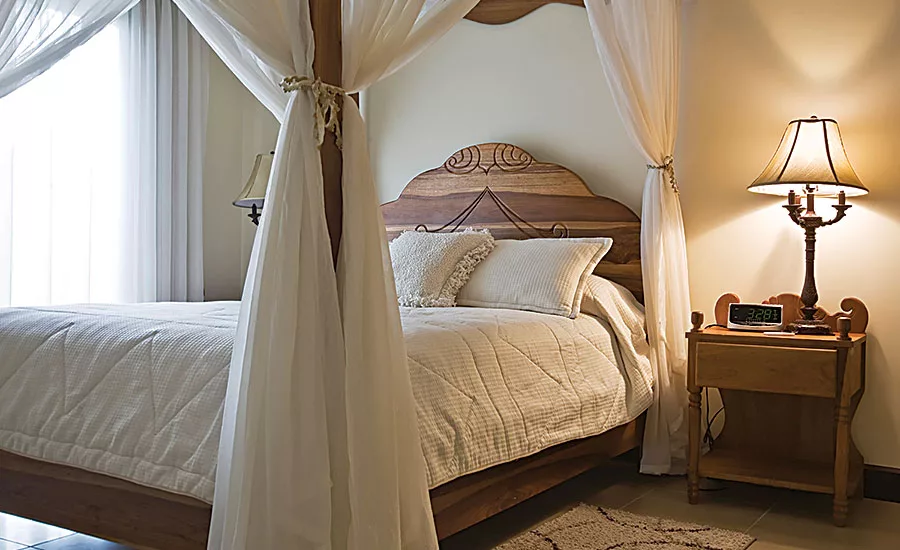
And think about those high Victorian beds with the canopies. That also had to do with the heating systems they used. In this case, it was most likely a fireplace. Hot air rises, so let’s raise the height of the bed and enclose it with a canopy and drapes to hold in the body heat. Feel free to channel Ebenezer Scrooge right about now if you’d like.
Willis Carriershows up in 1902 with a patent for his newfangled air-conditioning system and this, too, as time goes by has its effect on architecture. Porches gave way to backyard patios and neighbors stopped greeting each other as much. We turned to Facebook instead. I blame Willis for that.
Oh, and if you’re going to cool a room, isn’t it better if the ceiling height is 8 ft. instead of 10 ft.? Sure it is. And it’s also easier to heat that space if the ceiling is lower.
Let’s now consider houses of worship and our grand government buildings. Form follows function here as well, and the design of these buildings is to make us feel small, meek and humble. That sort of architecture presented its own heating challenges, again because hot air rises. I’ve pondered that a lot.
I’ve also pondered this: Do you suppose when we lowered the ceilings in our buildings from 10 ft. to 8 ft. the people in those buildings began to see themselves as taller and perhaps tougher? It’s all about perspective, right?
Do you suppose that increase in perceived height and toughness played a part in all the wars that took place during the 20th century?
And perhaps we blame Willis for that hot mess as well.
I know. I know. Way too much time on my hands.
Looking for a reprint of this article?
From high-res PDFs to custom plaques, order your copy today!


