Supply House Times logo Supply House Times
search
cart
facebook instagram twitter linkedin youtube
  • Sign In
  • Create Account
  • Sign Out
  • My Account
Supply House Times logo Supply House Times
  • NEWS
    • ASA NEWS
    • Company News
  • PRODUCTS
    • Interactive Spotlights
  • COLUMNS
    • Natalie Forster: From the Editor
    • Alicia Branham: Marketing Matters
    • Brad Williams: Succession Planning
    • Melissa Rasico: Luxury Plumbing Lounge
    • Letter from ASA President
    • Guest Columnists
    • Safety Columnists
  • MARKETS
    • Codes & Legislation
    • Heating & Cooling
    • Industrial PVF
    • Plumbing
    • Radiant & Hydronics
    • Solar Thermal | Geothermal
    • Technology
    • Women in Industry
  • BATH & KITCHEN PRO
    • Bath & Kitchen News
    • Bath & Kitchen Products
  • SPECIAL EDITIONS
    • B.I.G. Book Directory
    • Premier 150
    • Rep Locator Directory
  • MEDIA
    • Podcasts
    • Videos
    • eBooks
    • Webinars
  • RESOURCES
    • Radiant Comfort Report
    • Industry Calendar
    • Industry Links
    • Custom Content & Marketing Services
    • Market Research
    • Supply House Times Store
  • EMAG
    • EMAGAZINE
    • ARCHIVE ISSUES
    • CONTACT
    • ADVERTISE
  • SIGN UP!
ColumnistsPHCP and PVF Technology & Operations

Are you prepared to administer proper bleeding care?

Be on alert.
By Michael Place
November 1, 2013
under safety body


Bleeding occurs in many ways. External bleeding is most commonly the result of cuts, abrasions and lacerations, but in severe cases may arise as the consequence of avulsions, puncture, impalement or amputation.

A cut refers to a skin wound where the connective tissues have separated. There are “straight-line” wounds typically caused by sharp objects such as a knife, broken glass or sheet metal. Lacerationsare differentiated from cuts by the nature of the wound. While both represent a separation of connective tissues of the skin, a laceration implies a torn or jagged wound usually brought about by blunt-force trauma (i.e. collisions, falls, etc.). In severe cases, the term gash may be used as it implies a significant cut or laceration.

Avulsions, considered to be the most dangerous class of external bleeding injuries, are wounds where connective tissue is torn away from the body. This includes skin flaps (minor), degloving (moderate to severe) and amputation (serious to life-threatening).

The range of severity is broad for injuries resulting in external bleeding. From those requiring no medical attention to incidents requiring it immediately, first responders need to evaluate what type of bleeding injury has occurred. While gashes, degloving and amputation injuries are self-evident in their need for medical assistance, less severe bleeding may not be. If any questions exist as to the severity of an injury, always err on the side of caution. Unless you are sure medical treatment isn’t necessary, be prepared to dial 911.

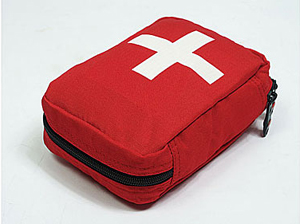
Let’s say a coworker of yours has badly cut his calf on a piece of sheet metal that slipped out of his hands. The wound is seeping blood and it’s unclear how deep the injury is. Another employee witnessed the incident and ran off in search of a first-aid kit. You’re standing there alone with the victim. He is lucid but in considerable pain. What do you do?

If you’re first instinct is to put pressure on the wound, you are correct. But do you have gloves?

Gloves are integral in assisting the victim with bleeding conditions. Environments with a chance for contact with blood represent a heightened risk of pathogens. OSHA Standard 1910.1030 focuses on bloodborne pathogens and how to respond to incidents involving the risk of exposure. To learn more about bloodborne pathogens, PPE and blood-stained waste disposal, go to www.osha/gov. 

If you do not have gloves with you, the best protocol to follow is having the victim put direct pressure on the wound until you’ve obtained them from your first-aid kit.

Tip: Most first-aid kits have latex or non-latex gloves in them. If yours doesn’t, consider upgrading your kit to one that does.

Once you have gloves, put them on. If you don’t have any available, improvise a barrier to limit the potential for contact with the victim’s blood.

The next step is to place a sterile dressing or clean cloth on the wound. Apply direct pressure with your hand for about 5 minutes.

Tip: Do not put pressure on the area if you know there is an object embedded in the wound. If this scenario involved a head injury, you would avoid putting pressure on the scalp in case the victim’s skull was injured in the incident.

Following this procedure, the first responder must reevaluate the bleeding condition. If it persists, put another dressing or cloth pad on top of the first one and keep applying pressure. If needed, apply a pressure bandage to keep pressure on the wound, wrapping from the end of the extremity toward the center of the body. 

Tip: The pressure of the bandage should be snug but loose enough to slip a finger under it. Learn more about applying pressure bandages in the Toolbox Talk at www.asa.net/safety.

While you are treating the wound, make regular checks on the victim’s condition. If the victim is unconscious or suffering from shock, call 911.

In the event of any extreme injury (i.e. amputation, degloving, severe gashes, etc.), a first responder may wrongfully consider the use of a tourniquet. Be advised tourniquets are a measure of last resort and should only be used by certified rescue trainers. There is a high risk of complications in the procedure and it should be avoided by anyone not specifically trained to perform it.

Measures to control bleeding, apply pressure bandages and dress wounds are only part of the knowledge a first responder needs. It is equally important to understand how to clean a wound, how to identify the signs and symptoms of infection or internal bleeding, and to recognize when medical attention is needed.

 See the Toolbox Talk at www.asa.net/safety for more information on these topics.


 Michael Place is training director for Dakota Supply Group and the chairman for DSG’s Safety and Wellness Focus Group. He also serves as a member of ASA’s Safety Committee and participates in industry and non-industry organizations promoting safety, training and continuing education. He can be reached at 701/255-7112 or  mplace@dsginc.biz.  Eye on Safety is produced each month by the American Supply Association Safety Committee. For more information, visit www.asa.net.


HELPFUL LINKS:

  • Toolbox Talk
  • Contact Supply House Times
  • Follow Supply House Times on Twitter!
  • Find Supply House Times on Facebook!
KEYWORDS: American Supply Association OSHA safety

Share This Story

Looking for a reprint of this article?
From high-res PDFs to custom plaques, order your copy today!

Michael Place is the training director for Dakota Supply Group and the chairman for DSG’s Safety and Wellness Focus Group. He also serves as a member of ASA’s Safety Committee and participates in industry and nonindustry organizations promoting safety, training and continuing education. He can be reached at mplace@dsginc.biz.

Recommended Content

JOIN TODAY
to unlock your recommendations.

Already have an account? Sign In

  • Stock financial index show successful investment on property business and construction industry with graph and chart for presentation and report background.

    2025 predictions: Twelve trends supply houses should know

    As 2024 ends, I’ll review last year’s predictions and...
    PHCP and PVF Technology & Operations
    By: Brad Williams
  • Background of aerial view of Industrial container port part of shipping in nighttime with a blue overlay.

    2025 Next Gen ALL-STARS: Top 20 Under 40 PHCP-PVF Professionals

    The future of the PHCP-PVF industry is being shaped by a...
    Heating & Cooling
    By: Natalie Forster
  • Premier 150: The top PHCP-PVF Distributors of 2026

    Premier 150: The Top PHCP-PVF Distributors of 2026

    Combined revenue across this year’s Premier 150 once...
    Market Sectors
    By: Natalie Forster
Manage My Account
  • eMagazine
  • Newsletters
  • Manage My Preferences
  • Online Registration
  • Subscription Customer Service

More Videos

Popular Stories

Rob Micklus, Chris DellaSala, John McKeown and Bob DellaSala

2026 Manufacturers Rep of the Year: Keystone Sales & Associates

Top 40 Under 40 Next Gen All-Stars Logo

Top 40 Under 40 Next Gen All-Star Competition Officially Open

SHT2026 Column Headshots Web Hannah

The View From the New Desk

2026 Premier Rankings

Events

December 30, 2030

Webinar Sponsorship Information

For webinar sponsorship information, visit www.bnpevents.com/webinars or email webinars@bnpmedia.com.

View All Submit An Event

Poll

Identifying Daily Time Loss Areas for Your Team

Where does your team lose the most time each day?
View Results Poll Archive

Products

The Water Came To A Stop

The Water Came To A Stop

See More Products

Download the FREE 2025 Water Conservation, Quality & Safety eBook

Download the Fifth annual Bath & Kitchen Pro eBook

Related Articles

  • Are you prepared to adminster first aid?

    See More
  • Are You Prepared To Leave Your Business?

    See More
  • Are You Prepared To Exit Your Business?

    See More

Related Products

See More Products
  • Inspector Book.jpg

    Lessons Learned: A Guide to Boilers for Home Inspectors

  • Pumping Away and other really cool piping options for hydronic systems

See More Products

Events

View AllSubmit An Event
  • January 24, 2014

    Webinar: How to Extend Lifecycles

    During the 30-minute presentation, executives from GPS Insight will discuss what you can do to stay on top of maintenance and control vehicle wear and tear.
View AllSubmit An Event
×

Stay in the know on the latest PHCP-PVF industry trends.

Get tailored content delivered your way.

JOIN TODAY!
  • RESOURCES
    • Advertise
    • Contact Us
    • Directories
    • Store
    • Want More
    • Plumbing & Mechanical
  • SIGN UP TODAY
    • Create Account
    • eMagazine
    • Newsletter
    • Customer Service
    • Manage Preferences
  • SERVICES
    • Marketing Services
    • Reprints
    • Market Research
    • List Rental
    • Survey/Respondent Access
  • STAY CONNECTED
    • LinkedIn
    • Facebook
    • Instagram
    • YouTube
    • X (Twitter)
  • PRIVACY
    • PRIVACY POLICY
    • TERMS & CONDITIONS
    • DO NOT SELL MY PERSONAL INFORMATION
    • PRIVACY REQUEST
    • ACCESSIBILITY

Copyright ©2026. All Rights Reserved BNP Media, Inc. and BNP Media II, LLC.

Design, CMS, Hosting & Web Development :: ePublishing