New Applications for Basic Piping Materials
Grooved piping systems and quarter-turn valves bring their own advantages.
In the April issue of Supply House Times I wrote an article on the technical advances we’ve seen in industrial and pharmaceutical piping due to the increased use of stainless steel. These advances are typical of the new applications we’re seeing in many established PVF products.
This month, let’s examine advantages and applications for grooved piping systems, ball valves and butterfly valves.
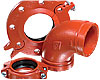
Today, other U.S. companies and numerous foreign manufacturers sell quality grooved couplings and fittings in the marketplace. From the initial bolted housing couplings for rapidly joining grooved lengths of pipe, these systems now include all standard shapes of grooved fittings: elbows, tees, reducers, crosses, caps, flanges and mechanical tees for tapping outlets. Today, most valves are available with grooved ends as well.
Grooved-end fittings are made in various materials, including carbon steel, malleable iron, ductile iron, stainless steel and aluminum. Coupling gaskets are produced in a number of different compounds, not only for potable water but also for corrosive services. These include EPDM, nitrile, neoprene, fluoroelastomer, silicone and halogenated butyl.
Grooved piping systems bring a number of advantages. For example, many piping applications do not need standard weight (schedule 40) pipe and fittings, which require threading. So, grooved systems are less costly because light-wall pipe and fittings can be utilized. This translates into lower costs for both the fitting material and installation. In addition, rolling a groove is less costly than threading and can be performed by in-house maintenance personnel using relatively inexpensive equipment. This situation facilitates the making of changes and additions by in-house maintenance staff because each fitting has the characteristics of a union.
Rapid connection and disconnection is another important advantage when used in operations that require frequent cleaning, such as pumps and food processing. Grooved fittings also suppress vibration attenuation near pumps. A final advantage is that grooved couplings can be made as rigid or flexible depending on the application.
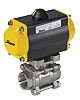
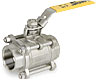
Ball valves operate with a ball that rotates from closed to open by a quarter-turn handle. The ball floats in elastomer concave seats in drop tight seals. The stems are blow-out proof. They are made of materials that include brass, steel, ductile iron, stainless steel, plastic and Monel. The seats are produced in many materials, which include Buna, neoprene, TFE and RTFE. Ball valves are made with a variety of ends: threaded, butt weld, socket weld, flanged, tube OD socket weld and solder/sweat.
Because ball valves have an oversized ball that allows the full-flow cross-section of the true nominal valve size, this creates many advantages. It means no restrictions, no turbulence and no pockets to retain residue. Another advantage is that in-house maintenance workers can replace worn valve seats. Three-piece ball valves with a four-bolt design can have seats replaced in line simply by removing three bolts and swinging the valve body down for access.
Quarter-turn ball valves have a stop at 90º so that the handle visually indicates a fully open or fully closed position. Ball valves are also easily adapted for actuation. Many are sold with standard mounting bolting that enables them to be automated in line at a future time.
Ball valves are used in process industries that operate automated ball valves controlled by computer instead of having extra employees walking from one location to another to open or close a valve. Technological and metallurgical advances have enabled large ball valves, especially flanged valves, to replace old-style plug valves in the petroleum and refining industry. The plug valves require more maintenance than trouble-free ball valves.
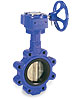
Smaller butterfly valves usually are operated with multi-position locking handles. Gear operators are factory mounted and also come with extension handles. Like other automated valves, butterfly valves can be automated with electric, hydraulic or pneumatic operators for variable positions. These automated valves can be computer-controlled for remote operation.
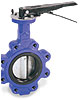
Another advantage is that butterfly valves can be opened incrementally to throttle flow. Butterfly valve ends are flanged, threaded, or lug type and wafer, which are mounted between user flanges. This reduces both the weight and cost of the valve. High-performance butterfly valves used in slightly higher pressure systems feature a slight offset in the way the disc is positioned. This increases the valve’s seating ability and decreases the tendency to wear.
Grooved piping fittings. Photos courtesy of Smith-Cooper International.
In the April issue of Supply House Times I wrote an article on the technical advances we’ve seen in industrial and pharmaceutical piping due to the increased use of stainless steel. These advances are typical of the new applications we’re seeing in many established PVF products.
This month, let’s examine advantages and applications for grooved piping systems, ball valves and butterfly valves.
Grooved Piping Systems
Grooved piping systems represent another example of the growth of an efficient method of connecting pipe, valves and fittings. In 1925, Victaulic originated and developed rapidly joining pipe mechanically for the military. Since then, grooved systems have developed into the fourth conventional piping method along with threaded, welded and flanged systems.Today, other U.S. companies and numerous foreign manufacturers sell quality grooved couplings and fittings in the marketplace. From the initial bolted housing couplings for rapidly joining grooved lengths of pipe, these systems now include all standard shapes of grooved fittings: elbows, tees, reducers, crosses, caps, flanges and mechanical tees for tapping outlets. Today, most valves are available with grooved ends as well.
Grooved-end fittings are made in various materials, including carbon steel, malleable iron, ductile iron, stainless steel and aluminum. Coupling gaskets are produced in a number of different compounds, not only for potable water but also for corrosive services. These include EPDM, nitrile, neoprene, fluoroelastomer, silicone and halogenated butyl.
Grooved Piping Applications
Grooved-end piping systems are used in plumbing, fire protection, HVAC, municipal water and wastewater, industrial and OEM applications. They can be found in a variety of industries: oilfield, chemical, food, pulp and paper, food and beverage, power and co-generation, mining process (aboveground and underground), military, shipbuilding and irrigation. A new application is the rapidly expanding oil shale drilling for handling large amounts of wastewater.Grooved piping systems bring a number of advantages. For example, many piping applications do not need standard weight (schedule 40) pipe and fittings, which require threading. So, grooved systems are less costly because light-wall pipe and fittings can be utilized. This translates into lower costs for both the fitting material and installation. In addition, rolling a groove is less costly than threading and can be performed by in-house maintenance personnel using relatively inexpensive equipment. This situation facilitates the making of changes and additions by in-house maintenance staff because each fitting has the characteristics of a union.
Rapid connection and disconnection is another important advantage when used in operations that require frequent cleaning, such as pumps and food processing. Grooved fittings also suppress vibration attenuation near pumps. A final advantage is that grooved couplings can be made as rigid or flexible depending on the application.
An automated ball valve.
Valve Technology
The two most spectacular advances in valve usages are in quarter-turn valves, specifically in ball valves and butterfly valves. Not only do both types of valves have rapid action, but the quarter-turn opening and closing are both well-suited for automation.Ball valves operate with a ball that rotates from closed to open by a quarter-turn handle. The ball floats in elastomer concave seats in drop tight seals. The stems are blow-out proof. They are made of materials that include brass, steel, ductile iron, stainless steel, plastic and Monel. The seats are produced in many materials, which include Buna, neoprene, TFE and RTFE. Ball valves are made with a variety of ends: threaded, butt weld, socket weld, flanged, tube OD socket weld and solder/sweat.
Because ball valves have an oversized ball that allows the full-flow cross-section of the true nominal valve size, this creates many advantages. It means no restrictions, no turbulence and no pockets to retain residue. Another advantage is that in-house maintenance workers can replace worn valve seats. Three-piece ball valves with a four-bolt design can have seats replaced in line simply by removing three bolts and swinging the valve body down for access.
Quarter-turn ball valves have a stop at 90º so that the handle visually indicates a fully open or fully closed position. Ball valves are also easily adapted for actuation. Many are sold with standard mounting bolting that enables them to be automated in line at a future time.
A small ball valve with handle.
Ball Valve Applications
Ball valves have replaced multi-turn gate valves in many plumbing operations. For example, when a pipe breaks in your home and is spouting water, you are happy to shut the water inlet valve in the front of your house with a simple quarter turn rather than laboriously turning the small gate valve hand wheel 20 times.Ball valves are used in process industries that operate automated ball valves controlled by computer instead of having extra employees walking from one location to another to open or close a valve. Technological and metallurgical advances have enabled large ball valves, especially flanged valves, to replace old-style plug valves in the petroleum and refining industry. The plug valves require more maintenance than trouble-free ball valves.
A geared butterfly valve.
Butterfly Valves
Butterfly valves go back to the days of the Roman aqueducts for regulating flow. Today, butterfly valves are used for both on-off and regulating service. The many technological, metallurgical and elastomer advances of recent years have enabled valve manufacturers to develop high-performance, drop-tight butterfly valves with sensitive automation. As with other types of valves, butterfly valves are made in many materials, including cast iron, ductile iron, steel and stainless steel. Liner materials are made in EPDM, Buna-N, Hypalon, neoprene and others, depending on the application.Smaller butterfly valves usually are operated with multi-position locking handles. Gear operators are factory mounted and also come with extension handles. Like other automated valves, butterfly valves can be automated with electric, hydraulic or pneumatic operators for variable positions. These automated valves can be computer-controlled for remote operation.
A standard lever-handled butterfly valve with position
locking device.
Butterfly Valve Advantages
The closing mechanism of a butterfly valve takes the form of a disc. Its operation is similar to that of a ball valve and thus, allows for quick shut-off. Butterfly valves are favored, however, because they are lower in cost as well as lighter in weight, meaning less support is required.Another advantage is that butterfly valves can be opened incrementally to throttle flow. Butterfly valve ends are flanged, threaded, or lug type and wafer, which are mounted between user flanges. This reduces both the weight and cost of the valve. High-performance butterfly valves used in slightly higher pressure systems feature a slight offset in the way the disc is positioned. This increases the valve’s seating ability and decreases the tendency to wear.
Links
Looking for a reprint of this article?
From high-res PDFs to custom plaques, order your copy today!


