College Of Product Knowledge: Electronic Plumbing Products
Some of the first examples of sensor-operated products came in the flush valve field, where the technology was applied to new equipment as well as to retrofit modules (replacing original mechanical actuators with the automatic type). These include both toilet and urinal applications, with model options of either integral or remote sensing (the latter most often mounted into the adjacent wall). The type of power supply usually depends on which of these configurations it is. In the case of the integral type, it is typically battery-powered - with the remote type, hard wiring.
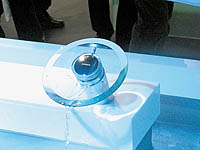
After flush valves, the next most common electronic washroom device today is the faucet. Here again, some are powered by battery, some hardwired. Though most faucets in this category provide just the basic “on-off” function, some manufacturers offer models that add a manual temperature mixing mechanism, activated by a handle. In other words, the faucet is turned on and off automatically, but the temperature is set by rotating a separate mixing mechanism. Within the battery-powered category, there are now recharging options that utilize ambient light or water power.
With infrared technology, the sophistication of the system varies depending on the product application. Its use with faucets is the simplest. Here the reflected light beam immediately turns on the faucet when the user's hands are placed in line with the sensing window, and the water continues to run until the hands are removed. On urinal flush valves, an additional requirement is introduced involving a delay of valve activation until the user moves away from the fixture (a two-step sequence here: 1) “arming” the system to prepare to activate when it senses the reflective beam off a user approaching the fixture, and 2) activating the valve when that reflective beam is lost by the user leaving). Toilet flush valves provide the greatest challenge. In addition to the two phases just described, there is an initial “usage confirmation” phase to detect whether the person in proximity is going to stay and use the toilet (as opposed to someone coming into the stall briefly to toss something into the toilet, tear off a piece of toilet paper, or sweep the floor). Good quality flush valves for the toilet will not “arm” until the signal is reflected back for a minimum number of seconds. After that period, the valve goes through the arming and activation phases described for the urinal type. Even the activation phase is a bit more sophisticated in this case, in that there is typically a delay to allow the user to leave the stall (to prevent a second “rearming” due to movement within the stall before actual departure).
Sensor-operated products are also showing up in shower rooms today - offering a better answer than either the “no limits” type of shower valve that can be left running, or the sometimes aggravating metering type that often seems to shut off at just the wrong time.
In addition to flush valves, faucets and shower valves, we are now seeing some other categories of “touchless” washroom products coming on the scene. These include sensor-operated soap dispensers, towel dispensers and hand dryers - and timer-actuated air fresheners. Back in the stall, there have been periodic attempts to provide more convenient sanitation of the toilet seat (something a bit more advanced than the seat-shaped piece of paper that rarely stays put). Some involve a sanitizing of the seat between uses, others a sheathing. One current example of the latter uses a cartridge of thin plastic tubing that rotates a clean section around a circular seat before each use. Like electronic towel dispensers, this utilizes a “wave” actuation in which the user brings his hand near a sensing window.
Not all electronic plumbing is touchless, however. There is an increasing number of faucets (especially in Europe) that require a light touch. Many of these are actuated with one or more piezo switches embedded flush with the surface of the base or spout, and some are “tuned down” capacitance devices that, like an elevator button, require light contact. Some in this genre provide a simple on-off function, or electronic metering (slow-close type that shuts off by itself). Others include varying capabilities of temperature regulation. (See coverage of the 2005 ISH fair in Germany in an upcoming issue.)
So where do we go from here with electronic plumbing? Some even more advanced examples are already with us, notably one called “programmed technologies.” Essentially, this is a computerized system of controlling water usage in prisons and schools. From a central control station, a PC not only monitors the use of each water-using device in a cell or washroom, but can restrict the usage as well as initiate remote flushing. <<
Sidebar: Technologies Used In Electronic Plumbing
- Infrared (IR): Probably the best known of the group, this involves the use of a “window” that emits a light beam that, when reflected off an object, is received back again to trigger activation (such as opening a solenoid or other type of electrical valve). In faucets, the “object” is the user's hands, and in flush valves, it is the user's body.
- Capacitive: Capacitive proximity sensors are designed to operate by generating an electrostatic field around a metal object (a faucet, for instance) and detecting changes in this field caused by an approaching object (hands, in this case). This requires a less specific “activation aim” than infrared, allowing the trigger action when the user's hand approaches from any direction. In other words, the entire faucet is the “sensing antenna” in this case.
- Radio Frequency (RF): This technology is not used for basic sensing, but in the transmitting of such sensing. An example here is a device used for flushing a tank-type toilet. A wall-mounted sensor typically uses infrared technology to do the sensing (reflecting a light beam off the user), but then transmits that signal to the electro-mechanical flushing device inside the tank by means of a radio signal.
- Piezo Switching: A piezo switch is one that is typically embedded flush with a product's metal surface, and though there is no actual movement involved when pressed, it “reads” an applied pressure to relay the signal. Piezo technology always requires the user to touch the control.
Looking for a reprint of this article?
From high-res PDFs to custom plaques, order your copy today!


