Supply House Times logo Supply House Times
search
cart
facebook instagram twitter linkedin youtube
  • Sign In
  • Create Account
  • Sign Out
  • My Account
Supply House Times logo Supply House Times
  • NEWS
    • ASA NEWS
    • Company News
  • PRODUCTS
    • Interactive Spotlights
  • COLUMNS
    • Natalie Forster: From the Editor
    • Alicia Branham: Marketing Matters
    • Brad Williams: Succession Planning
    • Melissa Rasico: Luxury Plumbing Lounge
    • Letter from ASA President
    • Guest Columnists
    • Safety Columnists
  • MARKETS
    • Codes & Legislation
    • Heating & Cooling
    • Industrial PVF
    • Plumbing
    • Radiant & Hydronics
    • Solar Thermal | Geothermal
    • Technology
    • Women in Industry
  • BATH & KITCHEN PRO
    • Bath & Kitchen News
    • Bath & Kitchen Products
  • SPECIAL EDITIONS
    • B.I.G. Book Directory
    • Premier 150
    • Rep Locator Directory
  • MEDIA
    • Podcasts
    • Videos
    • eBooks
    • Webinars
  • RESOURCES
    • Radiant Comfort Report
    • Industry Calendar
    • Industry Links
    • Custom Content & Marketing Services
    • Market Research
    • Supply House Times Store
  • EMAG
    • EMAGAZINE
    • ARCHIVE ISSUES
    • CONTACT
    • ADVERTISE
  • SIGN UP!

College Of Product Knowledge: Instant Hot Water Dispensers
January 5, 2004
This is an updated version of the product training course introduced by SUPPLY HOUSE TIMES in 1979, authored by Don Arnold.

Time for another definition. It isn't always clear to the uninitiated just what we mean by an “instant hot water dispenser.” After all, don't most plumbing systems make provisions for hot water? What's so unique about a product that delivers that? The uniqueness comes in the temperature of the water provided. Whereas your regular residential water heater typically furnishes water at temperatures up to 140°F, the instant hot water dispenser delivers it at near the boiling point - usually in the 190°F + range.

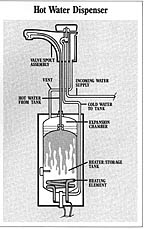
This product has the same function as the everyday tea kettle, providing hot water for instant beverages, soups, hot cereals, for thawing frozen foods, etc. Unlike the tea kettle, of course, this product is always ready to go. You activate the handle, and there it is - steaming hot water. Most models have a storage capacity of about two quarts. Even folks who understand the concept and purpose of an instant hot water dispenser, however, are sometimes puzzled about its construction. Why, for instance, if the dispensing valve is designed to handle a single fluid, are there often three or four different tubing connections involved in the process of hooking it up? The answer is related to the water's high temperatures. Without some means of handling the expansion of superheated water, a simple tank would act as a locked chamber, creating a dangerous situation. The solution is to provide a tank in which the heated water can be stored without being pressurized. Such a system necessitates routing the incoming supply water first through a valve in the dispensing head (above the counter). When activated, this valve permits water to pass down into the bottom of the storage tank, where it displaces heated storage water. This heated water then passes up through the tank's outlet tube to the spout where it is dispensed. In other words, as long as the activating valve remains off, there is no supply pressure on the tank; but once the valve is activated, water is permitted to flow through the tank and out to the spout.

All heating tanks are built with a provision to handle the expansion of the water when heated (volume can grow as much as 5% when brought to the near-boiling level). Before we explain that, let's look at what would happen if there were no such provision for expansion. If you filled the tank with cold water right up to spout level and stopped, what would happen as the water began to heat? The expansion would cause the water to slowly drip out the spout until the entire tankful reached the maximum temperature. Needless to say, most folks wouldn't care for this, so manufacturers provide a means of handling expansion internally. Usually this is accomplished through the use of an expansion chamber - in some cases vented to the atmosphere - in other cases contained within a flexible bladder (also acted upon by atmosphere). With such a chamber, the increased volume of water is given a place to go without dripping from the spout.

So far, so good - we found a place to put our expanded water during the heating cycle. Now, how do we get it out of there to make room for more? Very simply, the expansion water gets “sucked” out of the chamber by the primary flow of water during the next activation of the system. This process is called aspiration. So that explains the number of tubes involved in the installation. One goes directly to the dispensing head valve from the supply line; one goes from there to the bottom of the tank; one from the tank back up to the spout, and in the case of vented models, one more connects the vent outlet of the expansion chamber to the dispensing head.

The design of the dispensing heads (faucet component) for instant hot systems has been evolving in recent years to include a cold water option (often for filtered and/or chilled water), as well as more decorative high-end constructions.

Share This Story

Looking for a reprint of this article?
From high-res PDFs to custom plaques, order your copy today!

Recommended Content

JOIN TODAY
to unlock your recommendations.

Already have an account? Sign In

  • Stock financial index show successful investment on property business and construction industry with graph and chart for presentation and report background.

    2025 predictions: Twelve trends supply houses should know

    As 2024 ends, I’ll review last year’s predictions and...
    PHCP and PVF Technology & Operations
    By: Brad Williams
  • Background of aerial view of Industrial container port part of shipping in nighttime with a blue overlay.

    2025 Next Gen ALL-STARS: Top 20 Under 40 PHCP-PVF Professionals

    The future of the PHCP-PVF industry is being shaped by a...
    Market Sectors
    By: Natalie Forster
  • Premier 150: The top PHCP-PVF Distributors of 2026

    Premier 150: The Top PHCP-PVF Distributors of 2026

    Combined revenue across this year’s Premier 150 once...
    Plumbing
    By: Natalie Forster
Manage My Account
  • eMagazine
  • Newsletters
  • Manage My Preferences
  • Online Registration
  • Subscription Customer Service

More Videos

Popular Stories

Premier 150: The top PHCP-PVF Distributors of 2026

Premier 150: The Top PHCP-PVF Distributors of 2026

Jeff Dice

Built to Scale, Designed to Stay Local: Lessons From Winsupply at 70

Erin McCusker, Chief Impact Officer, LIXIL

LIXIL Elevates Impact Strategy to the Next Phase, Appoints Chief Impact Officer

2026 Premier Rankings

Events

December 30, 2030

Webinar Sponsorship Information

For webinar sponsorship information, visit www.bnpevents.com/webinars or email webinars@bnpmedia.com.

View All Submit An Event

Poll

Identifying Daily Time Loss Areas for Your Team

Where does your team lose the most time each day?
View Results Poll Archive

Products

The Water Came To A Stop

The Water Came To A Stop

See More Products

Download the FREE 2025 Water Conservation, Quality & Safety eBook

Download the Fifth annual Bath & Kitchen Pro eBook

Related Articles

  • College of Product Knowledge: Water Coolers & Drinking Fountains

    See More
  • College of Product Knowledge: Introduction To Water Heaters

    See More
  • College Of Product Knowledge: Water Treatment Products

    See More
×

Stay in the know on the latest PHCP-PVF industry trends.

Get tailored content delivered your way.

JOIN TODAY!
  • RESOURCES
    • Advertise
    • Contact Us
    • Directories
    • Store
    • Want More
    • Plumbing & Mechanical
  • SIGN UP TODAY
    • Create Account
    • eMagazine
    • Newsletter
    • Customer Service
    • Manage Preferences
  • SERVICES
    • Marketing Services
    • Reprints
    • Market Research
    • List Rental
    • Survey/Respondent Access
  • STAY CONNECTED
    • LinkedIn
    • Facebook
    • Instagram
    • YouTube
    • X (Twitter)
  • PRIVACY
    • PRIVACY POLICY
    • TERMS & CONDITIONS
    • DO NOT SELL MY PERSONAL INFORMATION
    • PRIVACY REQUEST
    • ACCESSIBILITY

Copyright ©2026. All Rights Reserved BNP Media, Inc. and BNP Media II, LLC.

Design, CMS, Hosting & Web Development :: ePublishing