What do contractors need from your training sessions?
Having a strong, trained and educated workforce is a key aspect of maintaining adaptable, resilient operations.

Image courtesy of kali9 / E+ / Getty Images
As tariff uncertainty remains and consumer and business sentiment continue to decline, the PHCP and PVF industry must stay adaptable and resilient. Having a strong, trained and educated workforce is a key component of maintaining adaptable, resilient operations.
Education versus training
Before approaching industry training, wholesalers and contractors alike must focus on industry education; education and industry training are both key components of success for today’s contractor. While both are critical, education and training cover different skills and applications. Laura Ciriello-Benedict, president of Ciriello Plumbing, noted that industry education focuses primarily on broad understandings of concepts, codes, principals and the industry itself--industry training, on the other hand, focuses on skills-based, hands-on trainings and applications. "Understanding both is what makes our industry a true craft," Ciriello-Benedict said.
Industry training is focused on the "how," which Erica Barnes, president of General Plumbing & Air Conditioning, noted is essential to reducing callbacks and liability with real-world applications. "This type of training ensures techs know how to execute their jobs safely, efficiently, and correctly," Barnes said. "It also keeps our techs current when it comes to tool, equipment, and methods of installation. Industry Training is essential to teaching sales as well as technical to maximize customer satisfaction and profitability."
Barnes emphasized that both industry education and training are key to contractor success, particularly in light of the number of technicians who will be retiring in the next few years. As a possible solution to dwindling numbers, Barnes recommended continuing to hire workers who currently know nothing about the trade; this presents an opportunity to educate and train these employees and turn them into dedicated industry professionals. "Training of employees also lead to greater retention and less turnover," she said.
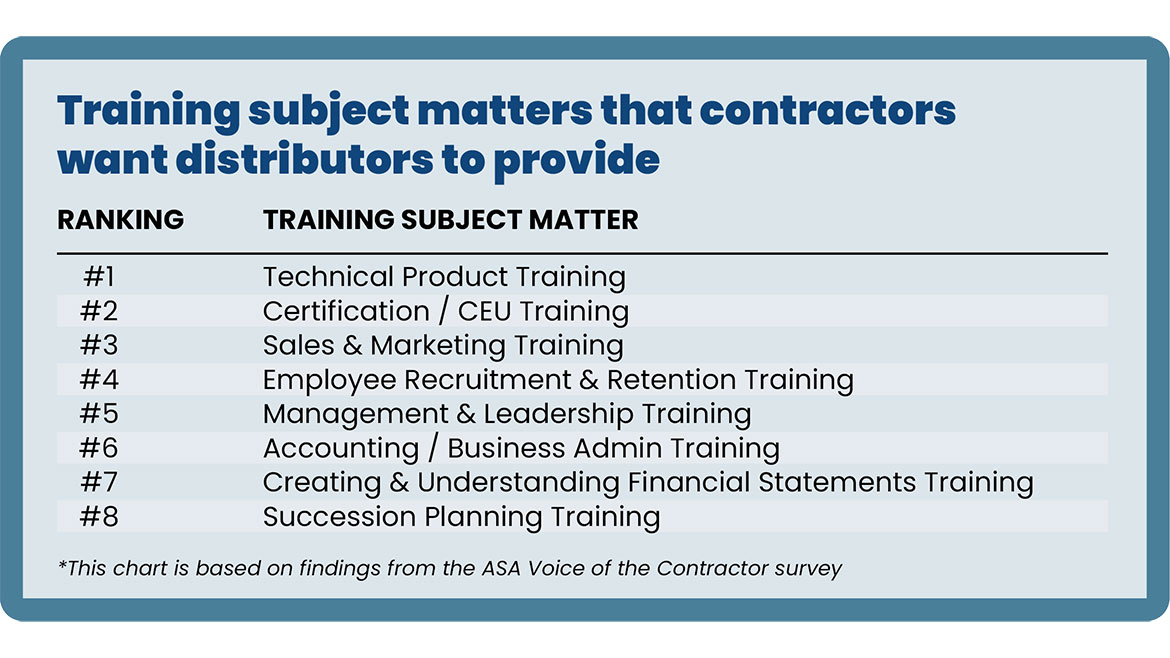
Illustration by Courtney Fathers / Supply House Times
Returning to in-person education
Many contractors want in-person, hands-on training experience. After years of webinars and online recordings, they want to be on site throughout trainings. "Most plumbers know all of the products and what they offer," Barnes said. "The real benefit our techs get from wholesalers is a hands on experience using the tools and materials." Another benefit is the ability to try the product before buying it.
Still, wholesalers shouldn’t leave online trainings and webinars in the dust— The American Supply Association's 2023 Voice of Builder Survey revealed that some contractors do still like the option of online training and education. Contractors often have limited schedule availability, and online training give them the freedom to move through the course material at their own pace.
In addition to online trainings, wholesalers can take the initiative to approach contractors about in-person training sessions. "We business owners, you’re so tied down with the business operations, that sometimes, unless training is scheduled and planned out very systematically, it can fall through the cracks," said Chris West, president of Chris West Plumbing. For his team, West likes when wholesalers reach out with intentional, specific trainings and ask when their customers are available and what they need out of their training sessions.
Soft skills
Barnes said that for her team, the most necessary market sector education includes soft skills and sales education, building code and permit knowledge, electric training, tankless water heater diagnosis and training, and leadership training. Leadership training prepares the workforce to teach the next generation—ensuring the longevity of the future workforce is a key component of PHCP and PVF industry resiliency.
Soft skills may not seem to be one of the most essential components of wholesaler-offered education, but it truly is. Empathy, understanding and the ability to connect with others are paramount in any industry, but especially for PHCP and PVF. When wholesalers are approaching training offerings, they must include soft skills training and applications to provide a well-rounded training experience.
"Each generation communicates in a different way, so at Chris West Plumbing we’re definitely trying to equip our team where they’re very well-rounded," West said. "Communication is so key to a successful business." Being able to understand each client and communicate effectively with them is a key component of daily work for contractors.
Attention spans are shorter than ever. With a world that moves so quickly, trainings and educational sessions need to be impactful, informative, and importantly—concise. PowerPoint presentations can be a great visual addition to a training session, but it’s important to not read straight from the screen like an essay. In addition to keeping trainings concise, wholesalers should prioritize strong trainee engagement. "Drawing your audience in with questions, and possibly relatable stories to the product—it might help keep them on the edge of their seats a little longer," West said.
Relationships and loyalty
The American Supply Association's 2024 Voice of Builder Survey revealed that contractors most prioritize product availability, price and relationships when selecting a plumbing distributor. Relationship building is an essential yet delicate aspect in developing and successfully offering education and training programs.
Many contractors find the same pain point with wholesaler-offered trainings—a salesy approach. Authenticity and objectivity are preferred by contractors by and large. "We don’t need a sales pitch. Put your money behind the product and trust it. I don’t need to be wined and dined at lunch," Barnes said. "I never accept lunch from a vendor because it is a two-hour waste of time. Today, that two hours is precious."
Ciriello-Benedict noted that in lieu of a sales-focused approach, wholesalers should focus on the training sessions and what they specifically have to offer.
Training is a heavy expense for contractors. To build customer loyalty, wholesalers can offer additional benefits in conjunction with trainings. "Wholesalers could help with that training by providing contractors with materials and tools to help with that training," Barnes said. She noted that training is so expensive for contractors because it takes away from selling time; additional material and tools costs are a critical concern for contractors when considering training programs.
Looking for a reprint of this article?
From high-res PDFs to custom plaques, order your copy today!