Supply House Times
  Home
  Subscribe
  Blogs
  Subscription Customer Service
  Subscribe to e-Newsletter
  Updates
  Today's Top News
  Calendar of Events
  PVF E-News Archives
  B&K Pro E-news Archives
  Latest News
  Milestones
  Events Photo Gallery
  Web Exclusives
  Current Issue
  Cover Story
  Features
  Columns
  Products
  Industry News
  ASA News
  Industrial PVF News
  Bath and Kitchen News
  Resources
  Career Center
  Premier 150
  Water Info Library
  AEC Store
  Archives
  Digital Edition Archive
  Free Product Info
  Ad Index
  B.I.G. Book
  Manufacturers' Rep Locator Directory
  Digital Radiant Flooring Guide
  Classified Ads
  Radiant Flooring Guide Directory
  Radiant Heating Report
  Industry Links
  Market Research
  Showrooms
  Webinars
  Video Archive
  Special Collections
  Economics Week in Review
  Supply HT Info
  Media Kit
  Contact Us
Search in: EditorialProductsCompanies
WEB EXCLUSIVE: A Walk Through ISH ’07
by Don Arnold
June 1, 2007

ARTICLE TOOLS
EmailEmailPrintPrintReprintsReprintsshareShare


I did the ISH thing again in March, heading over to Frankfurt, Germany, to see what the daddy of all plumbing shows had to excite the hordes this time. For those who have never attended, the biennial ISH Fair doesn't quite line up with any single show we have here in the U.S. in terms of overall size or product mix. Unlike K/BIS, it includes HVAC and other non-plumbing categories — and also unlike K/BIS, it has very little emphasis on kitchen products (except for faucet lines that include them in their overall product offerings). But what plumbing they do have, there is lots of — three large buildings’ worth.

The tour I'm about to take you on will give you a brief look at some of the significant trends and innovations from my perspective — followed by a more detailed look at one in particular. Here we go:


Untrends
  • Severe angular forms. Two years ago, we saw a lot of sharp-edged blocks, slabs and bands. I sensed at the time that this was probably an overreaction to 10 years of too many jellybean forms, which seems to have been borne out this time around. While there were plenty of angular designs, many were already morphing into softer iterations.
  • Minimalist designs (geometric cylinders and simple tubes) also seem to be fading.


  • Holding Steady

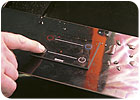
    Touch button with connecting slide bands.
  • “Domesticated” pre-rinse kitchen faucets. Not many truly new versions this time, but many of the previous ones. This category appears to be here to stay.
  • Open channel faucet spouts.


  • Trends

    Floor-mount lavatory faucet.
  • Stainless steel. There were more such faucets evident this time (meaning the real stuff, not faux plating on brass). Most were from Italian suppliers.
  • Joystick, flo-thru and cycling faucet mechanisms. (“Cycling,” sometimes called “progressive,” turns the water on through cold and delivers increasingly warmer water as you continue the rotation.)  In basic form, cycling faucets do not provide volume control, but there were versions of flo-thru designs this time that included a secondary control with that function. In one case, this was a lever coming off a flo-thru rotary control collar, and in another, it was a rotating flo-thru mechanism just above the aerator.
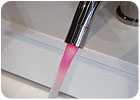
  • Lights. There were more examples of faucets and showerheads that direct light down into the flow, in one case, changing color to indicate water temperature.
  • “Shepherds crook” shower systems. This is a long length of tubing, with a big bend at the top that mounts to the surface of the shower wall. (This clearly appeals more to the European market, where valving and connecting water delivery is typically located outside the wall.)


  • Shelf faucet, baffle drain.
  • Faucet shelves. There were more examples of integrating faucets and tub/shower valves into shelves.
  • Stanchion (floor-mounted) faucets. While we have had floor valves for use with free-standing tubs for years in traditional form, we are now seeing highly styled contemporary designs, as well. What's really new in this category, though, are floor-mounted faucets designed for use with lavatories — especially vessel types.
  • “Galley” showers. This is what I would dub a growing number of enclosures that have just one wall of glass parallel to the room wall — open at both ends — and no doors.
  • Multi-function mirrors. Lots of examples this time of mirrors that have lights and/or TV screens showing through — even some with Ipod ports.
  • “Baffle” drain covers. These are covers that hide drain openings in lavatories and showers. Typically, they take the form of a plate that sits into a recess surrounding the drain. While covering the drain, they still allow free flow of water into it.


  • The Most Electrifying Trend Of All

    Lighted temperature indicator.
    In the early ’90s, we saw what looked like the beginnings of a movement in electronic faucets and shower valves — only to see it fizzle in short order. Given time to reflect on the failure, we generally concluded that many of those earlier generation offerings were just too complicated and expensive. As someone opined, “to get yourself a glass of water, you had to make a computer entry.” 

    With a number of years to reflect and learn from that false start, industry engineers have developed a new generation of much simpler, intuitive versions. (And our exposure to electronic controls on phones, PDAs, MP3 players and the like during the interval probably sets a better stage for acceptance this time around.) 

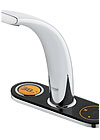
    Though there were some hands-free faucets and shower valves shown at ISH, the trend was more in the direction of touch-button systems. Most common were four-button types — providing one each for the functions of warmer, colder — more flow and less flow. Typically, these are time regulated. For example, the longer you keep your finger on the “warm button,” the warmer the water gets.


    Mirror with TV and light.
    While most provide infinite temperature selection, there were some that moved from one set point to another (10 different temperature selections, for instance). This approach is probably okay for faucets, but I question the suitability for showering, since our bodies have a very fussy way of defining comfort (and as little as five degrees off that mark just won't cut it).

    From the standpoint of technologies employed, most touch-button systems appeared to be capacitive (sensing via the conductivity of a user's fingers) or piezo (sensing minute pressures applied).

    One manufacturer showed an interesting variation on the four-button theme by connecting touch buttons with lines that you run your finger along to the desired temperature or flow settings.


    Touch controls on sprayhead.
    A novel twist from another manufacturer was a faucet with touch buttons located on the pull-out sprayhead.

    One of the most innovative designs in the hands-free category was a faucet with a series of infrared sensors positioned around an acrylic disk near the end of the spout. These sensors control the four basic functions without requiring the user to touch the faucet (providing time-regulated adjustments and infinite temperature selection). In addition to water delivery, this faucet also dispensed soap and disinfectant gel.


    Don Arnold
    Don Arnold has devoted most of his career to plumbing products,with roles ranging from designing, marketing, writing and training. He has been a contributor to Supply House Times for more than 20 years. He is the author of College of Product Knowledge, the product training course introduced by Supply House Times in 1979, which recently was updated and released in a CD format.  Don Arnold can be reached at INTERSOURCE, 646 Williams Ct., Gurnee, IL 60031, 847/918-7015; or e-mail: donarnold@earthlink.net.

    |PrintEmail

    Did you enjoy this article? Click here to subscribe to the magazine.


    BNP Media
    © 2010 BNP Media. All rights reserved. | Privacy Policy