Supply House Times on the Road

Don Arnold has devoted most of his career to plumbing products,with roles ranging from designing, marketing, writing and training. He has been a contributor to Supply House Times for more than 20 years. He is the author of College of Product Knowledge, the product training course introduced by Supply House Times in 1979, which recently was updated and released in a CD format.  Don Arnold can be reached at INTERSOURCE, 646 Williams Ct., Gurnee, IL 60031, 847/918-7015; or e-mail: donarnold@earthlink.net.

Rethinking Brass

June 1, 2010
/ Print / Reprints /
ShareMore
/ Text Size+


Historically, nothing has said "faucets" like the word "brass." Hey, the terms are virtually synonymous, and to consider making faucets and shower valves from a material other than that was unthinkable. Until now, maybe.  

In years past, brass was a perfect material choice for these applications - it was relatively inexpensive - could be produced using a variety of manufacturing processes - machined easily - could be electroplated or coated with a variety of other finishes, and it met the toxicity standards of the day. So what was not to like?  

But let's see now - last time I glanced at the calendar, I think it showed 2010, and it seems that some things have changed - drastically. Starting with the last criterion above, the latest hoop the regulators are having us jump through now is to limit lead content in brass down to a maximum of 0.2%. And that, in turn, tips a couple of other factors - the ones pertaining to cost and machinability. So now, the once perfect material option for making faucets ain't so perfect anymore.  

For the first time that I can remember, faucet manufacturers are beginning to look seriously at alternatives. There are a couple of ways to go at this. One is to continue using brass - even leaded brass - but isolate water from contacting it. An example of this is the use of plastic waterways inside brass housings. The other approach, not yet as far along in application, is to use a material other than brass that will, like brass, provide a faucet structure with integral waterways. 

Elkay Ella Faucet in Stainless Steel
The first, and probably most obvious example of this latter approach is the use of stainless steel. Once avoided because of its cost and more difficult machinability, stainless now betters ecobrass or low-lead brass in cost in many cases*, and machines about the same.  (*Cost here is heavily dependent on the complexity of the part and extent of machining required, however.) The nice thing about the stainless steel alternative is that it requires little convincing of the trade or consumers of its adequacy - if anything, its general perception is probably a cut or two above brass.  

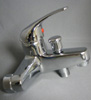
Cast Aluminum Tub-Shower Valve

The newest possible metal option is one long considered impossible for our application -  aluminum. The hang-ups with aluminum in the past have been corrosion and limited finishing options - particularly in regard to electroplating. Recently, I have seen examples of faucets made from an aluminum alloy that appears to have solved these issues. I am told that the alloy can be forged, cast and machined from bar stock.

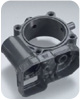
Automotive Throttle Valve Housing

There is also a relatively new (to our industry) non-metallic option on the scene, being used for the first time in plumbing applications. Historically "plastic faucets" have been rather flimsy shell constructions made from thermoplastic resins. What is emerging now is not the thermoplastic shell type, but solid thermosets that give more the perception of being cast, and having a weight not that much lighter than brass. 

This is generically called "bulk molding," traditionally using compression presses, but more recently, certain of the compounds can now also be injection molded, as well. Though for many years eclipsed in use by thermoplastics, thermosets have made a significant comeback based on recent advancements in compound formulation and molding technologies. These thermosets have been widely replacing metals in the automotive and appliance industries. With performance characteristics more like metal than plastic in many respects, there are compounds that can withstand extremely high temperatures and pressures, and are subject to zero creep under load. 

So where do we go from here? There is understandable nervousness by industry engineers about switching to other materials without the comfort of the traditional 100-year track record they are accustomed to with brass. Looking further into this, though, you would have to conclude that there are degrees of risk involved here, depending on the specific component or installation location. At one extreme end of the "fear spectrum" is anything that goes behind the wall, like a shower valve. At the other end of this range, though, would be something like a faucet spout - say the widespread lav or kitchen swing type. These parts are not subject to constant pressure (they're only pressurized when the faucet is on), and if there should be a leak, it would happen over a sink or lavatory where it would be readily spotted for replacement (and it wouldn't cause any damage).  

So what's your take on this - still stuck on brass as "the only way?" You might want to get over that before your competitors do.

Links

You must login or register in order to post a comment.

Multimedia

Videos

Image Galleries

2013 Manufacturers Representative of the Year: Spirit Group


Supply House Times Editor Mike Miazga recently traveled to Orlando to meet with Spirit Group, which has been named the 2013 Manufacturers Representative of the Year. 

Photos by Mike Miazga

3/13/13 2:00 pm EST

Prepared to Navigate the New Lead-Free Laws?

AVAILABLE ON DEMAND Sail through lead-free law compliance. When your contractors pipe a potable water system, some of those bronze valves you supply have an expiration date –January 4, 2014. Find out what US Senate Bill S.3874 is about, how it compares to previous standards, and most importantly — how it will affect your customers. Help your contractors save money and ensure compliance by defining where to install lead-free valves, and where it’s still okay to use standard products.

THE MAGAZINE

Supply House Times

May 2013 Cover

2013 May

Check out the May 2013 issue of Supply House Times today! You can also view our Ad Index here.

Table Of Contents Subscribe

Supply House Times Poll

Sales

As we approach mid-year, how do your sales compare to last year? Sales are:
View Results Poll Archive

The Supply House Times Store

M:\General Shared\__AEC Store Katie Z\AEC Store\Images\Plumbing\new sites\valve-handbook.gif
Valve Handbook

Revised to include details on the latest technologies, Valve Handbook, Third Edition, discusses design, performance, selection, operation, and application. This updated resource features a new chapter on the green technology currently employed by the valve industry, as well as an overview of the major environmental global standards that process plants are expected to meet.

More Products

Clear Seas Research

CS-OflRGBhomepage.jpgWith access to over one million professionals and more than 60 industry-specific publications,Clear Seas Research offers relevant insights from those who know your industry best. Let us customize a market research solution that exceeds your marketing goals.

Premier 125

Premier 125 button

The information SUPPLY HOUSE TIMES uses to rank the Premier 125 is the most accurate we can gather. It is primarily based on responses to a questionnaire we send to the wholesalers in our database, supplemented with information obtained from industry reports and estimates.

STAY CONNECTED

facebook twitter-bird-white-on-blue.gif youtube30px.jpg