Heating Sights From ISH 2011
Miles of aisles contained many technological wonders.

This past March, I was fortunate enough to spend four days in halls 6 through 11 of the International Sanitation and Heating Expo, known to most as simply ISH. This event returns to fairgrounds in Frankfurt, Germany every two years. Most hydronics professionals consider ISH as this planet’s preeminent event for viewing the latest in heating and plumbing technology.
This year’s show drew over 200,000 attendees, making it more than three times larger than the AHR show held each year by ASHRAE. I walked countless miles over the course of those four days, and my focus was only on the heating and cooling aspects of this show.
The European heating market continues a pervasive commitment to low energy use, reduced emissions, and environmental stewardship. This theme was evident at nearly every booth. Here are some of the highlights of what I saw.

The Europeans have a flare for elegant industrial design. It’s common to see devices such as boilers or heat pumps housed in cabinets that give little clue to their internal workings. Figure 3 is a good example. It’s a water-to-water heat pump with an internal buffer tank manufactured by Vaillant.
It’s evident that air-to-water heat pumps are a now major part of the heat pump market in Europe. Some manufacturers were claiming COPs as high at 4.0 with air source heat pumps (I’m sure under ideal conditions).
Most of these combi-systems featured a storage tank, known in Europe as a “thermal accumulator.” The high thermal mass of this tank serves as a moderator between the intermittent heat input from solar collectors, solid fuel boilers, or off-peak electricity, and a highly zoned distribution system.
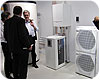
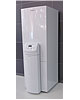 Figure 4 shows a setup by
Schuco. The device on the right is the outdoor unit of an air-to-water heat
pump. It was piped to the central control module seen in the lower middle of
the photo. This module connects to the wall hung boiler and a generously sized
thermal accumulator tank seen at the far left. The central unit manages heat
input from either the heat pump or boiler, heat exchange with the buffer tank,
and zone control. The fit and
finish of these products is superb. It’s easy to visualize them neatly
integrated into the laundry area of a European flat.
Figure 4 shows a setup by
Schuco. The device on the right is the outdoor unit of an air-to-water heat
pump. It was piped to the central control module seen in the lower middle of
the photo. This module connects to the wall hung boiler and a generously sized
thermal accumulator tank seen at the far left. The central unit manages heat
input from either the heat pump or boiler, heat exchange with the buffer tank,
and zone control. The fit and
finish of these products is superb. It’s easy to visualize them neatly
integrated into the laundry area of a European flat.
The capacity of residential heat pumps in Europe is relatively low. Thermal outputs of 6 to 9 KW (about 20,000 to 30,000 Btu/hr) are typical, and appropriate for smaller living units.
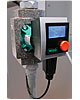 This product will meet a
very stringent European circulator efficiency standard set to go into effect in
two stages (Jan 1, 2013, and August 1, 2015). After the 2013 date, it will be
illegal to sell standard PSC-based wet rotor pumps in Europe.
It appears that what we know as the standard wet rotor circulator with
permanent split capacitor motor is soon to disappear from new European
installations. I asked about this circulator coming to North
America. While I didn’t get a no, the answer suggested it’s not
likely anytime soon.
This product will meet a
very stringent European circulator efficiency standard set to go into effect in
two stages (Jan 1, 2013, and August 1, 2015). After the 2013 date, it will be
illegal to sell standard PSC-based wet rotor pumps in Europe.
It appears that what we know as the standard wet rotor circulator with
permanent split capacitor motor is soon to disappear from new European
installations. I asked about this circulator coming to North
America. While I didn’t get a no, the answer suggested it’s not
likely anytime soon.
 Lowara (a division of ITT)
was also showing its new “Auto” and “Vario” circulators, which will be available
in the U.S.
later this year through Bell & Gossett (see Figure 6). The “Auto”
circulator operates in proportional differential pressure mode. The “Vario”
circulator has a dial for setting its speed over a wide range. Both of these
circulators use high-efficiency ECM motors controlled by microprocessors. Such
circulators could be likened to computers. With a change in firmware, they can
take on “multiple personalities.” This allows the potential for them to
work in a wide variety of specialized applications, such as drainback solar
systems, geothermal heat pump systems, and as variable speed injection pumps.
Watch for this increased versatility from a variety of manufacturers in the
near future.
Lowara (a division of ITT)
was also showing its new “Auto” and “Vario” circulators, which will be available
in the U.S.
later this year through Bell & Gossett (see Figure 6). The “Auto”
circulator operates in proportional differential pressure mode. The “Vario”
circulator has a dial for setting its speed over a wide range. Both of these
circulators use high-efficiency ECM motors controlled by microprocessors. Such
circulators could be likened to computers. With a change in firmware, they can
take on “multiple personalities.” This allows the potential for them to
work in a wide variety of specialized applications, such as drainback solar
systems, geothermal heat pump systems, and as variable speed injection pumps.
Watch for this increased versatility from a variety of manufacturers in the
near future.
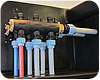
Manifold pits are water-tight enclosures, typically made of polyethylene, designed to be buried with their access cover flush with finish grade. They have several stubs of HDPE tubing welded through their sidewalls. Installers simply heat fuse HDPE earth loop circuits to these stub outs. Internally, they contain a large diameter manifold with individual flow setting and isolation valves for each circuit. The access cover is fully gasketed to make the unit water tight.
Uponor was showing large diameter (nominal 4-inch) composite PEX-AL-PEX tubing joined using stainless steel press fittings (see Figure 9).
One of my more interesting finds was the German company Multitubo Systems. They introduced a heat fusible PE-RT (polyethylene, raised temperature) composite tube and fitting system. The composite (PERT-AL-PERT) piping is rated for 10 bars (147 psi) pressure, and 95 ºC (203 ºF) temperature. PE-RT is not a crosslinked polymer. Unlike PEX, it can be remelted and reshaped. This allows the tubing and fittings to be joined by socket fusion (see Figure 10).
The inside of the fitting and outer surface of the tube are heated using a simple electrically powered tool, pulled apart, and immediately pressed straight together for a permanent bond. I was able to try this myself, and can vouch that it’s pretty easy. I see this offering as a simple and low cost way to permanently bond together pieces of tubing for longer circuits without reliance on mechanical couplings. Word is that it’s likely to find its way to North America soon.

From what I could gather there are new regulations in Italy, and perhaps other parts of Europe, that require setback capability on radiator valves. While I’m sure these products work, I still cringe when thinking about changing batteries at each radiator.

Viessmann was also into cow power. In a portion of what had to be the largest “booth” at ISH, they were displaying a very large compost turning device (Figure 15). It’s used to rotate feed stock (manure, plant matter, etc.) to generate bio gas. The bio gas is used to operate a pre-engineered combined heat and power unit that produces enough electricity and heat to sustain a small village. They showed a schematic of the whole process from cow to thermostat.
Don’t know if you can buy the whole thing as a kit - maybe. Not sure if it will include the cows.
 I’ve had the opportunity to
visit several ISH shows, as well as other European heating and plumbing trade
shows over the last few years. Ultimately, I’ve concluded that these events
show different products aimed at markets very different from those in North America. All the technology on display could be
produced and sold in the U.S.,
if and when energy prices (think $9 per gallon for unleaded gas), and cultural
mind-sets (think environmentalism as a quasi religion) occur over here. We’re
obviously not there yet, nor am I suggesting that we should be.
I’ve had the opportunity to
visit several ISH shows, as well as other European heating and plumbing trade
shows over the last few years. Ultimately, I’ve concluded that these events
show different products aimed at markets very different from those in North America. All the technology on display could be
produced and sold in the U.S.,
if and when energy prices (think $9 per gallon for unleaded gas), and cultural
mind-sets (think environmentalism as a quasi religion) occur over here. We’re
obviously not there yet, nor am I suggesting that we should be.
 The North American
hydronics industry can always learn from what’s on display at ISH. Over those
four days I saw quite a few of my American colleagues doing just that. Some of
what they saw will inevitably work its way into future North American product
offerings. The ultimate goal remains the same: Deliver unsurpassed comfort
using the fewest resources possible.
The North American
hydronics industry can always learn from what’s on display at ISH. Over those
four days I saw quite a few of my American colleagues doing just that. Some of
what they saw will inevitably work its way into future North American product
offerings. The ultimate goal remains the same: Deliver unsurpassed comfort
using the fewest resources possible.
Figure 1. A portion of the
Caleffi booth at ISH. Photos by John Siegenthaler
This past March, I was fortunate enough to spend four days in halls 6 through 11 of the International Sanitation and Heating Expo, known to most as simply ISH. This event returns to fairgrounds in Frankfurt, Germany every two years. Most hydronics professionals consider ISH as this planet’s preeminent event for viewing the latest in heating and plumbing technology.
This year’s show drew over 200,000 attendees, making it more than three times larger than the AHR show held each year by ASHRAE. I walked countless miles over the course of those four days, and my focus was only on the heating and cooling aspects of this show.
The European heating market continues a pervasive commitment to low energy use, reduced emissions, and environmental stewardship. This theme was evident at nearly every booth. Here are some of the highlights of what I saw.
Figure 2. Caleffi
demo of PIBVs versus manual balancing valves.
Combi-systems abound
Besides their usual offering of wall-hung condensing boilers, the “Big 3” heat source providers Viessmann, Buderus and Vaillant were all showing well thought-out combinations of heat pumps with other heat sources such as pellet-fired boilers, solar thermal subsystems, and even micro-combined heat and power units (MCHP).The Europeans have a flare for elegant industrial design. It’s common to see devices such as boilers or heat pumps housed in cabinets that give little clue to their internal workings. Figure 3 is a good example. It’s a water-to-water heat pump with an internal buffer tank manufactured by Vaillant.
It’s evident that air-to-water heat pumps are a now major part of the heat pump market in Europe. Some manufacturers were claiming COPs as high at 4.0 with air source heat pumps (I’m sure under ideal conditions).
Most of these combi-systems featured a storage tank, known in Europe as a “thermal accumulator.” The high thermal mass of this tank serves as a moderator between the intermittent heat input from solar collectors, solid fuel boilers, or off-peak electricity, and a highly zoned distribution system.
Figure 3. A
residential water-to-water heat pump from Vaillant.
The capacity of residential heat pumps in Europe is relatively low. Thermal outputs of 6 to 9 KW (about 20,000 to 30,000 Btu/hr) are typical, and appropriate for smaller living units.
Figure 4: Air-to-water
heat pump/wall hung boiler combi-system by Schuco.
Major changes ahead
Wilo was showing its Stratos PICO circulators (Figure 5). This is their flagship high efficiency circulator for single- and two-family housing in Europe over the next few years. The smaller PICO model tops out at 20 watts power draw at full speed, and can operate as low as 3 watts electrical input at minimum speed. To put this in perspective, the full speed power requirement of this circulator is less than 10 percent of the power drawn by circulators that simply push water through the heat exchangers of some North American mod/con boilers.Figure 5: Wilo Stratos
PICO circulator.
Figure 6: New Bell &
Gossett ECM circulator coming to US market this year.
Figure 7: Display of
an earth loop manifold shown by Roth.
Well Grounded
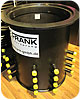
Several manufacturers displayed geothermal manifolds (Figure 7), and manifold “pits” (Figure 8). Geothermal manifolds are made of engineered polymers that easily handle the pressure and temperature requirements of earth loop circuits. The manifolds are designed for significantly higher flow rates compared to manifolds for radiant panel heating systems.Manifold pits are water-tight enclosures, typically made of polyethylene, designed to be buried with their access cover flush with finish grade. They have several stubs of HDPE tubing welded through their sidewalls. Installers simply heat fuse HDPE earth loop circuits to these stub outs. Internally, they contain a large diameter manifold with individual flow setting and isolation valves for each circuit. The access cover is fully gasketed to make the unit water tight.
Figure 8: An earth
loop manifold pit shown by the German company Frank GmbH.
Tubing For Every Need
Hall 6 at ISH has two floor levels dedicated to displays of piping. Although it is still possible to find copper tubing on display, it’s obvious that polymer tubing (PEX, PEX-AL-PEX, PP-R, and PE-RT) is now the dominant material for hydronic distribution systems as well as domestic water.Uponor was showing large diameter (nominal 4-inch) composite PEX-AL-PEX tubing joined using stainless steel press fittings (see Figure 9).
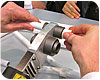
One of my more interesting finds was the German company Multitubo Systems. They introduced a heat fusible PE-RT (polyethylene, raised temperature) composite tube and fitting system. The composite (PERT-AL-PERT) piping is rated for 10 bars (147 psi) pressure, and 95 ºC (203 ºF) temperature. PE-RT is not a crosslinked polymer. Unlike PEX, it can be remelted and reshaped. This allows the tubing and fittings to be joined by socket fusion (see Figure 10).
The inside of the fitting and outer surface of the tube are heated using a simple electrically powered tool, pulled apart, and immediately pressed straight together for a permanent bond. I was able to try this myself, and can vouch that it’s pretty easy. I see this offering as a simple and low cost way to permanently bond together pieces of tubing for longer circuits without reliance on mechanical couplings. Word is that it’s likely to find its way to North America soon.
Figure 9:
Large diameter (nominal 4-inch) composite tubing shown by Uponor.
Pre-piped
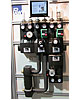
Many companies, such as PAW (Pommerening Armaturenwerk), were showing various mixing and zoning modules. These assemblies typically combine a hydraulic separator with a manifold. The latter can accept several pre-assembled modules having individually controlled mixing valves and a circulator. Such products have been available for several years. The difference is that some now sport the latest high efficiency circulators (see Figure 11).Figure 10: Socket fusion
of PE-RT composite tubing and fittings being shown by Multitubo Systems.
A Twist On TRVs
Danfoss, Honeywell and IVAR were among companies showing wireless / remotely controlled radiator valves (see Figure 12). Viessmann even had a boiler that could wirelessly communicate with battery-powered valve actuators. Each radiator valve actuator receives a signal from a central wall-mounted display unit.From what I could gather there are new regulations in Italy, and perhaps other parts of Europe, that require setback capability on radiator valves. While I’m sure these products work, I still cringe when thinking about changing batteries at each radiator.
Figure
11: Pre-piped mixing modules and header shown by PAW GmbH.
Radiators
I could fill every page in this magazine with photos of the designer radiators shown at ISH, and still not cover them all. While there were certainly new artistic impressions, (see Figure 13), I didn’t see anything radically new with perhaps one exception: Kermi showed a dual water plate radiator in which all flow passes through the front panel first, and then through the rear panel. This panel offers about the same heat output as other dual water plate radiators, but reduces heat loss to the exterior wall due to lower rear surface temperatures.
Figure
12: Wireless central controller operating several battery-powered thermostatic
valves. Product by Italian company IVAR.
Cow Power
I’m not sure what booth space costs at ISH, but apparently one company felt compelled to buy several square meters worth to promote the idea of biogas from farms animals (Figure 14).Viessmann was also into cow power. In a portion of what had to be the largest “booth” at ISH, they were displaying a very large compost turning device (Figure 15). It’s used to rotate feed stock (manure, plant matter, etc.) to generate bio gas. The bio gas is used to operate a pre-engineered combined heat and power unit that produces enough electricity and heat to sustain a small village. They showed a schematic of the whole process from cow to thermostat.
Don’t know if you can buy the whole thing as a kit - maybe. Not sure if it will include the cows.
Figure 13: One of
hundreds of designer towel warmers shown at ISH.
A Unique Experience
If you’re into hydronics or plumbing and have never been to an ISH show, I highly recommend you make the trek. The next one will be in 2013. If you have attended this show, you can surely relate to some of the novel hardware shown here.Gas from cows - what a novel idea! The next step is to lace some PEX
tubing through that molded bovine and offer it as a designer radiator.
Figure 15:
Viessmann pre-engineered compost turning device to produce biogas.
Links
Looking for a reprint of this article?
From high-res PDFs to custom plaques, order your copy today!