PVF Market - Ugly But Not Despairing
If only sales and profits were as resilient as people’s spirit!

Let’s get the worst part of this story over with. What I heard from a couple of dozen PVF manufacturers, master distributors and wholesalers that I interviewed was an unrelenting tale of woe from a business standpoint. The best performers reported sales down “only” in the 10-15% range this year, though that stretched out to 40% declines among those with the gumption to admit to it. U.S. pipe mills mostly have been operating at less than 50% of capacity - seamless pipe at below 10%, according to one estimate. Distributors have slashed inventories to the bone and sent pricing pressures to deep sea levels in desperate attempts to buy some business and unload material. Layoffs, salary cuts and reduced hours have replaced the weather as the most common topic of discussion among PVF work forces.
Chicago’s Porter Pipe & Supply has earned a reputation as one of the industry’s most employee-friendly companies. I spoke with President Jim Porter asking how they are weathering the storm.
“When we had our January meeting of all employees, I told everyone my goal was not to lay anyone off, and I’m happy to say we still have all 106 employees working,” said Porter when we spoke in early June. “But I’m looking at it month to month, and we are considering going to a 35-hour work week. We’ve already cut all overtime, which is hurting because it’s something our people have grown used to. Yet it’s getting harder and harder to find stuff for them to do. They’ve repainted all the trucks and warehouse walls.
 “A good idea we got from ASA was offering an additional week of vacation
for a 2% salary cut. We had 24 people take advantage of it,” noted Porter.
“A good idea we got from ASA was offering an additional week of vacation
for a 2% salary cut. We had 24 people take advantage of it,” noted Porter.
“Numbed” was the word used by Merit Brass Executive VP Alan Lipp to describe the industry’s mood. “We cruised through more than half the year of 2008 in a metals super-cycle and everyone in the channel benefited. Then, bam, we got smacked in the face by the financial crisis and for a period of time everyone was shocked by the velocity of it all. It was like jumping from boiling water to ice water.
“But now we’re numb to all the job losses, sales declines, pay cuts and so on. Hopefully our economy is resilient enough to withstand this haymaker, but we may be in the 4th or 5th inning of this thing rather than the 9th,” said Lipp.
The oil country segment of the PVF industry has been whipsawed as well as the industrial sector. Last summer’s $150-a-barrel oil and jacked-up commodity prices drove the OCTG sector to heights envisioned only in the wildest dreams of oilfield distributors. Smith International, parent of U.S. oilfield giant Wilson and Canadian counterpart CE Franklin, reported record revenues of $794.2 million in the fourth quarter for its distribution segment last year - a whopping 51% improvement over the prior year.
Then in the first quarter of this year, Smith’s distribution revenues dropped 28% from the prior quarter to about the level where sales stood when the dramatic oil price run-up was getting underway about a year before. By March 2009 the number of oil and gas drilling rigs operating in the United States had dropped to less than half of the previous peak of 2,200. OCTG prices were in freefall with month-to-month declines approaching double digits. (I’m writing this in late June, with oil prices bouncing around the $70 range. No telling what that situation might be by the time you read this.)
Canada’s PVF experience is pretty similar to that of the U.S. Data collected by the Canadian Institute of Plumbing & Heating showed PVF sales down 20.1% through the first five months of 2009, with May’s sales plummeting 38% compared with May 2008.
Based on my conversations with PVF people, there are a few things to take heart from. One is that despite the worst economic devastation of a lifetime, most manufacturers and distributors have survived what would seem to be knockout blows. The folks I interviewed were hard pressed to think of more than one or two small PVF distributors that have gone belly up during the crisis.
And this reflects another piece of good news for most companies in the industry. “This industry is still about independent wholesalers,” commented Anvil Chairman John Martin. “They all seem to have some niche that helps them get by, something that gets them that last look at a job.”
“It tells me that independent wholesalers were fairly strongly financed,” echoed Legend Valve’s Vice President of Business Development Robert Vick. “We all know that many businesses got sold when times were good, and it may be that some of those companies might have been the ones going under in these market conditions. Those who chose not to sell seem to have a good handle on their business.
“I don’t see panic in the streets,” Vick added. “There have been some layoffs, of course, but I haven’t seen key people let go anywhere. Wholesalers have cut back dramatically on inventory levels, which is not so bad because in most cases their inventory was bloated anyway.”
Gary Jackson, vice president of the PVF Division of the Affiliated Distributors (A-D) buying group, also cited the strength of independents. “We’re more nimble and have been able to take some business from the national chains. In my conversations with members, they all have taken proactive measures with workforce reductions and other cost controls.”
“Independents will continue to maintain inventory while larger companies can’t,” said Kip Miller, president of Eastern Industrial Supplies Inc. (EISI), a regional PVF distributor based in Greenville, SC, with a dozen locations in the Southeast. “The market may not be as busy as it normally is, but we’re able to reach out a little further and pick up business because we have the material.”
Almost to a man, the people I spoke with lamented the fact that what diminished business is still out there faces unrelenting pricing pressure. “End users want double-digit cost savings on fewer units, which causes higher costs to manufacturers,” commented Bonney Forge’s Executive VP of Sales & Marketing Rick Leone.
“Our quotation activity is very high but the convert-to-order ratios are low as customers shop for nearly every order and project commitments and releases are delayed,” noted Warren Alloy President Leonard Fruci.
“We landed a nice contract today from our oilfield division, but I’m not going to brag about the profit margin,” said Cullen King, president/CEO of The Industrial Group. “At least it’s moving some inventory, but I’m not seeing much happening on the industrial side. Everyone is suffering because of the lack of available money to do private projects. Most of the stuff we’re seeing comes from municipal money.”
“The biggest issue we face is maintaining profitability as sales dollars decline and competitive pressures increase,” said EISI’s Kip Miller. “This process includes focusing on our pricing model while containing operating costs. Material costs are declining at a more rapid pace compared with our other costs, creating pricing and margin stress.”
“I do think we have either reached or are close to reaching bottom,” said Cullen King. “We think 2009 is a survival year. If we make any money at all we’ll consider it a success, but think that 2010 will start to turn around and may see dramatic improvement by the end of 2010. So I’m bullish for the long term, but circling the wagons for the next two to four quarters.”
“I am not expecting any measurable improvement in economic activity for the balance of 2009, but I do expect some pickup in order size when our distributor customers drain their inventories and once again rely on our company for support,” noted Warren Alloy’s Fruci.
“I don’t see any immediate turnaround,” commented Robert Vick. “As long as there’s high unemployment it will affect construction, and the biggest impact is great uncertainty over credit markets.
“On the bright side, we might see some business generated by the American Recovery & Reinvestment Act. Institutional buildings are going green, and green buildings tend to get leased quicker and for more money. As this continues owners will start renovating buildings if only to attract tenants,” said Vick.
Phoenix Forge President Larry Dildine observed that “our history with PVF products has been that we lag the economy on the downturn and lag on the upturn. As soon as we see things getting stronger in the residential and commercial markets, we can expect a pickup in sales. As for the energy sector, we are not counting on a repeat of the past four years.”
 “I suspect we’ve all learned our lessons about speculative froth, not
only in metals and commodities but especially in the financial business,”
commented Merit Brass’s Alan Lipp. “There have got to be adequate foundations
beneath all the skyscrapers we’re trying to build.”
“I suspect we’ve all learned our lessons about speculative froth, not
only in metals and commodities but especially in the financial business,”
commented Merit Brass’s Alan Lipp. “There have got to be adequate foundations
beneath all the skyscrapers we’re trying to build.”
Said Vick: “One of my biggest concerns is that when business turns around, it tends to turn around quickly. When all the jobs being held back because of financing or whatever break loose, they may all break loose at once. With both wholesalers and manufacturers cutting back, there’s a chance there may not be enough material available in the pipeline. I’ve seen this happen before during my career, and the result is long lead times.”
Several people I spoke with hit upon a common theme of staying close to customers despite their lagging fortunes. “Our people are buying the cheapest airplane tickets, staying in budget hotels and dining on pizza and beer rather than steak and wine, but we feel it’s important to stay in front of our customers,” said Anvil’s Martin.
Porter Pipe & Supply is noted for lavish promotions and giveaways to customers. I asked Jim Porter if they were pulling back on those in light of the sour economy.
“No, we’re trying to keep all of that going,” he replied. “Our outside salesmen are still out there plugging away. Now is a good time to forge new relationships and shore up old ones, because a lot of other people are cutting back on that.”
Several other interviewees expressed similar sentiments.
“We must not allow the world’s chaotic economy to cause us to run for the foxhole and stay there,” advised EISI’s Kip Miller. “If we stay in the foxhole too long, the sky may begin to clear well before we begin to plan for the future. Vision always comes before resources, so dream big.”
“This is still the United States of America,” declared John Martin. “As my idol, John Wayne, once said and I quote: Courage is when you are scared as hell, but ya’ saddle up anyway! We must saddle up and move forward with positive thoughts and care for our industry and our future. Together, and with a lot of continued hard work and sweat, we can beat this thing!”
Let’s get the worst part of this story over with. What I heard from a couple of dozen PVF manufacturers, master distributors and wholesalers that I interviewed was an unrelenting tale of woe from a business standpoint. The best performers reported sales down “only” in the 10-15% range this year, though that stretched out to 40% declines among those with the gumption to admit to it. U.S. pipe mills mostly have been operating at less than 50% of capacity - seamless pipe at below 10%, according to one estimate. Distributors have slashed inventories to the bone and sent pricing pressures to deep sea levels in desperate attempts to buy some business and unload material. Layoffs, salary cuts and reduced hours have replaced the weather as the most common topic of discussion among PVF work forces.
Chicago’s Porter Pipe & Supply has earned a reputation as one of the industry’s most employee-friendly companies. I spoke with President Jim Porter asking how they are weathering the storm.
“When we had our January meeting of all employees, I told everyone my goal was not to lay anyone off, and I’m happy to say we still have all 106 employees working,” said Porter when we spoke in early June. “But I’m looking at it month to month, and we are considering going to a 35-hour work week. We’ve already cut all overtime, which is hurting because it’s something our people have grown used to. Yet it’s getting harder and harder to find stuff for them to do. They’ve repainted all the trucks and warehouse walls.
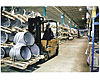
Large stainless fittings get transported inside the warehouse of Buffalo,
NY-based distributor Robert-James Sales.
“Numbed” was the word used by Merit Brass Executive VP Alan Lipp to describe the industry’s mood. “We cruised through more than half the year of 2008 in a metals super-cycle and everyone in the channel benefited. Then, bam, we got smacked in the face by the financial crisis and for a period of time everyone was shocked by the velocity of it all. It was like jumping from boiling water to ice water.
“But now we’re numb to all the job losses, sales declines, pay cuts and so on. Hopefully our economy is resilient enough to withstand this haymaker, but we may be in the 4th or 5th inning of this thing rather than the 9th,” said Lipp.
The oil country segment of the PVF industry has been whipsawed as well as the industrial sector. Last summer’s $150-a-barrel oil and jacked-up commodity prices drove the OCTG sector to heights envisioned only in the wildest dreams of oilfield distributors. Smith International, parent of U.S. oilfield giant Wilson and Canadian counterpart CE Franklin, reported record revenues of $794.2 million in the fourth quarter for its distribution segment last year - a whopping 51% improvement over the prior year.
Then in the first quarter of this year, Smith’s distribution revenues dropped 28% from the prior quarter to about the level where sales stood when the dramatic oil price run-up was getting underway about a year before. By March 2009 the number of oil and gas drilling rigs operating in the United States had dropped to less than half of the previous peak of 2,200. OCTG prices were in freefall with month-to-month declines approaching double digits. (I’m writing this in late June, with oil prices bouncing around the $70 range. No telling what that situation might be by the time you read this.)
Canada’s PVF experience is pretty similar to that of the U.S. Data collected by the Canadian Institute of Plumbing & Heating showed PVF sales down 20.1% through the first five months of 2009, with May’s sales plummeting 38% compared with May 2008.
Now for the good news … sort of
So, is there any good news to report?Based on my conversations with PVF people, there are a few things to take heart from. One is that despite the worst economic devastation of a lifetime, most manufacturers and distributors have survived what would seem to be knockout blows. The folks I interviewed were hard pressed to think of more than one or two small PVF distributors that have gone belly up during the crisis.
And this reflects another piece of good news for most companies in the industry. “This industry is still about independent wholesalers,” commented Anvil Chairman John Martin. “They all seem to have some niche that helps them get by, something that gets them that last look at a job.”
“It tells me that independent wholesalers were fairly strongly financed,” echoed Legend Valve’s Vice President of Business Development Robert Vick. “We all know that many businesses got sold when times were good, and it may be that some of those companies might have been the ones going under in these market conditions. Those who chose not to sell seem to have a good handle on their business.
“I don’t see panic in the streets,” Vick added. “There have been some layoffs, of course, but I haven’t seen key people let go anywhere. Wholesalers have cut back dramatically on inventory levels, which is not so bad because in most cases their inventory was bloated anyway.”
Gary Jackson, vice president of the PVF Division of the Affiliated Distributors (A-D) buying group, also cited the strength of independents. “We’re more nimble and have been able to take some business from the national chains. In my conversations with members, they all have taken proactive measures with workforce reductions and other cost controls.”
“Independents will continue to maintain inventory while larger companies can’t,” said Kip Miller, president of Eastern Industrial Supplies Inc. (EISI), a regional PVF distributor based in Greenville, SC, with a dozen locations in the Southeast. “The market may not be as busy as it normally is, but we’re able to reach out a little further and pick up business because we have the material.”
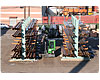
Activity in the pipe yard of American
Industrial Supply, Perth Amboy, NJ.
Pricing pressures
There is still some business out there, of course. North American factories haven’t shut down entirely and while MRO orders are reduced, that business is not nearly as volatile as mechanical construction work or the oilfield market. Anvil’s Martin told me he’s noticed “some stock replenishment orders, though smaller than normal, are starting to flow again. Projects for schools, hospitals, government bio plants, power work and geothermal plants seem to be the activity bed right now.”Almost to a man, the people I spoke with lamented the fact that what diminished business is still out there faces unrelenting pricing pressure. “End users want double-digit cost savings on fewer units, which causes higher costs to manufacturers,” commented Bonney Forge’s Executive VP of Sales & Marketing Rick Leone.
“Our quotation activity is very high but the convert-to-order ratios are low as customers shop for nearly every order and project commitments and releases are delayed,” noted Warren Alloy President Leonard Fruci.
“We landed a nice contract today from our oilfield division, but I’m not going to brag about the profit margin,” said Cullen King, president/CEO of The Industrial Group. “At least it’s moving some inventory, but I’m not seeing much happening on the industrial side. Everyone is suffering because of the lack of available money to do private projects. Most of the stuff we’re seeing comes from municipal money.”
“The biggest issue we face is maintaining profitability as sales dollars decline and competitive pressures increase,” said EISI’s Kip Miller. “This process includes focusing on our pricing model while containing operating costs. Material costs are declining at a more rapid pace compared with our other costs, creating pricing and margin stress.”
End of the tunnel?
Nobody I spoke with foresaw an imminent recovery but everyone seemed to think the worst at least is over.“I do think we have either reached or are close to reaching bottom,” said Cullen King. “We think 2009 is a survival year. If we make any money at all we’ll consider it a success, but think that 2010 will start to turn around and may see dramatic improvement by the end of 2010. So I’m bullish for the long term, but circling the wagons for the next two to four quarters.”
“I am not expecting any measurable improvement in economic activity for the balance of 2009, but I do expect some pickup in order size when our distributor customers drain their inventories and once again rely on our company for support,” noted Warren Alloy’s Fruci.
“I don’t see any immediate turnaround,” commented Robert Vick. “As long as there’s high unemployment it will affect construction, and the biggest impact is great uncertainty over credit markets.
“On the bright side, we might see some business generated by the American Recovery & Reinvestment Act. Institutional buildings are going green, and green buildings tend to get leased quicker and for more money. As this continues owners will start renovating buildings if only to attract tenants,” said Vick.
Phoenix Forge President Larry Dildine observed that “our history with PVF products has been that we lag the economy on the downturn and lag on the upturn. As soon as we see things getting stronger in the residential and commercial markets, we can expect a pickup in sales. As for the energy sector, we are not counting on a repeat of the past four years.”
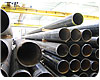
Large inventory of stainless flanges in the warehouse of Robert-James
Sales, in the summer of 2008.
Said Vick: “One of my biggest concerns is that when business turns around, it tends to turn around quickly. When all the jobs being held back because of financing or whatever break loose, they may all break loose at once. With both wholesalers and manufacturers cutting back, there’s a chance there may not be enough material available in the pipeline. I’ve seen this happen before during my career, and the result is long lead times.”
Several people I spoke with hit upon a common theme of staying close to customers despite their lagging fortunes. “Our people are buying the cheapest airplane tickets, staying in budget hotels and dining on pizza and beer rather than steak and wine, but we feel it’s important to stay in front of our customers,” said Anvil’s Martin.
Porter Pipe & Supply is noted for lavish promotions and giveaways to customers. I asked Jim Porter if they were pulling back on those in light of the sour economy.
“No, we’re trying to keep all of that going,” he replied. “Our outside salesmen are still out there plugging away. Now is a good time to forge new relationships and shore up old ones, because a lot of other people are cutting back on that.”
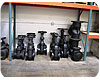
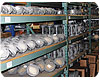
Valves in stock at the F.W. Webb Central Distribution Center, circa
2006.
Time to saddle up
A-D’s Gary Jackson took note of a positive spirit emanating from his members at their annual meeting in April. “Prior to the meeting we were concerned about the tone in view of economic conditions, but we were fascinated to learn that when people got together they seemed to come out of it with a stronger sense of camaraderie. They know they are not the only ones facing this and this enables them to battle back. We were pleasantly surprised our guys left with that much of a positive attitude.”Several other interviewees expressed similar sentiments.
“We must not allow the world’s chaotic economy to cause us to run for the foxhole and stay there,” advised EISI’s Kip Miller. “If we stay in the foxhole too long, the sky may begin to clear well before we begin to plan for the future. Vision always comes before resources, so dream big.”
“This is still the United States of America,” declared John Martin. “As my idol, John Wayne, once said and I quote: Courage is when you are scared as hell, but ya’ saddle up anyway! We must saddle up and move forward with positive thoughts and care for our industry and our future. Together, and with a lot of continued hard work and sweat, we can beat this thing!”
Looking for a reprint of this article?
From high-res PDFs to custom plaques, order your copy today!