GSS+FFF= 1-Stop PVF
Beyond metal and money, theirs is a story of corporate culture.

Houston-based Global Stainless Supply (GSS) has a mighty business advantage. That’s the economic clout of Japan’s Sumitomo Corp., a $150 billion global business conglomerate weighted toward trading and distribution. Its U.S. subsidiary, Sumitomo Corp. of America (SCOA), is itself a $6.6 billion business and the majority owner of GSS.
Access to large infusions of capital has given GSS the wherewithal to make a series of acquisitions and investments that has propelled the company from its relatively recent formation in 2002 to a $150 million PVF master distributor today. The most noteworthy of its acquisitions was the 2006 hook-up with Forgings, Flanges and Fittings (FFF), which now operates as a GSS subsidiary under the leadership of founders Danny and Stan Lee. FFF’s carbon steel specialization complements the stainless offerings of GSS, and led to a branding initiative aptly described by the company’s Web URL, www.onestoppvf.com.
GSS/FFF, as we’ll call the company from now on, is headed by visionary President/CEO Bill Bootz, who has an ownership position and whose powers of persuasion tap into Sumitomo’s wealth. Here’s how he described his thinking behind the FFF acquisition:
“A lot of people in the stainless PVF business want nothing to do with carbon steel, which is low price and intensely competitive. Many more companies sell carbon than stainless, but instead of a turn-off that’s what attracted me.
“It’s a matter of transactional proximity. The broader your product offering, the more frequently customers think of you as an option. If a supply house sells carbon 100 times a week and stainless twice a month and we come in saying we sell stainless, the reaction is likely to be, ‘so what.’ But if we say we have carbon, it will get attention, and then we have an opening to sell stainless and specialty grades, too. So having carbon steel is a way to increase brand awareness,” Bootz explained.
The brand he speaks of is the one-stop PVF concept. The business model envisioned by Bootz and his team is of a master distributor selling a wide array of product and value-added services to PVF distributors - “ONLY to distributors,” he emphasized - at competitive rates based not so much on sticker prices but on reduced transaction costs.
“We can offer one bill of lading for carbon, stainless and numerous specialty grades so our customers can buy truckloads rather than LTL. Buying one-stop leads to big freight savings, on the order of 1% of the transaction cost versus 5-10%,” Bootz explained. “Plus, our mission is a 30-minute load, with a second site to handle multiple trucks. We also have a machine shop with numerous capabilities to accommodate special orders, as well as 24-hour callouts for emergency orders. We constantly look for ways to lower our transaction costs in order to be competitive.”
Inventory management is a task that largely pivots around Bootz, especially for the stainless portion of the business where he’s earned his spurs for 21 years. “I don’t look much at sales histories, but at theoretical potential - how many we need to have on hand to be sure of not running out, and how many we can expect to sell in a year,” the CEO said. In his college days Bootz used to chart stocks, and he draws from similar trend analysis in PVF forecasting.
Houston headquarters has 210,000 sq. ft. under roof and a 14-acre outside storage area. GSS/FFF also operates sizable warehouses in Indianapolis, Los Angeles and Richmond. “For big projects requiring material that doesn’t have to ship today, we can bring stuff in from other locations. That factors into our inventory considerations,” Bootz said.
GSS/FFF focuses not only on inventory depth, but considerable breadth as well - between 60,000-75,000 line items at last estimate. On the stainless side they stock not only commodity grades like 304L and 316L but also special alloys like Alloy 20, Alloy 400, Alloy 625, Hastelloy C-276, 310, 347H, 304H, 317L, 321H, 800H/HT, 825, Aluminum, and Duplex. After purchasing FFF, GSS boosted its subsidiary’s carbon steel offerings by more than 2,000 line items, going up in size from 24-inch to 60-inch with many lines. Bootz recalls placing a $16 million buy to shore up FFF during the market downturn in 2009. Marketing manager Nathan Green noted that “FFF has more material coming in on the water than the company had in inventory pre-acquisition!”
GSS/FFF obtains its vast array of PVF materials from suppliers spanning some 20 nations around the globe. About 65% of its materials are imports, though relatively little comes from China compared with other Pacific Rim countries like South Korea, Vietnam, Malaysia and Taiwan, along with various European suppliers.
“Most people take an adversarial approach to purchasing,” said Bootz. “The old adage in distribution is you make your money on the buy side. That’s a great way to drive your suppliers out of business. We focus less on price than channelization. We like to partner with our suppliers and pay them enough so they don’t have to constantly chase multiple accounts. I figure that if we buy 1,000 tons of seamless pipe, we’re likely to get a better price than someone else buying 20 tons.”
Quality assurance is a key component of GSS/FFF’s business strategy. (See “The Nitty-Gritty Details of Quality Assurance” below.) “Our aim is to prevent mistakes rather than deal with them,” said Bootz. “Twenty years ago you had engineers in every factory; now it’s all about price lists, multipliers and the Internet. The industry took intellectual capacity away and made everyone price sellers. But applications are getting more complicated, not less. The BP experience taught us that we need to start selling risk management instead of price, and that’s where we look to add value.”

Bootz is a college dropout whose industry career began in 1989 when his father, who worked for a small metals trader, pulled some strings to land his unemployed son a $1,500 a month job selling stainless PVF. “I said, heck, why not. Then I asked, ‘What’s stainless?’” Shortly after taking the new job he read a book on metallurgy and took it upon himself to make 10 cold calls a day trying to drum up customers and learn more about what he was selling and how it meshed with their needs.
He parlayed that drive into a series of jobs with major PVF distributors/master distributors, including Van Leeuwen, KG Specialty Steel and Ta Chen. Along the way he was involved with three different startups: Stainless Piping Products in 1991, and Team Alloys in 1996, which was purchased the next year by Ta Chen, where he worked until 2001. That’s when he started talking to Sumitomo, which led to the formation of GSS the following year. Initially appointed its president, Bootz’s latest contract rewarded him with the added title of CEO.
I asked Bootz why he dropped out of college. “I was lazy,” he responded. “I was a National Merit Scholar and everything came easy, but I never developed good work habits.”
That exchange reveals a curious blend of hubris and humility that marks his charismatic personality. Bootz obviously is very smart and doesn’t try to disguise that, yet he delegates authority like a landscaper sprinkling grass seeds. “All the people who do the jobs I used to do are better at it than I was,” he told me. “They are specialists rather than generalists.”
When I asked Executive Vice President Ken Albano what persuaded him to come to work for GSS/FFF three years ago, he offered this observation: “I had lunch with Bill and he shared with me his vision for the company, and what the obstacles were. Then he looked at me and said, ‘Maybe I’m the problem.’ Not many bosses would say that.”
The self-effacing CEO runs a remarkably egalitarian organization in which perks and privileges are spread around. Bootz’s name and phone number heads the call list if a customer needs after-hours access to the warehouse. “I never ask anyone to do something I’m not willing to do myself.”
 Most revealing is the CEO’s work station
- a cubicle sited in the middle of the headquarters office, surrounded by
dozens of partitions belonging to people at all rungs of the corporate
hierarchy. (Bootz does have a modest personal office where he receives visitors
requiring a measure of privacy, but spends hardly any time there. I interviewed
him in that private office, whose door was left open throughout and various
associates ventured in at will. The office also functions as a child care
facility (see “Family-Friendly Policies Pay Off” on page
28).
Most revealing is the CEO’s work station
- a cubicle sited in the middle of the headquarters office, surrounded by
dozens of partitions belonging to people at all rungs of the corporate
hierarchy. (Bootz does have a modest personal office where he receives visitors
requiring a measure of privacy, but spends hardly any time there. I interviewed
him in that private office, whose door was left open throughout and various
associates ventured in at will. The office also functions as a child care
facility (see “Family-Friendly Policies Pay Off” on page
28).
The “bullpen” arrangement allows for easy communication and consultation, a central tenet of the GSS/FFF management philosophy. Nathan Green told me, “The rule here is that it’s okay to make a decision that’s wrong, as long as you don’t make it on your own. We’re expected to consult others.”
Bootz chimed in: “A lot of managers try to eliminate mistakes. I try to encourage mistakes - just try to control the size of the mistake. We look for creativity and anyone with an idea can implement it. I don’t have time to micromanage.
“Brainstorming creates a culture of inclusion, where everyone feels they are contributing,” he added. “People want to contribute. They don’t work for money, but for recognition and respect. If you triple your salary, eventually you’ll get used to what you’re making and still feel broke. Instead, I want to create a culture of vitality where everyone listens to everyone else.”
For small decisions, consultation might be limited to one other person familiar with a particular product or procedure. For big decisions, GSS/FFF personnel are expected to make the rounds as much as necessary to reach an informed consensus.
Albano, for instance, told me he routinely consults with Joe Phoenix and FFF executives Danny and Stan Lee, but not only with them. “We had one issue with welded pipe where the warehouse manager helped solve a problem the engineers were struggling with,” he said. “Another time a machinist said he didn’t like the surface finish on some flanges, so we looked at them and sure enough found anomalies that caused rejection. Our quality assurance program is not these two eyes, but the eyes of 50 people.”
 The top ranks of GSS/FFF are loaded with
PVF industry veterans, some of whom had worked with Bootz previously as
colleagues, suppliers or customers. Albano
came to the company from Ameriforge, Lee Brown via Southwest Stainless and Ta
Chen, Bill Thomas from Allied Fitting, Paul Brahier had stints with Dixie Pipe
and Texas Pipe, and Mike Chambers had a long tenure with McJunkin. Recently
Dale Swanson, a sage industry veteran formerly with Dodson-Global, joined the
team. Danny and Stan Lee remain as operating partners of FFF. This provides the
company with plenty of experience and expertise, and they are supplemented with
young talent recruited from places like Texas A&M’s Industrial Distribution
program.
The top ranks of GSS/FFF are loaded with
PVF industry veterans, some of whom had worked with Bootz previously as
colleagues, suppliers or customers. Albano
came to the company from Ameriforge, Lee Brown via Southwest Stainless and Ta
Chen, Bill Thomas from Allied Fitting, Paul Brahier had stints with Dixie Pipe
and Texas Pipe, and Mike Chambers had a long tenure with McJunkin. Recently
Dale Swanson, a sage industry veteran formerly with Dodson-Global, joined the
team. Danny and Stan Lee remain as operating partners of FFF. This provides the
company with plenty of experience and expertise, and they are supplemented with
young talent recruited from places like Texas A&M’s Industrial Distribution
program.
A phrase that popped up several times during our conversation was “organizational development,” which Bootz defined as “teaching young kids what the old folks know.” GSS/FFF has largely done away with titles and rigid job descriptions. For instance, earlier I identified Nathan Green as the company’s marketing manager, a role he’s taken to. (Bootz credited him with originating the “one-stop PVF” brand identity.) Yet Green also makes sales calls.
The company recently switched from commission-based sales compensation to a salary and bonus pool structure, in order to foster more cooperation. Nor is there any distinction between inside and outside sales. The default position for salespeople is on the telephone but they are encouraged to go out and meet their customers face-to-face whenever they perceive a need to do so. They also are encouraged to cultivate relationships by taking clients out to sporting events, concerts, dinners, etc. “Part of our bullpen culture is that what’s good for the CEO is good for everyone else,” Bootz noted. “If I can go out and enjoy a ballgame with a valued client and buy a good bottle of wine for dinner, so can a new salesman.”
Albano has begun taking young staffers along on his overseas inspection trips so they can learn about metallurgy and steel making. More than a dozen employees in the 25-35 age range are slated to travel the world at GSS/FFF expense in the near future. “Once they learn what’s going on in those factories, they can make more intelligent sales calls,” said Bootz. “It’s an investment in the future of our organization.”
Why subsidiaries instead of operating divisions? “As I said, people work for recognition, respect and prestige,” Bootz offered. “Subsidiaries enable five people to have the title of president and serve on a board, and all presidents of our subsidiaries will be on the board of all the others.”
His ambitions are not deterred by the bleak economic times, nor by his belief that the economic policies being pursued by the political powers that be will not lead to robust capital spending anytime before 2012 at the earliest. “I think tough economic conditions offer us greater opportunity to grow,” he said. “That’s because in order to grow market share you have to take advantage of weaker companies, but nobody is vulnerable in a boom time.
“Our main limiting factor will be the availability of human capital,” Bootz added. “When we buy a company, we always look at the people first. Our ultimate goal is to add value in the supply chain through expertise.”

Almost two-thirds of the company’s inventory is on the approved lists of refineries and other critical application customers. Executive Vice President Ken Albano, holder of a master’s degree in materials science, spends three to four months a year traveling abroad to audit suppliers and evaluate prospective ones. He works closely with Quality Assurance Manager Joe Phoenix, an ASQ-certified quality engineer with a chemical engineering degree.
Albano, who ran Ameriforge’s flange manufacturing division prior to joining GSS/FFF three years ago, discussed with me many details about the company’s quality assurance program, as follows.
Q: What do you look for in a supplier?
Albano: Our quality assurance program is very comprehensive. It begins with selecting suppliers who meet criteria that will enable them to consistently meet our specifications for products purchased. If we do not approve a supplier based on our audit of their manufacturing quality systems and first article testing of their products, they can offer the lowest price in the world but we won’t buy from them.
First we ask for a list of their equipment, and what size range they offer. In many cases you find offered for sale a size range that’s beyond the capability of their equipment. So the next question is, if you can’t make it on your equipment, where do you get it from? Sometimes I run into waffling or, “I buy it from my brother who lives down the street.” We don’t buy from brokers or from companies that buy it from someone else, because then you lose control of the manufacturing process.
Besides technical competence, we also look at the integrity of the people we’re dealing with.
Q: How do you determine that?
Albano: For example, when you look at certain inputs that go into MTRs, you can go back to the source of the data and tell if they’re legitimate or not. If we find something not legitimate, we don’t deal with those people. If someone sends product here and we find out it’s not manufactured in accordance with ASTM specifications, they’re done.
Q: I’ve heard stories of foreign manufacturers that go all-out to produce quality product in order to get the business, then after one or two orders cut corners in order to save money. How do you guard against these “bait and switch” tactics?
Albano: First, we don’t make just one visit. Also, I have a stamp that creates a unique mark. This assures they’re not hand selecting. They send the product in that I stamped, and we have documented a test protocol, not only testing required by ASTM specifications, but additional metallurgical testing based on my background.
 Q: Do
many fail your tests?
Q: Do
many fail your tests?
Albano: Very many, although in many cases a supplier will have nonconformities that don’t necessarily disqualify them across the board. They may have a product line that’s generally okay, except their threaded flanges may have problems. So they’ll be approved, but not for threaded flanges. Or maybe they’re qualified up to a certain size and pressure rating but not for anything larger.
Our goal is not to beat up our vendors but work with them and help them improve their quality performance. If they have problems in a certain area, we have people with a lot of knowledge that may be able to help.
Q: What are the most common problems you run into?
Albano: The number one problem is dimensional discrepancy. That’s product specific and manufacturer specific. The second most common is discrepancy on the material test report - not following procedures and not understanding the reporting standards.
Another common mistake is random quality problems resulting from a manufacturer not controlling processes correctly, where part of a production run may be nonconforming. It’s not that the entire line is bad, but they lost control of a production variable for a time. We’ll do the metallurgical evaluation, then explain what we found and what might have caused the problem.
Q: Do you think global sourcing is losing some luster with labor rates and shipping expenses on the rise around the world?
Albano: We’re in a global economy and global sourcing is here to stay. I just came back from a welded pipe mill in Ukraine that was state of the art, good as anything in the U.S. Based on the equipment and caliber of people I met, they’ll sell their product on a global basis, if not in the U.S., maybe in Europe or the Mideast. Where they sell it might depend on exchange rates.
For certain products, the U.S. doesn’t have capacity to meet demand, so we have to import. I don’t see any dramatic change in that. Companies will locate their manufacturing wherever they have cost advantage, a skilled workforce and ability to serve target markets. Political issues arise as well.
Different countries use different manufacturing processes. For example, in the U.S. carbon steel flanges are made on mechanical presses. In India that’s rare because the cost of electricity is much higher than here. So they produce theirs on drop hammers, which can produce quality equal to a mechanical press, but it’s a slower, lower productivity operation. But in India they’re paying workers $150 U.S. dollars a month. So capital is more expensive than labor in India, and that’s why they opt for lower capital expense, whereas in Europe and the U.S. labor is more expensive than capital.
Q: Any final thoughts?
Albano: We recognize that our customers rely on us to select manufacturers who can consistently meet the specifications they order, and this company has made a significant commitment to provide product that customers can be confident will be problem free. We’ve made the investment in people, travel and instrumentation to assure that.
When something does go wrong, we don’t just say, oops, and send it back to the manufacturer. We do forensic evaluation to find out what went wrong, and then go back to the manufacturer and square it away with them.

Partly it bespeaks a bleeding heart - “I didn’t want to put any of our people in a situation where they couldn’t afford formula for the baby” - but he also argues that it makes business sense. “Word gets around to customers how we treat our people, and that builds a sense of kinship because everybody is worried about their jobs these days.”
Houston is a sprawling metropolis with poor public transportation and GSS/FFF is located in an industrial district with little nearby housing or amenities. So most employees face lengthy commutes to and from work, and need to drive a few miles just to find a place for lunch. When gas prices started rising above the $2 a gallon level, Bootz decided to bring in food and provide free lunches for everyone to alleviate the financial strain. When gas got to $3 a gallon, he started issuing monthly $50 gas cards in lieu of pay raises, which would be hard to rescind if gas prices plummeted.
“People like warehouse workers struggle when gas prices jump,” he said, “and I don’t want our people to have to cut back on essentials like food in order to get to work. We spend about $4,000 a month on groceries, but that’s dwarfed by our business entertainment expenses. So if we can spend all that money on customers and suppliers, why not spend some on our employees. When we look at these and our health care costs as a percentage of revenues, it’s not that significant.”
The company offers health insurance for free to all employees, and pays 40% of family coverage. It’s a comprehensive plan that includes long-term disability, dental and vision.
GSS/FFF has another family-friendly policy that raised this reporter’s eyebrows. If someone’s kid has to stay home with the sniffles or a child care provider takes the day off, the employee can bring the child to work. Bootz’s infrequently used private office serves as a playroom, complete with TV, PlayStation 3 and whatever favorite toys the child chooses to bring along.
The payoff for all this paternalism is low employee turnover and resultant training expenses, as well as a motivated staff. GSS/FFF is a large corporation with the soul of a family business.
President & CEO Bill Bootz (foreground), with some of his GSS/FFF colleagues.
Houston-based Global Stainless Supply (GSS) has a mighty business advantage. That’s the economic clout of Japan’s Sumitomo Corp., a $150 billion global business conglomerate weighted toward trading and distribution. Its U.S. subsidiary, Sumitomo Corp. of America (SCOA), is itself a $6.6 billion business and the majority owner of GSS.
Access to large infusions of capital has given GSS the wherewithal to make a series of acquisitions and investments that has propelled the company from its relatively recent formation in 2002 to a $150 million PVF master distributor today. The most noteworthy of its acquisitions was the 2006 hook-up with Forgings, Flanges and Fittings (FFF), which now operates as a GSS subsidiary under the leadership of founders Danny and Stan Lee. FFF’s carbon steel specialization complements the stainless offerings of GSS, and led to a branding initiative aptly described by the company’s Web URL, www.onestoppvf.com.
GSS/FFF, as we’ll call the company from now on, is headed by visionary President/CEO Bill Bootz, who has an ownership position and whose powers of persuasion tap into Sumitomo’s wealth. Here’s how he described his thinking behind the FFF acquisition:
“A lot of people in the stainless PVF business want nothing to do with carbon steel, which is low price and intensely competitive. Many more companies sell carbon than stainless, but instead of a turn-off that’s what attracted me.
“It’s a matter of transactional proximity. The broader your product offering, the more frequently customers think of you as an option. If a supply house sells carbon 100 times a week and stainless twice a month and we come in saying we sell stainless, the reaction is likely to be, ‘so what.’ But if we say we have carbon, it will get attention, and then we have an opening to sell stainless and specialty grades, too. So having carbon steel is a way to increase brand awareness,” Bootz explained.
The brand he speaks of is the one-stop PVF concept. The business model envisioned by Bootz and his team is of a master distributor selling a wide array of product and value-added services to PVF distributors - “ONLY to distributors,” he emphasized - at competitive rates based not so much on sticker prices but on reduced transaction costs.
“We can offer one bill of lading for carbon, stainless and numerous specialty grades so our customers can buy truckloads rather than LTL. Buying one-stop leads to big freight savings, on the order of 1% of the transaction cost versus 5-10%,” Bootz explained. “Plus, our mission is a 30-minute load, with a second site to handle multiple trucks. We also have a machine shop with numerous capabilities to accommodate special orders, as well as 24-hour callouts for emergency orders. We constantly look for ways to lower our transaction costs in order to be competitive.”
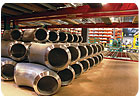
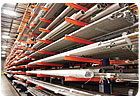
Vast amounts of stainless fi ttings, flanges and pipe are stored indoors at the GSS/FFF headquarters warehouse.
Inventory galore
Key to making “one-stop” work is, of course, having plenty of inventory readily available. “As a master distributor, we have to have it. That’s our function in the supply chain,” said Bootz. “If we get an inquiry for 30 pieces and only have 10, we might as well have zero.”Inventory management is a task that largely pivots around Bootz, especially for the stainless portion of the business where he’s earned his spurs for 21 years. “I don’t look much at sales histories, but at theoretical potential - how many we need to have on hand to be sure of not running out, and how many we can expect to sell in a year,” the CEO said. In his college days Bootz used to chart stocks, and he draws from similar trend analysis in PVF forecasting.
Houston headquarters has 210,000 sq. ft. under roof and a 14-acre outside storage area. GSS/FFF also operates sizable warehouses in Indianapolis, Los Angeles and Richmond. “For big projects requiring material that doesn’t have to ship today, we can bring stuff in from other locations. That factors into our inventory considerations,” Bootz said.
GSS/FFF focuses not only on inventory depth, but considerable breadth as well - between 60,000-75,000 line items at last estimate. On the stainless side they stock not only commodity grades like 304L and 316L but also special alloys like Alloy 20, Alloy 400, Alloy 625, Hastelloy C-276, 310, 347H, 304H, 317L, 321H, 800H/HT, 825, Aluminum, and Duplex. After purchasing FFF, GSS boosted its subsidiary’s carbon steel offerings by more than 2,000 line items, going up in size from 24-inch to 60-inch with many lines. Bootz recalls placing a $16 million buy to shore up FFF during the market downturn in 2009. Marketing manager Nathan Green noted that “FFF has more material coming in on the water than the company had in inventory pre-acquisition!”
GSS/FFF obtains its vast array of PVF materials from suppliers spanning some 20 nations around the globe. About 65% of its materials are imports, though relatively little comes from China compared with other Pacific Rim countries like South Korea, Vietnam, Malaysia and Taiwan, along with various European suppliers.
“Most people take an adversarial approach to purchasing,” said Bootz. “The old adage in distribution is you make your money on the buy side. That’s a great way to drive your suppliers out of business. We focus less on price than channelization. We like to partner with our suppliers and pay them enough so they don’t have to constantly chase multiple accounts. I figure that if we buy 1,000 tons of seamless pipe, we’re likely to get a better price than someone else buying 20 tons.”
Quality assurance is a key component of GSS/FFF’s business strategy. (See “The Nitty-Gritty Details of Quality Assurance” below.) “Our aim is to prevent mistakes rather than deal with them,” said Bootz. “Twenty years ago you had engineers in every factory; now it’s all about price lists, multipliers and the Internet. The industry took intellectual capacity away and made everyone price sellers. But applications are getting more complicated, not less. The BP experience taught us that we need to start selling risk management instead of price, and that’s where we look to add value.”
GSS/FFF’s executive team is headed by (from left) Lee Brown, Stan Lee, Bill Thomas, Bill Bootz, Ken Albano, Danny Lee and Mike Chambers.
Collegial management
So much for the metals and money side of the business. A third “M” word comes into play to gain understanding of what makes GSS/FFF successful. That’s management, in particular a collective management style fostered by Bootz that has resulted in a corporate culture unlike any this reporter has observed in the PVF industry.Bootz is a college dropout whose industry career began in 1989 when his father, who worked for a small metals trader, pulled some strings to land his unemployed son a $1,500 a month job selling stainless PVF. “I said, heck, why not. Then I asked, ‘What’s stainless?’” Shortly after taking the new job he read a book on metallurgy and took it upon himself to make 10 cold calls a day trying to drum up customers and learn more about what he was selling and how it meshed with their needs.
He parlayed that drive into a series of jobs with major PVF distributors/master distributors, including Van Leeuwen, KG Specialty Steel and Ta Chen. Along the way he was involved with three different startups: Stainless Piping Products in 1991, and Team Alloys in 1996, which was purchased the next year by Ta Chen, where he worked until 2001. That’s when he started talking to Sumitomo, which led to the formation of GSS the following year. Initially appointed its president, Bootz’s latest contract rewarded him with the added title of CEO.
I asked Bootz why he dropped out of college. “I was lazy,” he responded. “I was a National Merit Scholar and everything came easy, but I never developed good work habits.”
That exchange reveals a curious blend of hubris and humility that marks his charismatic personality. Bootz obviously is very smart and doesn’t try to disguise that, yet he delegates authority like a landscaper sprinkling grass seeds. “All the people who do the jobs I used to do are better at it than I was,” he told me. “They are specialists rather than generalists.”
When I asked Executive Vice President Ken Albano what persuaded him to come to work for GSS/FFF three years ago, he offered this observation: “I had lunch with Bill and he shared with me his vision for the company, and what the obstacles were. Then he looked at me and said, ‘Maybe I’m the problem.’ Not many bosses would say that.”
The self-effacing CEO runs a remarkably egalitarian organization in which perks and privileges are spread around. Bootz’s name and phone number heads the call list if a customer needs after-hours access to the warehouse. “I never ask anyone to do something I’m not willing to do myself.”
Marketing manager Nathan Green also makes sales calls.
The “bullpen” arrangement allows for easy communication and consultation, a central tenet of the GSS/FFF management philosophy. Nathan Green told me, “The rule here is that it’s okay to make a decision that’s wrong, as long as you don’t make it on your own. We’re expected to consult others.”
Bootz chimed in: “A lot of managers try to eliminate mistakes. I try to encourage mistakes - just try to control the size of the mistake. We look for creativity and anyone with an idea can implement it. I don’t have time to micromanage.
“Brainstorming creates a culture of inclusion, where everyone feels they are contributing,” he added. “People want to contribute. They don’t work for money, but for recognition and respect. If you triple your salary, eventually you’ll get used to what you’re making and still feel broke. Instead, I want to create a culture of vitality where everyone listens to everyone else.”
For small decisions, consultation might be limited to one other person familiar with a particular product or procedure. For big decisions, GSS/FFF personnel are expected to make the rounds as much as necessary to reach an informed consensus.
Albano, for instance, told me he routinely consults with Joe Phoenix and FFF executives Danny and Stan Lee, but not only with them. “We had one issue with welded pipe where the warehouse manager helped solve a problem the engineers were struggling with,” he said. “Another time a machinist said he didn’t like the surface finish on some flanges, so we looked at them and sure enough found anomalies that caused rejection. Our quality assurance program is not these two eyes, but the eyes of 50 people.”
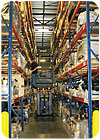
GSS/FFF maximizes warehouse space with narrow aisles. Side extending forklifts are kept centered along magnetic strips in the middle of the aisles.
A phrase that popped up several times during our conversation was “organizational development,” which Bootz defined as “teaching young kids what the old folks know.” GSS/FFF has largely done away with titles and rigid job descriptions. For instance, earlier I identified Nathan Green as the company’s marketing manager, a role he’s taken to. (Bootz credited him with originating the “one-stop PVF” brand identity.) Yet Green also makes sales calls.
The company recently switched from commission-based sales compensation to a salary and bonus pool structure, in order to foster more cooperation. Nor is there any distinction between inside and outside sales. The default position for salespeople is on the telephone but they are encouraged to go out and meet their customers face-to-face whenever they perceive a need to do so. They also are encouraged to cultivate relationships by taking clients out to sporting events, concerts, dinners, etc. “Part of our bullpen culture is that what’s good for the CEO is good for everyone else,” Bootz noted. “If I can go out and enjoy a ballgame with a valued client and buy a good bottle of wine for dinner, so can a new salesman.”
Albano has begun taking young staffers along on his overseas inspection trips so they can learn about metallurgy and steel making. More than a dozen employees in the 25-35 age range are slated to travel the world at GSS/FFF expense in the near future. “Once they learn what’s going on in those factories, they can make more intelligent sales calls,” said Bootz. “It’s an investment in the future of our organization.”
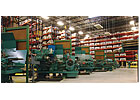
GSS/FFF’s
machine shop offers an extensive array of custom machining services.
Growth imperative
His goal is to grow GSS/FFF into one of the PVF industry’s dominant master distributors. Bootz shared with me his master plan of building an organization with GSS as the parent presiding over five subsidiaries: 1. FFF; 2. a manufacturing unit focused on quick turnaround of oddball items; 3. a specialty valve business; 4. a carbon steel pipe business, which is already underway in Houston; 5. an alloy pipe division, also being stocked in Houston. Only the manufacturing operation is still in the exploratory stage.Why subsidiaries instead of operating divisions? “As I said, people work for recognition, respect and prestige,” Bootz offered. “Subsidiaries enable five people to have the title of president and serve on a board, and all presidents of our subsidiaries will be on the board of all the others.”
His ambitions are not deterred by the bleak economic times, nor by his belief that the economic policies being pursued by the political powers that be will not lead to robust capital spending anytime before 2012 at the earliest. “I think tough economic conditions offer us greater opportunity to grow,” he said. “That’s because in order to grow market share you have to take advantage of weaker companies, but nobody is vulnerable in a boom time.
“Our main limiting factor will be the availability of human capital,” Bootz added. “When we buy a company, we always look at the people first. Our ultimate goal is to add value in the supply chain through expertise.”
Executive Vice President Ken Albano
The Nitty-Gritty Details Of Quality Assurance
PVF distribution is widely regarded as a commodities business, yet it’s interesting that I never heard the word “commodity” spoken during several hours of interviewing GSS/FFF executives. That’s because they are trying to rise above the commodity mentality with an aggressive program of quality assurance. It spans supplier audits, inspections and first article testing, both destructive and nondestructive, and includes full metallurgical analysis of grain structure and tensile strength.Almost two-thirds of the company’s inventory is on the approved lists of refineries and other critical application customers. Executive Vice President Ken Albano, holder of a master’s degree in materials science, spends three to four months a year traveling abroad to audit suppliers and evaluate prospective ones. He works closely with Quality Assurance Manager Joe Phoenix, an ASQ-certified quality engineer with a chemical engineering degree.
Albano, who ran Ameriforge’s flange manufacturing division prior to joining GSS/FFF three years ago, discussed with me many details about the company’s quality assurance program, as follows.
Q: What do you look for in a supplier?
Albano: Our quality assurance program is very comprehensive. It begins with selecting suppliers who meet criteria that will enable them to consistently meet our specifications for products purchased. If we do not approve a supplier based on our audit of their manufacturing quality systems and first article testing of their products, they can offer the lowest price in the world but we won’t buy from them.
First we ask for a list of their equipment, and what size range they offer. In many cases you find offered for sale a size range that’s beyond the capability of their equipment. So the next question is, if you can’t make it on your equipment, where do you get it from? Sometimes I run into waffling or, “I buy it from my brother who lives down the street.” We don’t buy from brokers or from companies that buy it from someone else, because then you lose control of the manufacturing process.
Besides technical competence, we also look at the integrity of the people we’re dealing with.
Q: How do you determine that?
Albano: For example, when you look at certain inputs that go into MTRs, you can go back to the source of the data and tell if they’re legitimate or not. If we find something not legitimate, we don’t deal with those people. If someone sends product here and we find out it’s not manufactured in accordance with ASTM specifications, they’re done.
Q: I’ve heard stories of foreign manufacturers that go all-out to produce quality product in order to get the business, then after one or two orders cut corners in order to save money. How do you guard against these “bait and switch” tactics?
Albano: First, we don’t make just one visit. Also, I have a stamp that creates a unique mark. This assures they’re not hand selecting. They send the product in that I stamped, and we have documented a test protocol, not only testing required by ASTM specifications, but additional metallurgical testing based on my background.
Vast amounts of stainless fittings, flanges and pipe
are stored indoors at the GSS/FFF headquarters warehouse.
Albano: Very many, although in many cases a supplier will have nonconformities that don’t necessarily disqualify them across the board. They may have a product line that’s generally okay, except their threaded flanges may have problems. So they’ll be approved, but not for threaded flanges. Or maybe they’re qualified up to a certain size and pressure rating but not for anything larger.
Our goal is not to beat up our vendors but work with them and help them improve their quality performance. If they have problems in a certain area, we have people with a lot of knowledge that may be able to help.
Q: What are the most common problems you run into?
Albano: The number one problem is dimensional discrepancy. That’s product specific and manufacturer specific. The second most common is discrepancy on the material test report - not following procedures and not understanding the reporting standards.
Another common mistake is random quality problems resulting from a manufacturer not controlling processes correctly, where part of a production run may be nonconforming. It’s not that the entire line is bad, but they lost control of a production variable for a time. We’ll do the metallurgical evaluation, then explain what we found and what might have caused the problem.
Q: Do you think global sourcing is losing some luster with labor rates and shipping expenses on the rise around the world?
Albano: We’re in a global economy and global sourcing is here to stay. I just came back from a welded pipe mill in Ukraine that was state of the art, good as anything in the U.S. Based on the equipment and caliber of people I met, they’ll sell their product on a global basis, if not in the U.S., maybe in Europe or the Mideast. Where they sell it might depend on exchange rates.
For certain products, the U.S. doesn’t have capacity to meet demand, so we have to import. I don’t see any dramatic change in that. Companies will locate their manufacturing wherever they have cost advantage, a skilled workforce and ability to serve target markets. Political issues arise as well.
Different countries use different manufacturing processes. For example, in the U.S. carbon steel flanges are made on mechanical presses. In India that’s rare because the cost of electricity is much higher than here. So they produce theirs on drop hammers, which can produce quality equal to a mechanical press, but it’s a slower, lower productivity operation. But in India they’re paying workers $150 U.S. dollars a month. So capital is more expensive than labor in India, and that’s why they opt for lower capital expense, whereas in Europe and the U.S. labor is more expensive than capital.
Q: Any final thoughts?
Albano: We recognize that our customers rely on us to select manufacturers who can consistently meet the specifications they order, and this company has made a significant commitment to provide product that customers can be confident will be problem free. We’ve made the investment in people, travel and instrumentation to assure that.
When something does go wrong, we don’t just say, oops, and send it back to the manufacturer. We do forensic evaluation to find out what went wrong, and then go back to the manufacturer and square it away with them.
President/CEO Bill Bootz in his "office" cubicle.
Family-Friendly Policies Pay Off
Like everyone else, GSS/FFF needed to cut costs during the depth of the downturn in 2009. So they did away with frills like business-class travel for executives. However, President/CEO Bill Bootz takes pride that the company laid off nobody.Partly it bespeaks a bleeding heart - “I didn’t want to put any of our people in a situation where they couldn’t afford formula for the baby” - but he also argues that it makes business sense. “Word gets around to customers how we treat our people, and that builds a sense of kinship because everybody is worried about their jobs these days.”
Houston is a sprawling metropolis with poor public transportation and GSS/FFF is located in an industrial district with little nearby housing or amenities. So most employees face lengthy commutes to and from work, and need to drive a few miles just to find a place for lunch. When gas prices started rising above the $2 a gallon level, Bootz decided to bring in food and provide free lunches for everyone to alleviate the financial strain. When gas got to $3 a gallon, he started issuing monthly $50 gas cards in lieu of pay raises, which would be hard to rescind if gas prices plummeted.
“People like warehouse workers struggle when gas prices jump,” he said, “and I don’t want our people to have to cut back on essentials like food in order to get to work. We spend about $4,000 a month on groceries, but that’s dwarfed by our business entertainment expenses. So if we can spend all that money on customers and suppliers, why not spend some on our employees. When we look at these and our health care costs as a percentage of revenues, it’s not that significant.”
The company offers health insurance for free to all employees, and pays 40% of family coverage. It’s a comprehensive plan that includes long-term disability, dental and vision.
GSS/FFF has another family-friendly policy that raised this reporter’s eyebrows. If someone’s kid has to stay home with the sniffles or a child care provider takes the day off, the employee can bring the child to work. Bootz’s infrequently used private office serves as a playroom, complete with TV, PlayStation 3 and whatever favorite toys the child chooses to bring along.
The payoff for all this paternalism is low employee turnover and resultant training expenses, as well as a motivated staff. GSS/FFF is a large corporation with the soul of a family business.
Links
Looking for a reprint of this article?
From high-res PDFs to custom plaques, order your copy today!