The Sun Shines On American Industrial New HQ
This PVF distributor capitalized on solar incentives to go green.

In one sense this story has its beginning way back in 1914. That’s when Public Service Electric & Gas (PSE&G) operated an extensive trolley system throughout 10 counties in New Jersey. One of those lines ran from Smith Street in Perth Amboy to downtown Newark. That 19-mile journey took one hour and 22 minutes, which is about what it takes by car nowadays during heavy rush-hour traffic!
Fast forward to 2009, and the ancient trolley depot at 351 Smith St. at this writing was about to open for business as the new headquarters of American Industrial Supply (AIS), a $20 million PVF distributor located in Perth Amboy since its founding in 1978. The renovated facility will include 64,000 sq. ft. of indoor warehousing, 6,500 sq. ft. of covered storage and a 3.5-acre pipe yard.
The expansion will enable American Industrial to consolidate several piecemeal storage facilities into one, expand pipe fabrication capabilities and provide a far more efficient warehouse design. And, it will consume energy frugally enough to save an estimated $14,500 a year on electricity, thanks to 574 rooftop solar panels spanning upwards of 11,600 sq. ft.
The solar system with installation cost around $790,000. The payback arithmetic doesn’t sound very attractive, until you couple it with a $210,000 federal tax deduction and a $344,000 loan from PSE&G, repayable over 15 years with a peculiar form of currency called Solar Renewable Energy Certificates. (See sidebar on page 21.) It amounts to payment for selling back energy saved to the PSE&G grid. These incentives, coupled with all but certain continued increases in electricity rates, make going green a lot more feasible.
In any case, green is about more than the color of money. Company founder and president Ned Higgins did a lot of homework before launching into this solar venture. His appetite got whetted while serving on the New Jersey Board of Public Utilities (NJBPU) Supplier Diversity Development Council (SDDC). The New Jersey Clean Energy Program is their signature initiative. (For details visit www.njcleanenergy.com.)
 “I pay attention during meetings, but especially those revolving around
alternative energies,” said Higgins. Presiding as president of the NJBPU is
Jeanne Fox, who also serves as a member of the New Jersey governor’s cabinet
and is a big proponent of alternative energy. “Over time, I learned that the
feasibility of solar for American Industrial Supply was
solid.”
“I pay attention during meetings, but especially those revolving around
alternative energies,” said Higgins. Presiding as president of the NJBPU is
Jeanne Fox, who also serves as a member of the New Jersey governor’s cabinet
and is a big proponent of alternative energy. “Over time, I learned that the
feasibility of solar for American Industrial Supply was
solid.”
Higgins pieced that insight together with information gathered from a customer, PSE&G, from which he learned that New Jersey was one of only three states that were funding solar (along with New York and California). According to Higgins, the final breakthrough occurred through his participation as a director on the Advisory Committee of The Engineers’ Club, a fraternal club of engineers that was founded in 1888 and funded by a $1.5 million grant from none other than Andrew Carnegie.
“Our meetings are interdisciplinary discussions that promote all aspects of successful construction project completion,” said Higgins. “We support each other, make presentations and share insights. Alternative energy is a topic high on our list. By participating fully in these organizations, keeping an open mind and truly coming to understand both the cost savings and the income generation attached to solar, I felt we had to work toward this path.”
 The solar contractor on the job was a New Jersey firm called GeoGenix,
which has completed more than 110 solar installations throughout the state and
provides integrated design and installation services. AIS business development
manager Hager McMillen coordinated the project, which was completed in late
January. “The biggest challenge was establishing the business case to prove to
management the project was worth moving forward on,” he said. “Once that got
established, the project went very smoothly.”
The solar contractor on the job was a New Jersey firm called GeoGenix,
which has completed more than 110 solar installations throughout the state and
provides integrated design and installation services. AIS business development
manager Hager McMillen coordinated the project, which was completed in late
January. “The biggest challenge was establishing the business case to prove to
management the project was worth moving forward on,” he said. “Once that got
established, the project went very smoothly.”
I asked Hager McMillen what advice he might give to fellow distributors contemplating such a project, and he offered the following:
“If these steps are taken, the project will run very smoothly and there will never be any surprises,” said McMillen.
Distributors wishing to find out more from McMillen can reach him at hmcmillen@ameind.com or 732-826-7600.

Along the way, the company has steadily expanded its pipe fabrication services to encompass cutting (up to 20-inch), bending, threading, grooving, beveling, painting, wrapping, coating and galvanizing. AIS also does valve repair, rebuilding and actuation. “Machine shops are hard to find in our area nowadays,” he noted.
“Anyone can sell PVF,” added McMillen. “We offer many other value-added services, and we are quick, accurate and can deliver large volumes of pipe ready for installation.”
Among those services are inventory management and integrated supply, steam trap surveys, rebate and material consignment programs, engineering assistance, and a few things not typically offered by PVF distributors, such as truck rentals complete with drivers. AIS operates a fleet of 11 trucks, the newest addition to which is a 22-ft. Mack truck equipped with a HIAB 175 knuckleboom crane. At full capacity, this truck can carry 38,000 lbs., while the crane can lift more than 13,000 lbs. at an extension of eight feet, and 2,500 lbs. at its full extension of 39 feet.
 “Sometimes we need to deliver materials that are both large and heavy to
sites that are pretty constricted. Placing these materials in exactly the right
place can be very tricky. The knuckleboom’s strength and maneuverability gives
us the ability to place big and heavy materials on-site with precision,”
explained Sean Higgins, Ned’s son, who functions as COO of the company.
“Sometimes we need to deliver materials that are both large and heavy to
sites that are pretty constricted. Placing these materials in exactly the right
place can be very tricky. The knuckleboom’s strength and maneuverability gives
us the ability to place big and heavy materials on-site with precision,”
explained Sean Higgins, Ned’s son, who functions as COO of the company.
In addition, AIS touts its 24/7 service, including emergency delivery throughout its trading area. Though official business hours are 7 a.m.-5 p.m. weekdays and 7 a.m.-4 p.m. Saturdays, customers have home and cell phone numbers of key personnel - including President Higgins - who they can call at any time to open up if needed. The company is EDI compatible and customers can place orders online at any time. Quotations requested in the morning get turned around by the end of a business day.
AIS qualifies as a Service Disabled Veteran Owned business, owing to an injury suffered by Higgins while serving at Fort Bliss, TX, as a National Air Defense Service mechanic and sharpshooter. This gives them a leg up on certain federally-funded work. They also are situated in a HUB zone and Urban Enterprise (UE) zone. The HUBZone Empowerment Contracting program was enacted in 1997 under the auspices of the U.S. Small Business Administration to provide federal contracting opportunities for qualified small businesses located in distressed areas. UE is a state program that is similar in concept. It offers reduced sales taxes to businesses situated in distressed areas.
AIS recently announced a strategic alliance with a company called Integrated Sourcing, which offers environmental cleanup products utilizing proprietary technology to augment AIS’s core competency in the supply of industrial PVF. Based in Camden, NJ, Integrated Sourcing is a certified MBE located in a HUB zone.
AIS stocks more than 20,000 items related to industrial PVF. On the ground, AIS has 1/8-inch to 48-inch carbon steel pipe, with the corresponding gaskets, valves and fittings. They also carry hard to find items, such as Monel F22 and F11 PVF materials, plus other exotic alloys.
“Moving into a new 40,000-sq.-ft. warehouse will immediately relieve the overcrowding of materials in our old facility,” noted purchasing manager Robert Burns. “It will allow for more efficient picking and stocking, and the additional space will enable us to expand our current product lines and diversify into new products. In addition, we can increase inventory levels for certain product lines to meet the needs of our customers without sacrificing our outstanding service.”

The program will support the development of 30 megawatts of solar power. That’s enough electricity to power 24,000 homes and, in terms of CO2 emissions, is the equivalent of removing about 3,700 cars from the road. Here are the major components of the program:
PSE&G’s solar program will be open to all of its electric
customers, including low-income, residential, commercial, industrial and
municipal/governmental. The solar panels would be owned by the developer or the
host customer.
Applications will be available for two years and accepted on a
first-come, first-served basis until 30 megawatts of projects have been
developed.
PSE&G will provide loans to developers or customers to cover
approximately 40-60% of the cost of a solar installation project, depending on
the projected output of the solar energy system and the cost of the system. The
borrower would repay the principal, plus interest, over 10 years for
residential customers and over 15 years for all other borrowers, a considerably
longer investment time frame than traditional lenders are willing to provide
for solar installations.
The remaining project cost would be funded by the owner of the solar
installation. The owner may have access to funds from banks and investors. In
addition, the owner may be eligible for a federal investment tax
credit.
Owners of solar energy systems would repay the loan with Solar
Renewable Energy Certificates, or SRECs, which are created every time the
system generates solar electricity. It takes one megawatthour of solar
generation to create one SREC, which has value in the marketplace. An SREC
is a New Jersey tradable product that represents the clean energy benefits of
electricity generated from a solar energy system. For the purposes of this
program, an SREC is valued at the market price or $475, whichever is higher.
Borrowers could also repay the loans in cash.
PSE&G’s electric customers will pay for the cost of the solar
program through the Solar Pilot Recovery Charge (SPRC), which will be included
in their monthly bill. PSE&G will sell the SRECs it receives for loan
repayment in an auction, and credit the proceeds from the sale to customers
through the SPRC, which will offset a portion of the program
costs.
Customers interested in learning more about PSE&G’s program should visit www.pseg.com/solarloan, send an email to solarloan@pseg.com or call the Solar Loan program at 973-430-8460.
AIS’ new facility is the first green buildling in town cited
by the 2009 Perth Amboy Green and Clean Campaign. Shown in photo, from left
are: Lisa Marinez, business development coordinator for AIS; Gerry Barcheski,
assistant public works director and coordinator of Perth Amboy Green and Clean;
Tracy Jordan, business development assistant, AIS; Mayor Wilda Diaz; AIS
president Ned Higgins; Councilman Peter Jimenez; and Michael Kehler, director
of business development for the City of Perth Amboy. (Photography by John Masi)
In one sense this story has its beginning way back in 1914. That’s when Public Service Electric & Gas (PSE&G) operated an extensive trolley system throughout 10 counties in New Jersey. One of those lines ran from Smith Street in Perth Amboy to downtown Newark. That 19-mile journey took one hour and 22 minutes, which is about what it takes by car nowadays during heavy rush-hour traffic!
Fast forward to 2009, and the ancient trolley depot at 351 Smith St. at this writing was about to open for business as the new headquarters of American Industrial Supply (AIS), a $20 million PVF distributor located in Perth Amboy since its founding in 1978. The renovated facility will include 64,000 sq. ft. of indoor warehousing, 6,500 sq. ft. of covered storage and a 3.5-acre pipe yard.
The expansion will enable American Industrial to consolidate several piecemeal storage facilities into one, expand pipe fabrication capabilities and provide a far more efficient warehouse design. And, it will consume energy frugally enough to save an estimated $14,500 a year on electricity, thanks to 574 rooftop solar panels spanning upwards of 11,600 sq. ft.
The solar system with installation cost around $790,000. The payback arithmetic doesn’t sound very attractive, until you couple it with a $210,000 federal tax deduction and a $344,000 loan from PSE&G, repayable over 15 years with a peculiar form of currency called Solar Renewable Energy Certificates. (See sidebar on page 21.) It amounts to payment for selling back energy saved to the PSE&G grid. These incentives, coupled with all but certain continued increases in electricity rates, make going green a lot more feasible.
In any case, green is about more than the color of money. Company founder and president Ned Higgins did a lot of homework before launching into this solar venture. His appetite got whetted while serving on the New Jersey Board of Public Utilities (NJBPU) Supplier Diversity Development Council (SDDC). The New Jersey Clean Energy Program is their signature initiative. (For details visit www.njcleanenergy.com.)
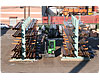
AIS stocks pipe ranging from 1/8 inch to 48 inch. (Photography by John Masi)
Higgins pieced that insight together with information gathered from a customer, PSE&G, from which he learned that New Jersey was one of only three states that were funding solar (along with New York and California). According to Higgins, the final breakthrough occurred through his participation as a director on the Advisory Committee of The Engineers’ Club, a fraternal club of engineers that was founded in 1888 and funded by a $1.5 million grant from none other than Andrew Carnegie.
“Our meetings are interdisciplinary discussions that promote all aspects of successful construction project completion,” said Higgins. “We support each other, make presentations and share insights. Alternative energy is a topic high on our list. By participating fully in these organizations, keeping an open mind and truly coming to understand both the cost savings and the income generation attached to solar, I felt we had to work toward this path.”
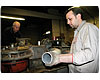
Bending (pictured here) and grinding are among AIS' pipe fab capabilities. (Photography by John Masi)
I asked Hager McMillen what advice he might give to fellow distributors contemplating such a project, and he offered the following:
- 1. Contact many companies that have installed solar and ask for the
pros and cons of their implementation.
2. Ask each one to create a business case as part of their quote.
3. Build a business case to justify the project based on the information from all the bidders.
4. Don’t be afraid to negotiate with the final bidder.
5. Part of the contract should be a mandatory progress report sent weekly along with pictures.
6. Schedule semi-monthly communication meetings with the supplier.
“If these steps are taken, the project will run very smoothly and there will never be any surprises,” said McMillen.
Distributors wishing to find out more from McMillen can reach him at hmcmillen@ameind.com or 732-826-7600.
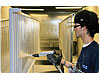
Heliarc welding (pictured here) and coating (shown below) constitute more of AIS' pipe fab services. (Photography by John Masi)
Changing with the times
The company’s PVF marketplace has changed considerably over the three decades of the company’s life. According to Higgins, manufacturing in the state has steadily disappeared and the company has had to adjust to new markets that include large commercial buildings, utilities, oil refineries and pharmaceuticals, as well as spreading out to cover New York and other parts of the Northeast. “‘Green living’ is a bright light, bringing not only cleaner energy and more jobs, but a whole new operating paradigm for industrial commerce,” Higgins said.Along the way, the company has steadily expanded its pipe fabrication services to encompass cutting (up to 20-inch), bending, threading, grooving, beveling, painting, wrapping, coating and galvanizing. AIS also does valve repair, rebuilding and actuation. “Machine shops are hard to find in our area nowadays,” he noted.
“Anyone can sell PVF,” added McMillen. “We offer many other value-added services, and we are quick, accurate and can deliver large volumes of pipe ready for installation.”
Among those services are inventory management and integrated supply, steam trap surveys, rebate and material consignment programs, engineering assistance, and a few things not typically offered by PVF distributors, such as truck rentals complete with drivers. AIS operates a fleet of 11 trucks, the newest addition to which is a 22-ft. Mack truck equipped with a HIAB 175 knuckleboom crane. At full capacity, this truck can carry 38,000 lbs., while the crane can lift more than 13,000 lbs. at an extension of eight feet, and 2,500 lbs. at its full extension of 39 feet.
Coating the pipe. (Photography by John Masi)
In addition, AIS touts its 24/7 service, including emergency delivery throughout its trading area. Though official business hours are 7 a.m.-5 p.m. weekdays and 7 a.m.-4 p.m. Saturdays, customers have home and cell phone numbers of key personnel - including President Higgins - who they can call at any time to open up if needed. The company is EDI compatible and customers can place orders online at any time. Quotations requested in the morning get turned around by the end of a business day.
AIS qualifies as a Service Disabled Veteran Owned business, owing to an injury suffered by Higgins while serving at Fort Bliss, TX, as a National Air Defense Service mechanic and sharpshooter. This gives them a leg up on certain federally-funded work. They also are situated in a HUB zone and Urban Enterprise (UE) zone. The HUBZone Empowerment Contracting program was enacted in 1997 under the auspices of the U.S. Small Business Administration to provide federal contracting opportunities for qualified small businesses located in distressed areas. UE is a state program that is similar in concept. It offers reduced sales taxes to businesses situated in distressed areas.
AIS recently announced a strategic alliance with a company called Integrated Sourcing, which offers environmental cleanup products utilizing proprietary technology to augment AIS’s core competency in the supply of industrial PVF. Based in Camden, NJ, Integrated Sourcing is a certified MBE located in a HUB zone.
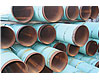
Pritek-coated pipe is among the company's hard-to-find inventory. (Photography by John Masi)
Breathing room
While the rooftop solar array provides razzle-dazzle for all to see, AIS’s staff speaks just as excitedly about the extra breathing room provided by the renovated facility.AIS stocks more than 20,000 items related to industrial PVF. On the ground, AIS has 1/8-inch to 48-inch carbon steel pipe, with the corresponding gaskets, valves and fittings. They also carry hard to find items, such as Monel F22 and F11 PVF materials, plus other exotic alloys.
“Moving into a new 40,000-sq.-ft. warehouse will immediately relieve the overcrowding of materials in our old facility,” noted purchasing manager Robert Burns. “It will allow for more efficient picking and stocking, and the additional space will enable us to expand our current product lines and diversify into new products. In addition, we can increase inventory levels for certain product lines to meet the needs of our customers without sacrificing our outstanding service.”
New Jersey aims to meet 20% of the state's energy needes with renewable forms by 2020. (Photography by John Masi)
PSE&G's Solar Loan Program
Last year Public Service Electric and Gas Co. (PSE&G) received approval from state regulators to begin offering $105 million in loans to help finance the installation of solar systems on homes, businesses and municipal buildings throughout its electric service area. PSE&G’s solar program addresses a New Jersey goal that calls for meeting 20% of the state’s energy needs with renewable energy by the year 2020.The program will support the development of 30 megawatts of solar power. That’s enough electricity to power 24,000 homes and, in terms of CO2 emissions, is the equivalent of removing about 3,700 cars from the road. Here are the major components of the program:
Customers interested in learning more about PSE&G’s program should visit www.pseg.com/solarloan, send an email to solarloan@pseg.com or call the Solar Loan program at 973-430-8460.
Looking for a reprint of this article?
From high-res PDFs to custom plaques, order your copy today!