UPSTARTS!
Express Pipe & Supply Plumbing Wholesale Outlet: Barry Pipe & Supply
New supply houses continue to spring up, despite consolidation … or because of it.

We all know about so many corporate identities having been wiped from the PHCP distribution slate due to consolidation. We know many people who have lost their jobs following acquisitions.
There are related stories begging to be told. These have to do with people leaving the distribution giants, whether voluntarily or as victims of job redundancy, and starting a new supply business from scratch. It’s happened many times in the consolidation era, but because the upstart companies mostly are small niche players, they tend to get overlooked. Yet they stand as testimony to the entrepreneurial spirit that has always characterized this industry, and they suggest that it remains undiminished despite forces aligned against distribution start-ups.
Almost every wholesaler in this industry, even the multi-billion-dollar chains, traces its heritage to a humble beginning. Many were formed by a plumber or sales rep that started out by selling goods out of the trunk of a car or the back of a pickup truck. These founders had a knack for buying low and selling high, and steadily built clientele by working their tails off servicing them and following through on handshake deals.
It’s a lot harder than it used to be to make a go of it with nothing but wits, hard work and personal integrity. Capital requirements are the most daunting obstacle. But three companies featured in the following pages prove it still can be done.
We chose these three to highlight because they are located within a single metropolitan market of greater Los Angeles, which enabled me to pay all of them a visit within the span of a couple of days. As it turned out, they also represent distinct points on the large-medium-small wholesaler spectrum, ranging from a 13-branch operation that ranks in the top half of our Premier 150 list of PHCP distributors, down to a tiny 11-person niche operation that manages to provide a good living for its founding family and close associates. Here’s how they came about.
Express Pipe & Supply was started in 1994 by Alan Shapiro and Greg Boiko, both formerly with Familian Corp. Familian was this magazine’s 1986 Wholesaler of the Year and was purchased by Ferguson parent Wolseley Corp. the following year. Familian continued to operate under its own name until 1999, when the company was merged under the Ferguson banner.
Both Shapiro and Boiko grew up in the supply business from high school on - Alan as part of the Shapiro family that had founded Familian and led it to become one of Southern California’s leading PHCP distribution firms. Shapiro oversees the financial end of Express’ business while Boiko handles all other operational functions.
The two left Wolseley’s Familian under amicable terms, and while nobody speaks badly of their former employer, Boiko gives off more than a few signs of chafing under the corporate environment. Express Pipe’s president chuckles in telling of the “no tie” policy he implemented, which forbids any Express employee from wearing a tie to work. His definition of business casual is broad enough to encompass shorts and Nikes.
In starting the company, Shapiro and Boiko had a vision of a plumbing supply house geared to self-service. According to Boiko, the self-service concept has dwindled in importance over the years, although the highly profitable will call business still accounts for a substantial part of Express’ sales.
Express caters mainly to residential and light commercial service plumbers, for whom product availability is a key component of great service. The company’s Anaheim headquarters includes an 80,000-sq.-ft. central warehouse that is busting at the seams with inventory and has a fleet of more than 40 delivery trucks. Open to customers from 4 a.m. till 6 p.m., the central distribution facility also employs a night crew to load trucks for daily branch shipments.
By design Express is minimally exposed to the tract housing market, which the Grim Reaper has almost entirely put to rest in Southern California. “We’re still growing because we have the inventory, we have ample staff and we give great service,” said Boiko. “When times get tough, the larger wholesalers tend to get rid of inventory and people, which in turn impacts their service.”
I asked Boiko what was the biggest challenge of starting up. “Capital,” he replied without hesitation. The Shapiro family’s reputation gave them more wherewithal than most to acquire the needed funds, “but until you try it, you don’t have a clue how much rigmarole is involved,” said Boiko. He recalls rapid growth right from the beginning, which is a plus but also puts a lot of pressure on those banking relationships.
Another early hurdle was acquiring desirable lines. Big competitors have leverage over vendors in maintaining selective distribution. Things started to change when it became apparent that Express was willing to stock items most other companies wouldn’t. Tired of losing sales due to unavailable product, sales reps began pressuring their companies to give the upstart a shot. Over time Express Pipe’s commitment to a strong inventory position eliminated this problem.

Based in San Gabriel, his company, Plumbing Wholesale Outlet (PWO), now operates seven branch stores in contiguous markets and employs 52 people … 10 of whom are relatives. They include sister Lupe and brother Juan Garcia. PWO business cards do not include titles, but this triumvirate handles the administrative work typically associated with top management.
So much for the fast-forwarded summary. The road from beginning to now was filled with peril.
PWO opened for business in September 1996. Their first major payable was due Nov. 10 of that year and they didn’t have a dime in the bank. Homes and pensions were on the line. Then an SBA loan came through on Nov. 12 in the nick of time.
“We had spent all our money building the business infrastructure,” said Robert Garcia. “If you need a truck and forklift, you have to get them, but there are endless surprises and it was impossible to budget for everything at the beginning. We knew the SBA loan was coming and we weren’t going to let anybody down, but thank goodness it came when it did.
 “It was very tough for at least the first five years,”
he added. “We worked seven days a week from seven in the morning till seven at
night all those years.”
“It was very tough for at least the first five years,”
he added. “We worked seven days a week from seven in the morning till seven at
night all those years.”
“Plus most holidays!” chimed in brother Juan, who left a printing business to help realize the family dream. “We worked 359 days a year.”
Catering to small service and repair clientele, they chose to open in San Gabriel because they lived nearby and it was relatively underserved by other supply houses. But this also meant they had no familiar customer base to draw from. They built the business from scratch by keying in the names and addresses of local plumbing contractors from stacks of Yellow Pages books, supplemented by local advertising in publications such as Reeves Journal. They repeatedly sent mailers to neighborhood plumbers, enticing them with barbecue lunches every Friday afternoon.
“It cost us $300 every week to hold those luncheons, but we developed great relationships and that’s what built our business,” said Robert.
Brother Juan added with a wry smile, “We didn’t have a lot of inventory. When a plumber came in and wanted something we didn’t have, Robert would keep chatting with him while one of us went over to some other supply house to pick it up. He never knew we were gone and never knew we didn’t have it in stock! Our philosophy was we’ll do anything to take care of the customer.”
Subterfuge aside, PWO pulls off a lot of clever merchandising tricks that Robert has picked up during his 35-year career in plumbing distribution. Like displaying more expensive goods up front in the self-service area, requiring customers to work their way to the back for bargain basement items. They utilize activity-based pricing software that captures customer historical buying habits and prices orders accordingly. Furthermore, PWO departs from conventional wisdom by putting price tags on all displayed merchandise. Selling only to the trade, Robert explained that they cater to many Asian plumbers and others with limited command of English. But they all understand our monetary system and this enables customers to calculate material costs despite language barriers.
PWO aimed its business to be reliant on self-service but found that to be less important in the long run than they figured. Garcia’s company went so far as to establish two separate will call counters, one for quick and simple self-service transactions, the other identified with a large “Customer Service” banner for customers in need of some kind of assistance. He envisioned that around 80% of PWO’s pickup business would come from the self-service counter, but it turned out the other way around. Some 80% of customers take their orders to the full-service counter with inquiries of one kind or another … or just to schmooze.
You can slice and dice numbers every which way, but never underestimate the importance of schmoozing in business development. PWO’s owners and staff are as jovial a bunch of people as this reporter has ever spent time with. They clearly enjoy what they’re doing and it’s just as plain to see that customers like hanging around them.
“I’m proud to say that we are a very expensive wholesaler,” Robert said. “That’s how we can afford to give superior service to our customers. The volume of customers we have is small, but they are quality people, and because there aren’t that many, we get to spend a lot of time and bond with them. We get to know their families, their habits and what kinds of products they buy. That’s more profitable than having 100 people in your store all wanting to buy cheap and insisting on deliveries.”

Barry Pipe & Supply is the smallest of the companies featured here.Operating out of a 15,000-sq.-ft. building in west Los Angeles, not far from the beach communities of Marina del Rey and Venice, company personnel consists of the founder, son Brian, wife Barbara and seven other employees. Give the company a call and there’s a good chance one of the Barrys will be the person answering the phone. They have a phobia about voice mail and telephone runarounds.
“We’re old school,” said the founder. “We don’t put you on hold and bounce you around to a bunch of people, none of whom can answer your questions. Call here and you’ll get a live person on the phone, and we strive to answer it on the first ring.”
I got an inadvertent glimpse of this company’s M.O. immediately upon arriving for my appointment to interview Bob Barry. He was tied up with a gentleman whom I took to be a customer and the conversation went on for awhile. I busied myself inspecting the small showroom and chatting with the company receptionist-slash-showroom attendant, who it turned out was the daughter of a woman who worked for one of Barry’s vendors.
Upon finishing with the other client, Barry apologized for the delay and I told him it’s no big deal and I hoped he landed a big order. “Oh, that wasn’t really a customer,” he said. It was merely a neighborhood resident who just wanted some advice about a product going into a remodeling project, a line Barry did not even sell or want to sell. He confided that he was anxious to end the conversation, but not so anxious that he would cross the boundary of politeness. The visitor did not represent any direct business for Barry Pipe & Supply, but he was a person of potential influence and a decent human being.
“It’s all in how you treat people,” Barry told me. “This business is about personal relationships and having everyone on your side. If you act like an S.O.B. you won’t get anywhere. People buy from us not because we have the best price … we don’t … but because they like to deal with us.”
 Barry Pipe & Supply’s customers include contractors the
founder befriended throughout his career, and frequently their sons or
grandsons. They sell to a major mechanical contractor thousands of miles away
in Hawaii, who gives them business because he’s known Barry a long time and
trusts him to do what he says he’ll do and level with him if he
can’t.
Barry Pipe & Supply’s customers include contractors the
founder befriended throughout his career, and frequently their sons or
grandsons. They sell to a major mechanical contractor thousands of miles away
in Hawaii, who gives them business because he’s known Barry a long time and
trusts him to do what he says he’ll do and level with him if he
can’t.
A business can’t survive completely relying on old friends, however. Mortality and other forms of attrition eventually take their toll. Another good friend of any business is the holy trinity of location, location, location. Barry’s business got a boost a couple of years ago after moving from its original site in Santa Monica to its present facility, which happens to be directly across the street from a Stock Building Supply store. The spillover effect is enormous. “Our will call business picked up 300% after moving here,” he said, “and business in general is up 100%.”
Another competitive edge is that all of Barry’s people are bilingual. This is no little thing in a neighborhood where Barry estimates 50% of his customers are Spanish speakers.
Being as small as they are precludes Barry from any notions of being all things to all people. Their inventory consists mainly of staples, with the notable exception of their Toto line, for which Barry stocks everything, including repair parts. “Not many people buy everything Toto makes, but it’s great for business. You can make more money selling the parts than the regular goods.” They are partial to lines like Toto, A.O. Smith and California Faucets, which are not found in big box stores. Because of limited inventory capacity, they also favor lines with local manufacturer or rep warehouses where they can obtain needed items quickly.
I asked Barry what were his biggest challenges in starting out. “Nothing really stands out,” he replied. “A lot of it was just doing the homework, like contacting former customers to let them know I’d be opening. I hosted many breakfasts, lunches and customer appreciation days early on, and did a lot of advertising at first.”
He started out with merely seven employees. Son Brian was working for his in-laws in the fur business in far away New Jersey when the Southern California native decided to return to those sunny climes about six years ago.
Something that goes with the territory for all the entrepreneurs I visited with for this story is long hours. Work weeks consistently span 70-80 hours. “We don’t stop when we close the doors,” said Barry. “We’ll go home, break for dinner, then price invoices and so on.”
The rewards are commensurate with the effort, however, and not only monetarily. “It gives me a lot of satisfaction to be working with my family in the business,” said Bob Barry. “Our aspirations are to grow the business without it getting out of hand.”
A glimpse inside the Anaheim central warehouse of Express Pipe & Supply.
We all know about so many corporate identities having been wiped from the PHCP distribution slate due to consolidation. We know many people who have lost their jobs following acquisitions.
There are related stories begging to be told. These have to do with people leaving the distribution giants, whether voluntarily or as victims of job redundancy, and starting a new supply business from scratch. It’s happened many times in the consolidation era, but because the upstart companies mostly are small niche players, they tend to get overlooked. Yet they stand as testimony to the entrepreneurial spirit that has always characterized this industry, and they suggest that it remains undiminished despite forces aligned against distribution start-ups.
Almost every wholesaler in this industry, even the multi-billion-dollar chains, traces its heritage to a humble beginning. Many were formed by a plumber or sales rep that started out by selling goods out of the trunk of a car or the back of a pickup truck. These founders had a knack for buying low and selling high, and steadily built clientele by working their tails off servicing them and following through on handshake deals.
It’s a lot harder than it used to be to make a go of it with nothing but wits, hard work and personal integrity. Capital requirements are the most daunting obstacle. But three companies featured in the following pages prove it still can be done.
We chose these three to highlight because they are located within a single metropolitan market of greater Los Angeles, which enabled me to pay all of them a visit within the span of a couple of days. As it turned out, they also represent distinct points on the large-medium-small wholesaler spectrum, ranging from a 13-branch operation that ranks in the top half of our Premier 150 list of PHCP distributors, down to a tiny 11-person niche operation that manages to provide a good living for its founding family and close associates. Here’s how they came about.
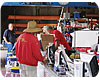
Express Pipe & Supply's counter bustles with business at most times of day.
Express Pipe & Supply
This is the big company described above, growing from a single 5,000-sq.-ft. location in Anaheim at inception to a 13-branch operation in six Southern California counties with 250 employees.Express Pipe & Supply was started in 1994 by Alan Shapiro and Greg Boiko, both formerly with Familian Corp. Familian was this magazine’s 1986 Wholesaler of the Year and was purchased by Ferguson parent Wolseley Corp. the following year. Familian continued to operate under its own name until 1999, when the company was merged under the Ferguson banner.
Both Shapiro and Boiko grew up in the supply business from high school on - Alan as part of the Shapiro family that had founded Familian and led it to become one of Southern California’s leading PHCP distribution firms. Shapiro oversees the financial end of Express’ business while Boiko handles all other operational functions.
The two left Wolseley’s Familian under amicable terms, and while nobody speaks badly of their former employer, Boiko gives off more than a few signs of chafing under the corporate environment. Express Pipe’s president chuckles in telling of the “no tie” policy he implemented, which forbids any Express employee from wearing a tie to work. His definition of business casual is broad enough to encompass shorts and Nikes.
In starting the company, Shapiro and Boiko had a vision of a plumbing supply house geared to self-service. According to Boiko, the self-service concept has dwindled in importance over the years, although the highly profitable will call business still accounts for a substantial part of Express’ sales.
Express caters mainly to residential and light commercial service plumbers, for whom product availability is a key component of great service. The company’s Anaheim headquarters includes an 80,000-sq.-ft. central warehouse that is busting at the seams with inventory and has a fleet of more than 40 delivery trucks. Open to customers from 4 a.m. till 6 p.m., the central distribution facility also employs a night crew to load trucks for daily branch shipments.
By design Express is minimally exposed to the tract housing market, which the Grim Reaper has almost entirely put to rest in Southern California. “We’re still growing because we have the inventory, we have ample staff and we give great service,” said Boiko. “When times get tough, the larger wholesalers tend to get rid of inventory and people, which in turn impacts their service.”
I asked Boiko what was the biggest challenge of starting up. “Capital,” he replied without hesitation. The Shapiro family’s reputation gave them more wherewithal than most to acquire the needed funds, “but until you try it, you don’t have a clue how much rigmarole is involved,” said Boiko. He recalls rapid growth right from the beginning, which is a plus but also puts a lot of pressure on those banking relationships.
Another early hurdle was acquiring desirable lines. Big competitors have leverage over vendors in maintaining selective distribution. Things started to change when it became apparent that Express was willing to stock items most other companies wouldn’t. Tired of losing sales due to unavailable product, sales reps began pressuring their companies to give the upstart a shot. Over time Express Pipe’s commitment to a strong inventory position eliminated this problem.
Express Pipe & Supply's management team includes (from left): President Greg Boiko, General Manager Bob Riggs and Regional Sales Manager Kimberly Graves, who specializes in commercial accounts.
Plumbing Wholesale Outlet
Founder Robert Garcia left his job as a high-ranking executive (vp & gm) with well-regarded Hirsch Pipe & Supply when he opened this fledgling supply house in 1996. His sister, Lupe Perez, was also employed at Hirsch as an administrative assistant, but any company is going to draw the line somewhere when it comes to non-owner nepotism. “The main reason we did this was because of family,” Garcia told me. “I wanted to give our kids the opportunity to choose this as a career. Now we have four families in here learning the business from the ground up.”Based in San Gabriel, his company, Plumbing Wholesale Outlet (PWO), now operates seven branch stores in contiguous markets and employs 52 people … 10 of whom are relatives. They include sister Lupe and brother Juan Garcia. PWO business cards do not include titles, but this triumvirate handles the administrative work typically associated with top management.
So much for the fast-forwarded summary. The road from beginning to now was filled with peril.
PWO opened for business in September 1996. Their first major payable was due Nov. 10 of that year and they didn’t have a dime in the bank. Homes and pensions were on the line. Then an SBA loan came through on Nov. 12 in the nick of time.
“We had spent all our money building the business infrastructure,” said Robert Garcia. “If you need a truck and forklift, you have to get them, but there are endless surprises and it was impossible to budget for everything at the beginning. We knew the SBA loan was coming and we weren’t going to let anybody down, but thank goodness it came when it did.
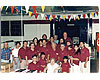
This group photo of the original staff was taken a couple of days before PWO opened for business in 1996. Most of the people are still there, and their numbers have grown.
“Plus most holidays!” chimed in brother Juan, who left a printing business to help realize the family dream. “We worked 359 days a year.”
Catering to small service and repair clientele, they chose to open in San Gabriel because they lived nearby and it was relatively underserved by other supply houses. But this also meant they had no familiar customer base to draw from. They built the business from scratch by keying in the names and addresses of local plumbing contractors from stacks of Yellow Pages books, supplemented by local advertising in publications such as Reeves Journal. They repeatedly sent mailers to neighborhood plumbers, enticing them with barbecue lunches every Friday afternoon.
“It cost us $300 every week to hold those luncheons, but we developed great relationships and that’s what built our business,” said Robert.
Brother Juan added with a wry smile, “We didn’t have a lot of inventory. When a plumber came in and wanted something we didn’t have, Robert would keep chatting with him while one of us went over to some other supply house to pick it up. He never knew we were gone and never knew we didn’t have it in stock! Our philosophy was we’ll do anything to take care of the customer.”
Subterfuge aside, PWO pulls off a lot of clever merchandising tricks that Robert has picked up during his 35-year career in plumbing distribution. Like displaying more expensive goods up front in the self-service area, requiring customers to work their way to the back for bargain basement items. They utilize activity-based pricing software that captures customer historical buying habits and prices orders accordingly. Furthermore, PWO departs from conventional wisdom by putting price tags on all displayed merchandise. Selling only to the trade, Robert explained that they cater to many Asian plumbers and others with limited command of English. But they all understand our monetary system and this enables customers to calculate material costs despite language barriers.
PWO aimed its business to be reliant on self-service but found that to be less important in the long run than they figured. Garcia’s company went so far as to establish two separate will call counters, one for quick and simple self-service transactions, the other identified with a large “Customer Service” banner for customers in need of some kind of assistance. He envisioned that around 80% of PWO’s pickup business would come from the self-service counter, but it turned out the other way around. Some 80% of customers take their orders to the full-service counter with inquiries of one kind or another … or just to schmooze.
You can slice and dice numbers every which way, but never underestimate the importance of schmoozing in business development. PWO’s owners and staff are as jovial a bunch of people as this reporter has ever spent time with. They clearly enjoy what they’re doing and it’s just as plain to see that customers like hanging around them.
“I’m proud to say that we are a very expensive wholesaler,” Robert said. “That’s how we can afford to give superior service to our customers. The volume of customers we have is small, but they are quality people, and because there aren’t that many, we get to spend a lot of time and bond with them. We get to know their families, their habits and what kinds of products they buy. That’s more profitable than having 100 people in your store all wanting to buy cheap and insisting on deliveries.”
Founder Robert Garcia (right) is assisted in managing the company by brother Juan and sister Lupe Perez.
Barry Pipe & Supply
This is another company whose main stock in trade is personalized service and relationships. Founder Bob Barry spent 34 years with Familian before being let go in 1998 while serving as a vice president and director of purchasing. A decent severance package enabled him to spend the better part of a year putting together a business plan that persuaded a bank to finance his new supply house … along with risking personal collateral, of course.Barry Pipe & Supply is the smallest of the companies featured here.Operating out of a 15,000-sq.-ft. building in west Los Angeles, not far from the beach communities of Marina del Rey and Venice, company personnel consists of the founder, son Brian, wife Barbara and seven other employees. Give the company a call and there’s a good chance one of the Barrys will be the person answering the phone. They have a phobia about voice mail and telephone runarounds.
“We’re old school,” said the founder. “We don’t put you on hold and bounce you around to a bunch of people, none of whom can answer your questions. Call here and you’ll get a live person on the phone, and we strive to answer it on the first ring.”
I got an inadvertent glimpse of this company’s M.O. immediately upon arriving for my appointment to interview Bob Barry. He was tied up with a gentleman whom I took to be a customer and the conversation went on for awhile. I busied myself inspecting the small showroom and chatting with the company receptionist-slash-showroom attendant, who it turned out was the daughter of a woman who worked for one of Barry’s vendors.
Upon finishing with the other client, Barry apologized for the delay and I told him it’s no big deal and I hoped he landed a big order. “Oh, that wasn’t really a customer,” he said. It was merely a neighborhood resident who just wanted some advice about a product going into a remodeling project, a line Barry did not even sell or want to sell. He confided that he was anxious to end the conversation, but not so anxious that he would cross the boundary of politeness. The visitor did not represent any direct business for Barry Pipe & Supply, but he was a person of potential influence and a decent human being.
“It’s all in how you treat people,” Barry told me. “This business is about personal relationships and having everyone on your side. If you act like an S.O.B. you won’t get anywhere. People buy from us not because we have the best price … we don’t … but because they like to deal with us.”
Founder Bob Barry (left) and son Brian.
A business can’t survive completely relying on old friends, however. Mortality and other forms of attrition eventually take their toll. Another good friend of any business is the holy trinity of location, location, location. Barry’s business got a boost a couple of years ago after moving from its original site in Santa Monica to its present facility, which happens to be directly across the street from a Stock Building Supply store. The spillover effect is enormous. “Our will call business picked up 300% after moving here,” he said, “and business in general is up 100%.”
Another competitive edge is that all of Barry’s people are bilingual. This is no little thing in a neighborhood where Barry estimates 50% of his customers are Spanish speakers.
Being as small as they are precludes Barry from any notions of being all things to all people. Their inventory consists mainly of staples, with the notable exception of their Toto line, for which Barry stocks everything, including repair parts. “Not many people buy everything Toto makes, but it’s great for business. You can make more money selling the parts than the regular goods.” They are partial to lines like Toto, A.O. Smith and California Faucets, which are not found in big box stores. Because of limited inventory capacity, they also favor lines with local manufacturer or rep warehouses where they can obtain needed items quickly.
I asked Barry what were his biggest challenges in starting out. “Nothing really stands out,” he replied. “A lot of it was just doing the homework, like contacting former customers to let them know I’d be opening. I hosted many breakfasts, lunches and customer appreciation days early on, and did a lot of advertising at first.”
He started out with merely seven employees. Son Brian was working for his in-laws in the fur business in far away New Jersey when the Southern California native decided to return to those sunny climes about six years ago.
Something that goes with the territory for all the entrepreneurs I visited with for this story is long hours. Work weeks consistently span 70-80 hours. “We don’t stop when we close the doors,” said Barry. “We’ll go home, break for dinner, then price invoices and so on.”
The rewards are commensurate with the effort, however, and not only monetarily. “It gives me a lot of satisfaction to be working with my family in the business,” said Bob Barry. “Our aspirations are to grow the business without it getting out of hand.”
Looking for a reprint of this article?
From high-res PDFs to custom plaques, order your copy today!