Charlie Horton's Legacy

For this Golden Anniversary edition of Supply House Times, we decided to focus on the future rather than wallow in nostalgia as the best way to serve PHCP industry readers of 2008.
At the same time it would be unforgivable to completely ignore the legacy of this magazine’s unforgettable founder, Charlie Horton, who guided this magazine through the first 60% of its existence. This writer, Publisher Scott Franz and Plumbing Group Publisher George Zebrowski all had our careers jump-started by Charlie, and we have done our best to serve this industry and elevate its stature in a way that would make him proud.
Charlie was the most talented writer ever to grace this industry’s trade press, and one of its most perceptive observers. From the first edition of this magazine in March 1958 until the final one in which his byline appeared - July 1989 - Charlie wrote hundreds of articles and commentaries about our industry’s affairs with unsurpassed passion and persuasiveness - and, from time to time, with belligerence! He picked a lot of fights and wasn’t always right, but he was never boring.
Enough tell. It’s better to show you what I mean by reproducing some of his extraordinary prose. I’ve selected one editorial from each of the four decades in which he presided over Supply House Times. Following these four masterpieces is a tribute penned by me and published in the August 1989 edition of Plumbing & Mechanical magazine, then also owned by Horton Publishing Co. and which I served as Editor at the time.

From SUPPLY HOUSE TIMES March 1958
Business trends down. So what?In this period of economic downturn, we could not help but be intrigued by the advertisement of Republic-Odin Appliance Corp., which appears on the center spread of this magazine.
The ad makes the bold assertion that while water heater industry-wide sales declined by 14-1/2 percent in 1957 as against 1956, this particular company had increased its own sales 37-1/2 percent.
This claim dramatizes a point very much worth making under today’s conditions. None of us, either as companies or individuals, should regard ourselves as prisoners of events or trends. To a very considerable extent, we can make our own trends; can buck trends.
We can do so by getting a bigger share of the available business; and the available business, nationally, in the plumbing and heating industry is still at least 80 percent as big as it ever was even at the peak of the boom.
And since a jobber usually operates in only one area, it is possible that the available business in his community is as big if not bigger than ever.
The point is, don’t pay too much attention to headlines or newsletters, which must be oracles of doom in order to get their fancy circulation prices.
Those headlines and statistics are all averages; and the average is always pulled away by many things that are not typical of most areas; a hard-hit single industry region for example.
And the averages are also pulled down by lazy, un-progressive, cowardly individuals who seize on the scare headlines as a justification for their own very personal and very individual inadequacies.
Actually, a difficult period like today is the very best time for a single wholesale house to increase its share of the available business.
The contractors and builders are having their problems too and they are looking for answers. Customer loyalties to your competitors are more fragile, sales opportunities more mobile, the whole situation more fluid in times like these.
The jobbing houses that come up with new ideas, new approaches, new products and services today will usually find a more quickly responsive market than they would have found a couple of years ago.
In the words of Joe Pitts, brilliant young president of Brown-Roberts Hardware and Supply: “it depends a lot on what we ourselves do to pull ourselves up by our own bootstraps. Remember this … regardless of how quiet business becomes, every wholesaler’s sales aren’t off exactly the same amount or the same percentage. Some aggressive ones who don’t seem to know any better even manage to increase their sales during such times.”
Intelligent, unremitting competition can always win.
… Particularly when the heat is on and customers want answers to problems.

From SUPPLY HOUSE TIMES September 1968
An Appeal For Consideration Of The Master Distributor Idea On A National BasisOn some products - and the number will likely increase - the industry is groping toward a third level of distribution; that is, an intermediate step between the point of production (the manufacturer’s plant) and the wholesaler. This is happening in many fields, and in some it is much more advanced than ours. For example, in the giant automotive parts industry this intermediate step, called the warehouse distributor, is now pretty much the standard operating procedure.
There is nothing new in this idea in the plumbing-heating-piping industry. We have had one version of it, the manufacturer’s warehouse, for years. Nor is there anything regrettable about it necessarily - if it meets a real need, and if it lowers the cost of distribution, and if it improves service to the customer, and if it does not foster destructive competition for the real wholesaler, and if it does not limit his ability to be a full-service wholesaler, and if it does not penalize quality of performance at the wholesale level.
Those are numerous and big “ifs” and past performance as well as present trends are not encouraging in that respect.
Pressures Do Exist
Marketing factors do exist, and become more pronounced all the time, that indicate a certain inevitability in this pressure for the new intermediate step in distribution. Let us emphasize again that this does not apply to all products, or even a majority of them, now or later. But on some, most definitely.
Most important of these factors is the enormous, increasing, seemingly endless proliferation of products in both “technical” and consumer items. In “technical” items the high cost of on-site labor spurs the efforts of manufacturers to develop new items, as does the growing use of value analysis by purchasing agents. New materials, new joining methods, new types of valves all contribute to the variety of lines and multiplicity of items in every catalog. In consumer items, particularly plumbing fixtures and trim, it is even more pronounced.
No wholesaler can possibly stock everything in a major line today, even if space or investment were no factor. But they are extremely important factors. This product proliferation is happening at the same time that the need for better inventory turnover is becoming more critical and more recognized than ever.
The Master Distributor
If these many specials, low-turnover items, deluxe items, etc., are to be available on a good service basis at reasonable distribution costs, there has to be an intermediate point of supply in the various regions of the country. If the wholesaler is to be able to give this service and still get an adequate inventory turnover, there has to be a closer supply point than the factory a thousand miles or more away. And if the manufacturer is to get the business he must have, there has to be an availability of his product in the market place.
All of this is involved in the pressure for a new, intermediate step in distribution; a local or regional supply point for quick availability on items that cannot be economically stocked by the wholesaler. This need - let’s call it what it is, a marketing need - is increasingly being filled by manufacturers’ and manufacturers agents’ warehouses, particularly the latter.
But there is a better alternative to the manufacturers’ or agents’ warehouse, and we aren’t aware that wholesalers, generally, have asked for it, or given much indication that they would support it. This better alternative is the master distributor where one wholesaler in an area carries the special and slow-moving stock for all. Instead of having 10 or 20 such stocks, none of them complete, none getting a profitable turnover, you would have only one, but it would be complete. No matter what odd-ball item the customer ordered, any wholesaler could deliver it within 24 hours and without the penalty of LTL freight from a distant factory. He could buy it from the master distributor at the same price he would pay the factory, make his full profit, keep his customer happy and his customer’s customer (the consumer) happy as well.
Tens of thousands of sales lost every year, for lack of availability, would be saved to the benefit of everybody: manufacturers, representatives, wholesalers, contractors. Wasteful freight premiums, which become a part of the product’s cost, would be avoided. Long delays in installation and job completion, so irritating and expensive to consumers and contractors, could be eliminated. All this bickering about poor service, all this expediting and tracing, those nasty letters and frantic long-distance phone calls would be cut by 90 percent.
So Why Not?
The master distributor approach is the right way to do the intermediate local or regional distribution job that must be done. He would, of course, have to be compensated for this service, but not at the expense of other wholesalers, or by adding to the cost of distribution. The manufacturer would compensate him, via an extra discount on these items only. He would pay the master distributor to do well what he, the manufacturer or his agent, now does poorly. It would be a shifting of function and cost, not an increase in either.
Wholesalers complain, and with justice, that many manufacturers’ or agents’ warehouses are destructive to good precepts of wholesaling, because they just don’t understand what wholesaling is all about, and can’t appreciate the effect of their policies and practices. Certainly, this is a lot less likely to happen when a fellow wholesaler is handling the intermediate function. He does understand, hence will do it right, free of the ignorance or short-sighted opportunism they so bitterly deplore.
If the wholesaler, acting as master distributor, can do the job more efficiently and more soundly than the alternatives, why isn’t it developing that way?
There are no logical reasons, but there sure are some powerful emotional barriers. Wholesaler A doesn’t want wholesaler B “making money off me.” That’s silly - A buys as well from B as he would from the factory. B’s extra discount is fair payment for extra services he performs and extra costs he incurs.
A feels it makes him second-rate to go to a fellow wholesaler for these items rather than to the factory. It makes him feel like a big man to pick up the phone and call the factory on everything. That’s silly, too. He would still get all his quantity, high-turnover merchandise from the factory. And if wholesaler B is the master distributor on one line, wholesaler A could be the M/D on another. Thus, they would be each other’s customer to their mutual benefit.
The irony of it is that the master distributor idea involves nothing that wholesalers don’t do all the time - on a hit-and-miss basis. All day long they are picking items up from one another, after first phoning all around to see who has it. They pay one another a “courtesy” discount that takes all the profit out of it for the buyer without giving the seller enough spread to make it profitable for him either.
Thus, wholesalers will not do on an organized and efficient basis what they now do haphazardly and inefficiently. They will not do profitably what they have always done unprofitably. They will not trust the people who understand wholesaling (themselves) and who are committed to its sound development; they thrust the problem back on others (agents and manufacturers) who don’t understand all the nuances of wholesaling and who aren’t very good at it.
Once a distribution evolution moves beyond a certain point it is beyond recall. There is no point in reviving the tired old arguments against manufacturers’ warehouses in copper tubing and pipe fittings. The omelette was made years ago; you can’t unscramble it now, even if it was a good idea.
It is not too late to head off the new generation of warehouses, particularly agents’ warehouses, now being hatched. Hollering and threatening won’t head it off, because the need for this intermediate step in distribution is very real - again we emphasize on some products. The only way to head it off is for wholesalers themselves to do the job - do it well, do it the way they want it done. Otherwise, by default it will be done by others - not necessarily done well, and almost certainly not done the way most wholesalers would like.
But one way or another, it will be done.

From SUPPLY HOUSE TIMES July 1976
200 Bicentennial Cheers For Our IndustryIn this 200th year of our country, it is permissible to feel a soaring pride in our magnificent achievements as a people, including our progress in the material sphere.
“Materialism” is supposed to be bad. Critics of our country eternally cite it as a defect in our national character and values. But is it bad? Is it a defect? What’s wrong with striving for things that make for a higher standard of living and a better quality of life?
Nothing is more symbolic of American materialism than the products of our industry, yet no other American achievement - in any sphere of human endeavor - has done so much to improve the well-being and quality of life for everybody.
And it all happened within the last 100 years. So as our hearts swell with pride in our 200 years as a nation, let them also beat faster as we feel a justified pride in our 100 years as an industry.
What We Did
No industry has more reason for pride in its history, accomplishments and contributions than we. It was we who banished the diseases spread by unsanitary environment and impure water: typhoid, dysentery, cholera, those ancient scourges of man that claimed tens of thousands of innocent lives every year. We conquered them. We were the first, and are still the most, in pollution control. It was we who abolished filth and its associated plagues from man’s life.
It was we who gave man control of his indoor climate, through central heating and air conditioning, and thereby improved his health, comfort and efficiency. People function better, sleep sounder and work more productively because of us. Allergies and asthma are less debilitating because of us. Infants are spared the torture of heat rash because of us. Furniture and draperies stay cleaner because of us. Even the flowers in the vase stay pretty longer because of us.
It was we who lifted heavy toil from the back of the American housewife. The drudgery of drawing, carrying and heating water, or scrubbing clothes and washing dishes, of handling garbage and human waste - all banished from her life by our industry.
It was we who provided the pipe, valves and fittings that are the veins and arteries of an industrial civilization, essential to its production processes: mining, manufacturing, public utilities, agriculture, food processing, the production and distribution of energy. To all the wealth-creating endeavors of man, we are essential.
Constant and Universal
The blessings our industry brings to the American people are constant and universal; enriching life for all regions, all races and social classes, all ages, all members of the family; and in all the hours, of all the days, of all the seasons.
This enrichment is not purely functional. It is esthetic as well. Our products have beauty, elegance and taste. The bathrooms and kitchens we provide are a feast to the eye, as beautiful as any room in the house.
It is particularly to the credit of our industry that its thrust has always been toward the mass market. It has always strived to bring its blessings to everyone, and has continually lowered its prices in relationship to consumer income. It has a positive genius for developing so-called “competitive” products that, without sacrifice of durability or functional efficiency, are comfortably within the reach of the average family.
The beneficial impact of our industry is not just on individuals, but on society as a whole. Modern urban life would be impossible without plumbing. The tremendous industrial and population growth of the “Sunbelt” states could not have happened without air conditioning. Nor could the northern tier of states had their full development without central heating.
Who then would ask a more worthy destiny than to be a member of our fraternal industry? How could you better serve your fellow American than by bringing to him its constant, universal blessings? So on this Bicentennial occasion, let’s hear it 200 times - and loud! - for plumbing, heating, piping and air conditioning, and for the industry that made its miracles happen!
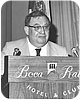
From SUPPLY HOUSE TIMES May 1987
“Partners For Profit” - Plumbing FraternityEditor’s note: These remarks were prepared for delivery at the annual convention of the Southern Wholesalers Association in Orlando, FL, on April 5, as keynote to a panel on the convention theme, “Partners For Profit.”
Plumbing and heating is a huge industry, and a great one - Yes. It is a fiercely competitive business at all levels - Yes. But as I will seek to develop further along, it is a decent type of competition in which each segment respects the need of the others to make a profit. All are enlightened enough to recognize that the well-being of their individual segments, and individual companies, depends on the health and progress of the industry as a whole.
Our industry is also an institution, with which tens of thousands of good people proudly identify themselves and to which they give steadfast loyalty.
On the whole an admirable sense of fraternity exists among the people of our industry. It is not universal of course; there are those whose attitude toward the industry is cynical, self-seeking and downright squalid. But they are the exceptions, actually a small minority. Most of our people do have a strong sense of industry citizenship, and for many of them it amounts to a second patriotism.
This is quite admirable. It is also rare, so rare as to be a noteworthy and special characteristic of our industry. It is also productive and contributes greatly to the progress and prosperity of all segments. This fraternal feeling does indeed make us “Partners for Profit.”
I know that some of you will interpret these views as naive and Pollyanna, and I don’t care. I will not seek to hide that I am idealistic about our industry. In fact, I want the whole world to know it. On the whole, this idealism is justified.
On the whole I think the plumbing & heating industry is great, and in some important respects almost unique. It deserves our sense of identity and our loyalty, and also our appreciation.
Four Chapters
Unique how? Several ways. This is my 37th year in the industry during which I have heard not less than a thousand references to its “personal” quality. These person-to-person relationships and interactions have a huge impact on what happens and how it happens. It is a quality of mutual respect, mutual integrity, mutual trust. There aren’t many contracts in this business. Major deals and agreements are seldom written down or even formalized by a handshake. They don’t have to be. People honor their commitments.
People who come to our industry from outside are especially given to expressing their appreciation and awe of this “personal” characteristic. Unlike those of us whose whole career has been spent in the plumbing industry, they have a basis of comparison, and we look very good in this comparison. Once these outsiders discover the plumbing industry they never leave. They never go back to the appliance business or the automobile industry or wherever it was they came from. They might change jobs, but they stay in the plumbing fraternity.
Confidence in the integrity, ability and professionalism of the other party can be a powerful, even decisive, factor, in business deals and decisions. Plumbing industry people trust one another and have confidence in one another. This contributes enormously to the efficiency of the entire process. It would not be possible without this fraternal spirit that so markedly characterizes our industry.
Our fraternity has four chapters: manufacturers, reps, wholesalers and contractors. Each has its own special objective and interests. There are and should be aspects of conflict between the segments and individual companies within a segment. There is fierce competition and there should be. But happily for all of us, these adversarial collisions take place within a context of friendship and mutual respect, and within that fraternal feeling for the good of the whole.
Sweetness And Light
It isn’t all sweetness and light. It’s absurd to expect it to be, but it’s self-defeating to make a big deal out of routine conflicts. Some things you put up with, even though you don’t agree. If the total relationship is profitable, then you don’t go to war because some details of it are not entirely to your liking.
For example, there is no way that a manufacturer and a rep will forever see eye-to-eye on commissions. The rep wants more and is convinced he needs more. The manufacturer often wants to cut him down, especially in situations where his own profit margins are reduced, such as sales to buying groups, special deals, promotions, low-end “competitive” items, etc.
Seldom is the manufacturer going to be happy about the number of lines the rep carries. He thinks he already has too many, but the rep wants the income and sales potential the additional line offers.
The wholesaler is seldom happy about the amount of distribution a key line has in his territory. He thinks they have too much already. The manufacturer and the rep want to increase sales, so are prone to see a need for additional distribution.
The contractor is never going to be satisfied with the inventory service or prices of wholesalers. He wants a 100% fill rate on every order and lower prices, while the wholesaler sees a pressing need to increase his margins and get a better turnover by holding down on inventory. A “merchandising” plumber is not going to be happy about wholesaler showrooms, especially those making retail sales, because he sees them as competition. Contractors are not going to be happy at seeing name-brand products advertised by DIY stores at near his cost or below.
And of course there is the eternal jousting over price - there is, has to be and should be. Prices are fluid. At any time they are either strengthening or weakening. Therefore the wholesaler is eternally testing the market with his sources of supply, just as the contractors are testing his prices every day - none of which makes either of them a bad guy or a chiseler.
It goes with the business. It is inherent in a free market, and I find nothing wrong with that.
These are but a few of the inevitable and ongoing tensions that exist within our fraternity. So what do you do? You dicker and compromise, never going for that last drop of blood.
You let one another live. Neither party gets entirely what he wants and thinks he deserves. Each gives enough so that the other party can accept the compromise, however reluctantly. Both can then continue the relationship and the partnership for profit.
What if you can’t agree? Well then you quit. Fortunately, that option is available to all parties most of the time. There are so many good wholesalers these days, so many good reps and sources of supply that any party can change when he feels he has to. At least 98% of all the business relationships in this industry are “at will” - meaning that there are no contractual restrictions on either party terminating the relationship at any time.
Classic Free Market
Everybody is free to seek his best economic interest as he perceives it, all the time. Our industry is a classic free market, and therefore very efficient. While injustices do occur in the specific instance, this “at will” free market is to the benefit of all segments of our industry, and certainly to the public as well.
In an “at will” relationship, you have to re-win the right to that customer’s business every day. Nobody guarantees you any security in a price, a distributorship, a line, or a customer. The only security is in the contribution you make to the profitability of the other party.
While either party can terminate at will, literally thousands of business relationships in this industry have existed for 25 years, and many a lot longer than that.
When a relationship - a business partnership - ceases to be profitable, it shouldbe terminated. Therefore, the concept of “Partners for Profit” is more than a bromide. It is a compelling necessity, because if you don’t contribute to the profitability of your partner, you will lose him, and therefore it will cost you money.
How you terminate a relationship is important. No hysterics, no acrimony, nothing personal; but with proper notice, explanation, fraternal spirit and consideration. The number-one philosophy derived from my long career is this: never make a permanent enemy. You will need that guy again someday. Today’s enemies have a way of becoming tomorrow’s allies.
Still A Strong Partnership
You hear a lot of talk these days about the “decline” in the relationship among the industry partners. On the whole, I don’t buy it, but I readily admit that some new stresses have come to exist over the past decade, or so. These would include:
- 1) A weakening of selective distribution. Many manufacturers have
sought to increase their sales by appointing more and more distributors.
2) The advent of the buying groups.
3) The increased role of DIY outlets in the marketing of plumbing products, and their “loss leader” merchandising techniques.
4) The great increase in the number and quality of wholesaler showrooms.
While this has unquestionably been good for the industry, it has caused concern among some of the contracting fraternity, especially when retail sales are made.
5) The flood of imports that has seriously impacted relationships, especially in PVF.
There have been more changes in the past 15 years than in the preceding 50, but for all these changes the industry’s traditional structure has remained intact. None of the four segments of the fraternity have been diminished; on the contrary, all have grown stronger.
And I think all segments have acquired a greater appreciation of one another. As their labor costs have soared, contractors have indeed come to appreciate more the services of a reliable wholesaler.
As marketing costs have increased astronomically, manufacturers have become more aware of the cost-effectiveness of the rep, and the fact that he bears a large portion of the overhead of marketing.
As manufacturers have had more experience with DIY chains, their ruthless methods of buying, their “salami tactics” that whittle away their profit margins, and their lack of loyalty, they have indeed acquired a new appreciation for the plumbing wholesaler. Prior to this era they had nothing to compare him with. Now they do, and he looks good in that comparison.
In the old days wholesalers were endlessly exasperated at contractors for their lack of merchandising interest, their price-happy buying practices, slow pay, lack of loyalty, etc. Now they too have a basis of comparison and are learning to love the contractor. Why shouldn’t they? He still accounts for 90% of sales for most wholesalers.
Manufacturers - Reps - Wholesalers - Contractors. It really is a functioning partnership and it is profitable for all. Together they comprise a dynamic industry that does its thing efficiently and well, and that keeps on getting better!
From Plumbing & Mechanical August 1989
Charlie Horton: The Giant Who Walked Among UsBy Jim Olsztynski
Charlie Horton died of a massive heart attack the afternoon of July 5, 1989.
Charlie was our boss, the founder, president and owner of Horton Publishing Co. He began the company in 1958 with the establishment of Supply House Times, the premier publication for PHCP wholesalers, to which Charlie contributed reams of the best writing this industry has ever seen.
He started Plumbing & Mechanical in 1984. By choice, Charlie kept his distance from the new magazine. He held no PM staff title and got involved with editorial decisions only when we had the good sense to seek his counsel. He reasoned that it would be awkward trying to represent the interests of both the distribution and contracting sectors of the industry, especially since those interests on occasion conflict.
Once in awhile PM’s position on some industry matter differed from Charlie’s. That was okay with him. There was nothing that delighted him more than a stimulating argument - or to use the phrase he preferred, a “spirited discussion.”
Declaration Of Love
Charlie cared deeply about this magazine and its audience. He regarded plumbers and plumbing contractors as the hub of an industry that fascinated him. His overriding philosophy was expressed in this paragraph from a Supply House Times Editorial of May 1987, titled “Partners For Profit - The Plumbing Fraternity.”
Our fraternity has four chapters: manufacturers, reps, wholesalers and contractors. Each has its own special objective and interests. There are and should be aspects of conflict between the segments and individual companies within a segment. There is fierce competition and there should be. But happily for all of us, these adversarial collisions take place within a context of friendship and mutual respect, and within that fraternal feeling for the good of the whole.
The only piece Charlie ever wrote specifically for PM appeared as the Editorial in the inaugural issue of March 1984. Titled “A Declaration Of Love For Our Industry,” it read in part:
I love our industry for what it is, starting with its people: down-to-earth “Middle America” folks, primarily of working class backgrounds, who go to church, who pay their taxes, who honor the flag, who believe in the traditional values that made this country great. People who earn their living by hard work, by doing useful things. People whose word is their contract. People you can trust and depend on.
I love it for its competence and efficiency. It knows its business. It has a strong sense of standard of craft and mechanical integrity. Its impulse is always for quality … its preference is always to do the job right …
I love it for the fact that it is made up primarily of small, independent, risk-taking businessmen. This is the most efficient of all business units, with the owner on the scene every day, closely controlling all aspects, and inspiring the employees by his example.
It was a gospel Charlie preached throughout his career. Here’s what he had to say in a speech he gave in November 1973 on the occasion of the 100th anniversary of the Metropolitan Washington PHCC, the nation’s oldest contractor association:
Our past is a glorious one, and it’s a shame that so few people in the industry today know anything of our history. Not knowing it, they are denied real understanding of our purpose and contribution. They deny themselves the pride that our industry is entitled to in its unequaled record of benefit to mankind …
Deaths due to bad plumbing or faulty heating systems are now so rare as to be practically a non-subject. We have done our work so well that the world can afford to take us for granted. We have done such a good job of protecting the health of the nation that it has become corny even to mention the subject. If only the doctors were half as good at their job as we are at ours!
He elaborated on these ideas in a stirring Editorial titled “200 Bicentennial Cheers For Our Industry” that appeared in the July 1976 edition of Supply House Times.
No industry has more reason for pride in its history, accomplishments and contributions than we. It was we who banished the diseases spread by unsanitary environment and impure water: typhoid, dysentery, cholera, those ancient scourges of man that claimed tens of thousands of innocent lives every year. We conquered them. We were the first, and are still the most, in pollution control. It was we who abolished filth and its associated plagues from man’s life.
It was we who gave man control of his indoor climate, through central heating and air conditioning, and thereby improved his health, comfort and efficiency. People function better, sleep sounder and work more productively because of us. Infants are spared the torture of heat rash because of us. Furniture and draperies stay cleaner because of us. Even the flowers in the vase stay pretty longer because of us.
It was we who lifted heavy toil from the back of the American housewife. The drudgery of drawing, carrying and heating water, or scrubbing clothes and washing dishes, of handling garbage and human waste - all banished from her life by our industry.
It was we who provided the pipe, valves and fittings that are the veins and arteries of an industrial civilization, essential to its production processes: mining, manufacturing, public utilities, agriculture, food processing, the production and distribution of energy. To all the wealth-creating endeavors of man, we are essential.
Master Essayist
To say that Charlie was one of the best thinkers and writers ever to grace our industry is to damn him with faint praise. First, let’s dispense with that wishy-washy “one of the best” phrasing. It’s rather obvious that nobody, ever, was any better.
Next, let’s follow his lead and expand our horizons. Charlie’s genius lay in the way he reported the doings of the PHC industry in the context of the world at-large. His commentaries went beyond the insider gossip and shop talk that is the specialty of any trade’s press. He knew the workings of the industry better than any journalist ever has and he frequently wrote about its details. Yet by and large his prolific body of writing deals not with mundane matters of business. The beat he covered was that of the human condition, and how it is impacted by the business of our industry. Outsiders enjoyed reading his commentaries as much as people within the PHC fraternity.
They were consistent masterpieces, better than most of the editorials and opinion columns that appear in the New York Times, Wall Street Journal and all the magazines favored by our nation’s intelligentsia. As an essayist, Charlie deserves to be ranked with the likes of Ralph Waldo Emerson, Walter Lippmann, George Will and others who have raised expository prose to an art form. What immense good fortune for our industry to have had his insights shimmering so brilliantly on our behalf for more than three decades!
Humble Origins
Born of humble origins in rural South Carolina, Charlie began his lifelong romance with the trade while working for a plumber in his youth. The plumbing craft embodied the dignity of manual labor and other bedrock values that remained important to him throughout his life. Also, Charlie couldn’t stand pretentious people, and whatever their other faults, few plumbers are known to put on airs.
People who come to our industry from outside are especially given to expressing their appreciation and awe of (its) “personal” characteristic … Confidence in the integrity, ability and professionalism of the other party can be a powerful, even decisive, factor in business deals and decisions. Plumbing industry people trust one another and have confidence in one another. This contributes enormously to the efficiency of the entire process. (“Partners For Profit - The Plumbing Fraternity,” May 1987)
By the time his life came to an end, Charlie had become recognized as the plumbing industry’s most authoritative statesman. He testified on several occasions before the U.S. Congress on industry regulatory matters. Many of the industry’s leading manufacturer and wholesaler executives came visiting to seek his advice. He delivered upwards of 200 speeches to industry groups, and would have given many more had not arthritic knees severely hampered his mobility in the last years of life.
Yet Charlie never forgot where he came from. A passionate promoter of free enterprise and fiscal responsibility, he nonetheless spoke and wrote with forceful compassion about the downtrodden.
We are a civilized, compassionate and just society; therefore, we can’t let people go hungry in the midst of plenty; can’t leave old folks in penury; can’t allow them to die for lack of medical care, or be wiped out financially by a single illness. (“The Taxing Days And Years Ahead,” November 1984)
As noted, Charlie frequently held court in his office with some of the industry’s most prominent citizens. Yet he was apt to spend just as much time chatting with the plumber or electrician who came to do work in our facilities. Charlie listened and learned from them. He valued the views of the working stiffs of the world a lot more than those of bankers, accountants and lawyers.
When a ragged, illiterate loser holds up a gasoline station for $50, the whole force of society comes down on him and he gets five years in prison. When a high-educated attorney in a three-piece suit holds up a contractor for $500,000 and the ruin of his business, society doesn’t care. The difference is, he didn’t use a gun. His weapon is the perversion of the law and of the court system. (“Marauders In Three-Piece Suits,” September 1984)
Charlie Horton was a great and good man, but hardly a perfect one. It would be a mockery of this complex person, and a laughing matter to his numerous friends, to pretend that he was an unadulterated bundle of sugar and honey.
Mercurial and irascible are a couple of the adjectives that could be used to describe Charlie in his lesser moments. To the discomfort of many people who loved and admired him, he could be merciless in wielding an acid pen against individuals who rubbed him the wrong way. Never was this caustic side of Charlie’s personality more evident than in the legendary editorial exchanges of the 1960s between him and the late Herb Walther, former publisher of Contractor Magazine.
A relic from the Stone Age by the name of Herb Walther recently had a look at the 20th Century and now wishes he had never left his cave …
As his own survey shows, and as his venomous editorial snarls underscore, he didn’t know what he was talking about all the while. His information and assumptions were years out of date, which means that his viewpoints were worthless … We have had enough - and we suspect the industry has had enough - of his arrogant threats, clumsy demagoguery and strident, unceasing, contemptible vulgarity. (“A Comment On Herb Walther’s Survey Of Wholesaler Attitudes Regarding The Changing Distribution Picture,” November 1968)
Rough stuff. But it must be balanced with appreciation of the friendship that evolved between these two men who had so much in common. Charlie paid several visits to his comrade-in-vilification during Walther’s 13-month ordeal with cancer, then penned these remarks on the occasion of Herb Walther’s death:
The industry is bereaved and cruelly diminished by the death of Herb Walther …
Walther was the greatest editor and publisher in the annals of our industry, and certainly one of its outstanding personalities.
He was always a controversial figure; always a crusader and curmudgeon; always ready to do battle for what he believed in. His enemies over the years were numerous. But curiously, the conflict was seldom personal and the enmity never permanent. His enemies respected him for the courage of his convictions, for his intellectual honesty and high moral sense, and for his sincerity of purpose …
As many readers are aware, I fought publicly with Herb for many years on various industry questions, exchanged countless insults with him in print, competed with him fiercely - what a tough competitor he was! - and even sued him on one occasion. He was “the man I love to hate,” and I knew the feeling was mutual. Both as a journalist and as a man, he was absolutely first-class. (“Herbert Walther 1905-1974,” November 1974)
Extraordinary Humanity
People who knew him well long ago stopped puzzling over Charlie’s bouts of irascibility and other eccentricities. We simply came to recognize and accept them as an intrinsic part of his extraordinary humanity.
Just about all of us who worked for him for any length of time have felt the sting of a Charlie Horton tongue lashing - made all the more painful knowing that no matter how much right may have been on our side, we could not hope to articulate our excuse as well as he could the grievance!
Yet we also know that Charlie ignored mistakes readily admitted and was quick to forgive even those that weren’t. And that he never held a grudge. And that he would accept “back talk,” even in a harsh tone, if you really had a case. (We suspect he actually enjoyed these arguments, uh, “discussions.”)
Most of all, we know that for every tongue lashing, there have been hundreds of acts of kindness and generosity from an employer that most employees can only dream of working for. We know that we have been enriched materially, intellectually, spiritually and professionally by our association with this unique individual. We know that we will never meet another like him.
The Legacy
It is with a peculiar blend of sadness and awe that we think about his passing. And it is with a profound sense of responsibility that we grasp his legacy.
The publishing legacy of Charlie Horton is one of excellence and dedication. The staffs of both magazines have had this philosophy instilled so deeply that we would have trouble violating it even if we had an inkling to for some unfathomable reason.
You see, Charlie tricked us. He always treated us well in terms of compensation and working conditions, and in return expected us to work hard and produce quality publications. This was the deal we signed on to when hired.
What we didn’t realize is that we would get trapped in the same romance with the plumbing industry that so captivated Charlie for most of the years of his life. It wasn’t part of the bargain, but we had no choice. To produce to the standards Charlie demanded, talent isn’t enough, not even when combined with hard work. In addition, you have to thoroughly enjoy what you’re doing and develop an abiding respect for your readers.
So now we’re stuck. We’ll try to make the best of it, remembering these words extracted from Charlie’s 100th anniversary speech to the Metro Washington PHCC:
As a young man, almost 35 years ago, I worked two summers for my late uncle, a country plumber in South Carolina. The REA was just then bringing electricity to this remote rural area. Most of our work consisted of installing water systems and putting bathrooms into farm homes that had no indoor plumbing. I will never forget the joy, the absolute rapture, in the faces of those farm women when they would turn on that faucet for the first time and water would come streaming out into that new sink.
No automobile, no color TV, no oil painting, no fine furniture could ever evoke such happiness, such a sense of well-being as I saw with my own eyes. And having seen it, my pride in our industry and my commitment to its purpose knows no bounds, even to this day.
Supply House Times Timeline
March 1958 - First edition published.March 1984 - First edition of Plumbing & Mechanical (PM) magazine, aimed at plumbing and mechanical contractors as a companion to Supply House Times.
July 5, 1989 - Charlie Horton dies.
July 1989 - August 1991 - Horton Publishing Co. owned and managed by widow Phyllis and daughter Marion Horton.
August 1991 - Supply House Times sold to Cahners Publishing Co.; PM acquired by Business News Publishing Co. (now BNP Media Inc.)
January 2001 - Supply House Times acquired by BNP Media Inc., reuniting with PM’s ownership.
The Lighter Side of Charlie Horton
A classic from his personal correspondence shared with industry friends.March 12, 1986
Department of Health & Human Services
Social Security Administration
820 Church St.
Evanston, IL 60204
Attention: Mrs. Levin
Dear Mrs. Levin:
Re my application for Medicare, I have tried to call you at least a dozen times over the past two days, but always get the recorded message, “all circuits are busy; please hold on, a representative will be with you shortly.” I then listen for 10 minutes to your music-to-wait-by, but nothing happens.
I accept philosophically and in good grace this inability to reach you. It occurs to me that your office is engaged full-time in giving away money. No wonder you are so popular and swamped all day long! What other activity could have such irresistible appeal to the public?
I suspect it will continue that way forever, and in fact get worse. Just about the only really predictable thing in this world is the size and composition of the national population within a 20-year time frame. Current demographics indicate that it is aging at a really alarming rate.
Within five years the number of antique Americans will increase by 4,500,000 and within 16 years will double! Therefore the futile 10-minute wait today to reach you will gradually stretch out to 10 hours and eventually to 10 days.
Before going further I would like to compliment you on your choice of music. Glenn Miller! What could be more suitable and pleasing to your geriatric clientele, including me. But having now heard “In The Mood,” “Moonlight Serenade” and “Chattanooga Choo-Choo” 10 times, I don’t care for yet another nostalgic reprise of my misspent youth, hence this letter.
Through no fault or intent of yours, you have inflicted on me a truly shattering identity crisis! Do I exist? Is there really a me? To the bureaucratic mind the document is the reality. The citizen to which it applies is only an abstraction. No driver’s license, therefore no driver. No birth certificate, therefore no birth, therefore no me.
In the rural backwoods of South Carolina where I was born 65 years ago, they didn’t have such niceties as birth certificates. No hospitals either. The nearest one was 65 miles away, but in terms of accessibility to our family it could just as well have been a thousand miles removed. Hospitals cost money and, unlike the country doctor who delivered me, they would not accept payment in chickens or potatoes.
So in a three-room cabin in a cotton field, I came into this awful world without even a name, as you will see from the enclosed document executed in 1963 by the South Carolina Board of Health. I later did acquire one, including the noble middle name “Cornelius.” He was the good Roman Centurion at the Crucifixion. Therefore, I am a nice guy.
The document further states that I am white, male and have blue eyes, all of which I can prove - although one of the blue eyes is a fake; an implant from a recent cataract operation; on which I prayerfully hope you will give me some reimbursement if I succeed in establishing that I really do exist. (In the event that you do irrevocably rule me to be a non-person, then I think you should refund the roughly $3 million of Federal taxes I have paid over the last 35 years.)
While the enclosed document looks official enough, I tremble at the fact that it has no seal. Will this cast me into limbo? I do have a seal on my Honorable (more or less) Discharge from the U.S. Army after four years of service in World War II. (Also enclosed.)
I hope the two documents will suffice to establish in the eyes of Uncle Sam and your gracious self that there is a me. Please give me that reassurance as soon as you conveniently can.
Anxiously yours,
Charles C. Horton (I think)
President
Horton Publishing Co.
Looking for a reprint of this article?
From high-res PDFs to custom plaques, order your copy today!