A Walk Through ISH / PART ONE
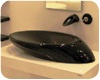
What better way to launch a new blog than to take you on a walk through the biennial ISH Fair that I snooped around in Frankfurt, Germany, a couple of months ago.
For those who have never attended, ISH doesn't quite match up with any single show we have here in the U.S. in terms of overall size or product mix. Unlike K/BIS, it includes PVF, HVAC and other non-domesticated categories - and also unlike K/BIS, it has very little emphasis on kitchen products (except for faucet or fixture lines that include them in their overall product offerings). But what outside-the-wall plumbing they do have, there is lots of - several large buildings' worth, in fact.
The tour I'm about to take you on will give you a brief look at some of the significant trends and innovations from my perspective - followed by a more detailed look at one in particular. Let's get started:
GENERAL OBSERVATIONS
FinishesFor the past couple of shows, most of the mainstream fixture firms have given you your choice of white when it comes to color options, with the exceptions coming from the specialty firms. That pretty much told the story again this time, though there were some introductions of black and black/white combinations, from several of the big guys. When it comes to other finishes offered by the specialty producers, some of them really pull out all the stops to stand apart (snakeskin, anyone?)
Also catching my eye were lavs and counters laminated in actual sea shell, and a copper pedestal lav plated in chrome. I've long wondered why somebody hasn't utilized the unique Chinese art of cloisonne for fixtures and fittings. (This is an intricate process of applying an artistic grid of wire to a ceramic surface and filling the spaces inside with colors that match or complement for an inlaid look.) Well - now somebody has (surprise, surprise - the producer is from China).
Faucet finishes in Europe continue to be predominantly chrome (not nearly as much use of brushed nickel and oil-rubbed bronze as we see here). The one growing exception in this category relates to a bit of a trend in the direction of actual stainless steel (as opposed to the faux variety that is plated over brass). More about that next.
Materials
Fixture materials commonly used in Europe pretty much match ours, with a couple of notable differences. Cast iron is not used as much - and enameled steel is used much more. The latter point is an interesting one. Here, we have traditionally viewed enameled steel at the low-end of the quality spectrum. Europeans don't see it that way, and as a result, give design attention to products in this category that tends to surprise us. Companies like Alape, Bette and Kaldewei produce some really well-designed fixtures. When I have asked these manufacturers to explain this difference in perception, they typically claim their quality of producing enameled steel is better than the way we do it. Dunno if that's true or not, but suspect it would take quite an effort to overcome the image that enameled steel has here.
Style
The angular "block" look is still popular in faucet design, but less evident within the fixture category. Even with faucets, though, the earlier severe forms are largely giving way to softened lines. I suspect things will continue to morph back toward even softer lines now (without going back to the "jelly bean" look that dominated everything a few years back.
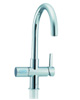
Grohe's "Blue" Faucet
FAUCET TRENDS
MechanicalFrom the standpoint of faucet "engines," I saw two continuing trends. One is the joystick type cartridge, typically actuated with a vertically-oriented control (usually a lever). I saw both deck and wall-mount versions of this. The other trend, somewhat newer on the scene, is the use of cycling cartridges on lavatory and kitchen faucets. (Sometimes called "progressive" mechanisms, these control temperature only, rotating from off - through cold - and then progressively through warmer settings of the travel range.
Though faucets using cycling cartridges look very much like single-lever types, they are limited to a rotational motion (hence, no volume control). While this type of mechanism has been widely used on tub and shower valves in the past, it was long considered inappropriate for use on faucets because of the lack of volume regulation. With the flow output of faucets being throttled significantly in recent years through code-mandated restrictive aerators, however, faucets have become increasingly "on-off" devices, with most users tending to open them to their full flow limit each time.
Electronic
During the 26 years I have been hitting the ISH show, I have seen two or three "mini-trends" involving residential electronic faucets come and go. This year, there was no clear sign of movement in regard to hands-free actuation, and the subject seems to have cycled back to the square one question of whether that feature is warranted for use in the home. What I did find significant regarding electronics was the thinking of manufacturers such as KWC and Hansa, who seem to have concluded that "hands-free" and "electronics" are not necessarily mutually inclusive. (In other words, there is no reason not to actually touch the faucet to operate it electronically.)
Filtration
Like electronic actuation, the idea of incorporating filtered water delivery through a primary kitchen faucet has had a somewhat spotty story of success over the years. The concept enjoyed something of a boomlet here in the U.S. a few years ago, but has since pretty much faded from the scene. The more heavily-promoted products we saw during that period had small-capacity filters located in the faucet spout or pull-out device, and in assessing their demise, it was concluded that the better answer was the under-counter filter location which allows for higher capacity.
That seems to have been Grohe's conclusion behind the introduction of their "Blue" faucet. This provides a conventional single-lever handle on one side for primary faucet use (non-filtered), and a rotation handle on the other side for controlling water directed from the filter below. (Since American sinks are typically larger than European ones, allowing for more components on the faucet deck, we seem to have found the dedicated filtered water faucet to be a satisfactory answer for this need.)
Looking for a reprint of this article?
From high-res PDFs to custom plaques, order your copy today!