Kelly Pipe Evolves Into Master Distribution
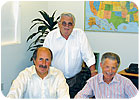
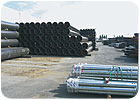
Pipe, pipe, pipe, pipe, pipe. There’s smallish pipe just a few inches in diameter, yet the major inventory is of huge pipe up to 54-inch O.D., some with wall thickness up to an inch and a half. Lengths of pipe, pipe, pipe, pipe, pipe, weighing in at well over 75,000 tons, are stacked as far as the eye can see in Kelly’s 22.5-acre yard at company headquarters in Santa Fe Springs, CA.
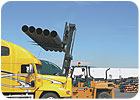
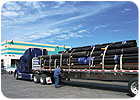
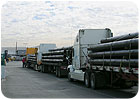
On the day of this reporter’s visit, dozens of flat-bed trucks were strung end to end across the massive lot and backed into the street waiting to drop off shipments from Europe and the Far East. There would be 200 truckloads altogether, and delivery would continue into the next day. Still more Kelly pipe, pipe, pipe, pipe, pipe is stored at other stocking locations in Northern California; Riverside and Bakersfield (CA); Phoenix; Salt Lake City; Casper, WY; Denver; Houston; Chicago and Sharon, PA.
In case it hasn’t been made clear, this company specializes in selling pipe. It’s been doing so ever since 1898.
Pipe accounts by far for the bulk of Kelly’s $300 million-plus yearly sales. The company maintains a modest inventory of valves and fittings as a service to its pipe customers.
“Our customer base is a key to our success,” explained President and CEO Earle Cohen. “We’re very diversified and don’t focus on any single industry for too great a share of our business. That path has taken us to the point where all sales in our Central Region are to other distributors who in turn cover a broad section of industrial users.”
The company’s client list has grown to more than 4,000 active customers in the database, spanning just about any end user category imaginable in Kelly’s Western Region - mechanical contractors, refineries, manufacturers and fabricators, drillers, fire protection, mining, municipalities, utilities, government and other distributors. Across all regions and divisions, Kelly books orders ranging from triple-digit bucks into the multi-millions.
“We support other distributors while going out of our way not to compete with them,” added Cohen. This begged the question of how the company gets competitors to buy from it. The basic answer is, when it makes sense to do so. If Kelly Pipe has the product they need at the right price, other distributors can use it as a supplier to make a sale they otherwise might lose if they had to wait for a vendor delivery.
Len Gross, Kelly’s chief operating officer, noted some significant advantages of doing business with distributors. “With contractors, you have to be there at certain times to meet a crane, and they want to buy copper tubing and a lot of other stuff that we don’t have and don’t want to get into. We also have a different relationship with wholesalers than contractors pertaining to order size, credit and dependability. Wholesalers often buy from us because our purchasing power enables us to offer better prices than if they tried to go direct to the source. We still sell to end users, but a good share of growth has come from selling to distributors,” said Gross.
“Service is still critical, no matter who the customer is,” added John Wolfson, Kelly’s vice president and general manager in charge of branches. “We ship 60-70% of our orders within a day of when they are booked. No job is too large for us. As a result, many accounts rely on us because we have the material they need immediately available.”
Geography Dictates Strategy
Kelly’s path to master distribution was dictated in part by geographic expansion. “Historically we used to think of ourselves as a big fish in a small pond,” said Cohen. “Our shoreline then was the Rocky Mountains, because it’s impractical to ship pipe in small lots to end users from the West Coast across the continent. At the same time we looked at Texas, where more pipe is sold by accident than is sold on purpose in California, and we wanted a piece of that pie. Master distribution is the way to open the door.”Pursuit of the market east of the Rockies led Kelly, starting in 2004, to launch new branches in Denver, Chicago, Houston and Pittsburgh. Opening these new branches in major markets, each with their own inventories, makes more sense than shipping from the West Coast. Known as the Central Region and headed by Vice President Steve Livingston, this group - along with the Salt Lake City branch - markets all of Kelly’s line pipe products as well as an extensive assortment of stainless steel and coated pipe. Specializing in serving other distributors, Livingston believes that “next to our people, our customer base is our most valuable asset, and as such they all have access to our third most valuable asset, which is our extensive inventories.”
Kelly’s Oil Country Division headed by Vice President Mark Brozek and Joe Wangsness, sales manager, has also added a totally new dimension to the company’s growth. This division services major as well as independent oil and gas producers in California, along with oil product distributors. In the Rocky Mountain states and Texas it concentrates mainly on supplying other oil product distributors. Placing sizeable orders with leading mills around the world and capitalizing on their impressive business contacts, Brozek and Wangsness are able to effectively compete with established players in this fast-paced industry sector. With the recent opening of its London office, known as Kelly Pipe International, the OCTG division now can sell to and service worldwide users.
Kelly’s Central and OCTG Divisions account for approximately 60% of Kelly’s overall sales. “The market for both is huge and very competitive, with 10 or 12 large distributors all fighting it out,” Cohen commented. “Yet in spite of the competition, our business model is sound and highly successful,” he added.
For most of its long history, Kelly Pipe was able to thrive while staying close to its West Coast regional marketplace. A big asset has been its location in an industrial area just south of downtown Los Angeles. “This is premier industrial property. Few companies could afford a pipe yard here now,” said Cohen. “We were very fortunate to acquire the property in 1971.”
That advantage is paying fewer dividends with the passage of time as L.A.’s legendary traffic congestion makes cross-town and inter-city journeys in Southern California an ordeal chewing up most of the day. “It can take three hours to come into town from Riverside,” noted Cohen. “We’re not ready to abandon L.A., but it may be something we need to look into in the future.”
As a safety valve, Kelly has established a major pipe storage yard at its 30-acre site in Riverside, CA, closer to eastbound trade.
Foreign vs. Domestic
Historically, Kelly sold almost nothing except domestic product, and it stayed domestic oriented longer than most distributors. Now about 40% of its inventory is imported, so testing and certification take on more importance than ever before.It’s sobering for everyone in the PVF business to contemplate that a simple piece of pipe selling for little more than a buck a foot could end up costing millions in liability expense. Until recent times, foreign mills in places like China and Russia had only a single customer - their respective governments. The private sector is much more demanding.
Quality control always has been a big issue with Kelly. When the company discovers pipe not up to its quality standards, Kelly has the option of either returning it to the source or selling it on the secondary market for non-critical structural uses - pilings, fencing, etc. Kelly strives to make sure its distributor customers take the same kind of care.
“During the manufacturing process there can be a small amount of defective pipe,” asserted Cohen. “The question is, do their quality control and inspection departments identify and take it out? Right now there’s a lot of turmoil in the market. When the Japanese started bringing pipe in, the quality was questionable, but they improved. As their cost went up, Korea took over. Now we’ve got China coming on stream. They’ve built 127 new mills. We don’t have 27 in the entire United States. Within two years, China will increase production by 133 million tons, which is more than the total U.S. steel industry produces annually.
“We really spend time analyzing the credibility of the mills we buy from,” said Cohen. “We have brought major oil company customers to the mills for inspection, and have worked very hard with manufacturers in Eastern Europe and Asia to get quality that’s acceptable to American end users. We are very, very selective about who we deal with,” Cohen added.
For oil country tubular goods, Kelly employs a third-party American Petroleum Institute professional pipe auditor along with Kelly personnel for quality assurance. They do checks of each mill’s metallurgy, quality control manuals, and product testing procedures, chemical analysis records, gauge calibration and training of internal inspectors.
Operational Efficiency
Like virtually everyone else in the PVF sector, Kelly Pipe Co. suffered during the industrial recession of the late ’90s and early 2000s. Pipe that sells for around $800 a ton today was going for $350 a ton at the low point, about what scrap is selling for nowadays. Kelly weathered that recession better than most thanks to its experienced management team and knowledgeable employees.Kelly’s volume has tripled in the last five years to $300+ million. Most astonishing, it is generated by a work force numbering fewer than 200 employees. That sales-per-employee ratio bespeaks a lot of delegated authority.
“Each of our branches is distinctive,” said Wolfson, who is in charge of branch operations in the Western Division. “Some of our branches are in areas with a lot of water well drilling, while in other places mining may be paramount. Our branch managers know best what they need, and we let them act on what they know best.”
“People who come to work for us from other supply houses tell me they’re astonished at how much information we share with them compared with previous employers,” added COO Len Gross. “We believe in open book management. This gives them confidence in us and a willingness to participate. When they see something wrong, they tell us.”
A profit sharing program and incentives percolate throughout the company all the way down to the receptionists. It gets everyone involved in thinking up ways to operate more effectively. It also has a lot to do with Kelly’s turnover rate of less than 1%, and no shortage of job applicants.
The company brags in its literature that salespeople in the field are no more than one phone call away from a management decision. “Our customers do not have to wait while information passes up and down a lengthy chain of command,” said Cohen. “We have published prices in the computer and the people working our desks are very experienced. Most have been with us 15 to 20 years.”
Salespeople discuss large quotes with Cohen, or Wolfson and Marketing Manager Gary Childs in the West, and Livingston in the Central Region. “Numerous ingredients need to be considered before establishing a selling price,” Wolfson commented. “You have to have a feel for the marketplace, and day to day something can have a different value.”

Extensive fabrication operations at Santa Fe Springs headquarters and its Imperial Pipe Services (IPS) affiliate in Riverside also comprise a competitive edge. IPS, led by Bob Raber, is an up-to-date pipe processing and pole fabrication plant with modern welding, cutting and cement coating/lining capabilities. By selling to a broad assortment of waterworks distributors, pump stations, pipeline contractors, water well drillers, oil and gas operators, lighting contractors, electrical distributors and major utilities, IPS enables Kelly to function as a one-stop shop for its customers.
So too is Kelly Valve, Automation & Controls Inc. (KVAC), a valve automation unit formed in 2001, headed by Ron Guminski. KVAC specializes in supplying and activating valves and valve automation products for the water, wastewater, power and process industries. Its highly engineered valves designed for extreme applications provide Kelly further penetration of this demanding market.
Safety has taken on increasing importance over the years. Moving and loading pipe is an inherently dangerous job. The product is clumsy to handle and inattentiveness can lead to people falling off trucks or getting crushed by tons of rolling metal. California’s worker comp regulations make it imperative for companies to minimize accidents. Kelly’s safety program includes monthly meetings of a safety team that includes the CEO and other top managers. There also are monthly “tailgate” safety meetings for all operating departments and branches, and a safety award incentive program.
Safe work procedures get developed by a group staffed with representatives from employees, supervisors, equipment manufacturers and safety consultants. A safety coordinator conducts accident reports and investigations, with findings disseminated through safety team meetings. Relevant personnel undergo mandatory drug and alcohol testing.
Kelly’s main claim to fame inevitably rolls back to its extensive, diversified pipe inventory. Most of it is carbon steel, although Kelly also sells a fair amount of stainless and other special alloys. In the last 10 years it has added industrial high-density polyethylene pipe to its repertoire as well.
“We look at inventory as an asset and a tool to do more business,” said Cohen. “People always ask, how many turns are you getting? To me the key is not whether you turn it one time or five times. The key is, does it give a good return on your investment?”
Cohen expects Kelly to double sales in the next five years. Historically, the company has made few acquisitions, and the CEO sees future growth from internal growth continuing, with a large share of the next doubling in sales likely to come from selling to other distributors.
“So far, we don’t need to buy other companies,” said Cohen. “We know what to do, and we have the expertise to do it. It is all about good people who are well trained and have product knowledge. We give them the products to sell and the tools to perform.”
Kelly Pipe's Thoroughly Modern History
Unusual for a company that’s been around for 109 years, the folks at Kelly Pipe Co. talk a lot more about the present and future than its history. They don’t even know the first name of the company namesake.They do know that the founder was a boilermaker by trade and started the business in 1898 by selling used pipe, fittings and miscellaneous materials out of a former vineyard near the railroad depot in central Los Angeles. Kelly sold the business in 1915 to a Mr. Levin, whose son, Hyman Levin, took over in the 1920s and under whose leadership the company prospered.
Kelly Pipe Co. then began selling new pipe as well as used and made equipment investments that enabled it to recondition pipe and expand sales into various new applications, such as underground water service and temporary service at construction sites. By the 1930s the company was a public works supplier on projects such as Yosemite National Park and oilfield lines for Standard Oil. During World War II, the company supplied pipe that brought water to General Patton’s desert airstrip near Indio, CA.
Kelly’s modern history and most spectacular growth began in 1971, when the company was acquired by Shapco, a holding company of brothers and current owners Bernard and Leonard Shapiro. They promptly moved the company to its present location in Santa Fe Springs and recruited Cohen as president. The Shapiros also used to own and manage Familian Pipe & Supply, a prominent Southern California plumbing wholesaler they eventually sold to Wolseley in 1988.
A veteran of the steel business going all the way back to 1954, Cohen originally was hired by the Shapiros to run Kelly Pipe after they bought it in 1971. He served as the first chairman of the National Association of Steel Pipe Distributors after NASPD was formed in 1975 and as Kelly Pipe’s president until 1980, when he left to take the top position at another California pipe distributor. He was rehired to head Kelly in 1993 and has been at the helm ever since.
Cohen, with more than 40 years of experience, is assisted by several key executives: Len Gross, COO, a 30-year industry veteran, who was executive VP at Familian Pipe and Supply through 1999; John Wolfson, a 27-year veteran with Kelly Pipe, who is vice president and general manager in charge of Western branches; and 38-year veteran, Central Region VP and GM Steve Livingston. Along with 27-year OCTG veterans Mark Brozek and Joe Wangsness, they all play a central role in developing Kelly as a nationwide company. These gentlemen and the rest of Kelly’s managers work closely as a skilled team and are leading Kelly Pipe through the headiest days of sales growth and geographic expansion in the company’s long history.
Looking for a reprint of this article?
From high-res PDFs to custom plaques, order your copy today!