Hey, What's Wrong With European Shower Valves?

When we North Americans first began to discover that Europeans did indeed have indoor plumbing back in the early ’80s, and that some of it was more elegant than much of the pedestrian stuff we were peddling at the time, we began an ongoing analysis of which of their products made sense for our market - and which didn't.
In the "didn't" column, there were some rather objective bases for rejecting some of them - things like toilets with 10" rather than 12" roughs, 10mm rather than 3/8" faucet supplies, kitchen sinks that didn't fit standard cutouts here - and numerous other examples. In time, European manufacturers who were serious about marketing here modified many of their products to accommodate our way of doing things.
But there is one European approach to product design - or more accurately, product installation - that never seems to have been accepted here, and lately, I've begun to wonder why. I'm talking about exposed tub and shower valve installations, which are the norm across the pond. This really isn't a matter of right or wrong - it's just a matter of opinion. We like our shower valves concealed, along with the connecting piping to the tub and/or shower outlets. That's just our preference - we seem to think it's classier, I guess. Somehow, we must think that having the shower valve hanging outside the wall for God and country to see seems, well, tacky. Really - why? From a functional standpoint, I could give you some arguments why it's a heck of a good idea. We'll get to those in a minute.
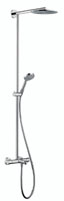
A new generation of shower products from Hansgrohe
What struck me in the Hansgrohe booth (and they are not alone in this, by any means) is a new generation of shower products that provides both a fixed showerhead, and a handheld attachment. With this combination, the supply to the showerhead isn't just a utilitarian-looking exposed pipe, it doubles as the slide rail for the hand shower as well as the parking place for other accessories.
But if we can provide all that with concealed valve installations (assuming we include a conventional slide rail for the handshower), what's the advantage? Glad you asked. I see big advantages when it comes to installation. Not having to run piping to the tub filler and shower behind the wall is one. And since the tub spout is typically integrated with the valve body on European shower valves, there is no piping to that component period. Next, let's look at servicing. Changing out a valve cartridge may be pretty much the same with both types, but on a concealed installation, what happens if you have a defective valve body that leaks?
In this case, you are talking about the potential of damage that could go undetected until it reaches disaster stage -- followed by having to tear into the wall to replace the valve body. But on the other hand, if a body leak develops in an external-mount valve, (1) you see it right away, (2) it doesn't cause any damage, and (3) you can replace it in minutes.
I think it's time to reconsider the European approach here. What do you think? Write me at: donarnold@earthlink.net
Links
Looking for a reprint of this article?
From high-res PDFs to custom plaques, order your copy today!