A Peek Inside The New American Standard

It has been a momentous couple of years for the company with the most illustrious name in American plumbing history. Last year the company’s bath and kitchen segment - and name - was acquired by the private equity firm Bain Capital Partners for $1.755 billion. Later in the year ownership was joined with a minority stake by Sun Capital Partners, whose affiliates owned Crane Plumbing and Eljer. Once privately held, the American Standard brand name was subsumed into a business called American Standard Americas, with its former publicly traded corporate parent adopting the name of its Trane division.
Then, in a move that was largely preordained once Crane’s and Eljer’s owners came aboard, American Standard completed a merger last month with its former rivals. The combined company has adopted the name American Standard Brands. Don Devine, previously president and CEO of American Standard Americas, has assumed the same titles with the combined company.
Devine last month consented to a wide-ranging interview with Supply House Times, as follows.
Supply House Times: How do you see today’s American Standard?
Devine: It’s been an adventurous couple of years. American Standard went from being a relatively small part of a large conglomerate to a stand-alone bath and kitchen and plumbing business focused on the American Standard brand and NAFTA market. Then we saw an opportunity to get greater scale and breadth by bringing the Crane and Eljer brands in house.
Our owners purchased the company with the intent of creating value and enhancing and growing the American Standard brand. Besides financial performance metrics, the owners expect us to deliver product performance, ease of doing business and product availability. We are being evaluated in all of these areas.
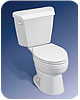
We’ve been really pleased at how we’ve continued to improve our business and keep our eye on the ball, despite a lot of distractions as we went through the sale and now the merger process. Over the last 15 months we have been very aggressive in re-launching the Champion 4, which has been very well received, as well as the Cadet 3 platform, which has been a winner in all of our channels.
Now we’re shifting to a high level of focus on our FloWise line of high-efficiency toilets and showerheads. The toilets use only 1.28 gallons per flush and are now available in the market. Similarly, dual flush toilets that are now selling in Canada and Mexico will be coming here in the future.
All of those introductions have been executed throughout the sale process we went through last year, and through the merger process taking place now and into next year.
In the faucet category, we’ve been very active in updating our styles and finishes for both Jado and American Standard branded lines. We’ve also complemented them with our speed-connect drain. A lot of people in the trade will see that as focused on the DIY customer, but it’s also for the commercial plumber who works on large projects and can benefit from huge labor savings with a quality component as well. We’ve also been active with new styles and designs in our jetted tubs and sink categories.
We don’t want any of the transactions we’ve been through or the one currently underway to be a distraction to their ability to run their business. In the future we will have a greater breadth and scale and a better business system, which will give our distributors the ability to provide the products and services to their customers that allow everybody in the chain to win.
What are the biggest challenges you see regarding American Standard’s distribution channel?
Distributors are always trying to figure out a maximum level of choice and assortment, while at the same time effectively managing their business as it relates to SKUs, velocity and so on. We look at American Standard today as being a multi-product and multi-channel company. There’s a huge advantage to doing business with us because you can have a common brand, common selling points and reliable products that allow distributors to simplify their business.
We think their biggest challenge is trying to figure out how to give choice and still meet their own need to manage their variety. As we become a stronger and more effective company, they can count on us to provide a lot of those solutions because they won’t need to carry competitors’ products side-by-side to get the assortment and velocity they are looking for.
Will the Crane and Eljer brands be maintained, or are one or both destined to be subsumed under the American Standard name in the foreseeable future?
Absolutely the brands will stay. A hypothesis of the merger is that each of the three brands has a role in the new company. At the same time, we expect to take out as many of the redundancies as possible in support of the three brands. Details of that will be worked out with our integration team over the next 30-60-90 days.
Do you anticipate acquiring more competitors in the near future?
At this moment the focus is on the integration of these three companies. At the same time our owners are very much in the market and looking at opportunities to acquire companies. If something were to arise that seems to make sense, where we could buy it right and increase value, and not impact customers in any negative way, we would have a good discussion with both of our private equity partners.
Operational consolidation is inevitable with this merger. Can you tell us what you know thus far about which plants among the three companies are destined to be closed?
No decisions have been made as to the next round of plant closures, if any. We have to go through a process of figuring out the economics of each facility. Each of the companies had a set of assumptions about how to operate their business as a lone entity. Now, in bringing the three companies together, we have to evaluate how the capabilities of each company will influence where we make products. That process is underway.
Then the next step is proper notification of employees and unions if any more facilities are to be closed. We are not yet at this stage.
We’ve really been focused on American Standard prior to the merger, and I don’t think that changes. Our goal is to concentrate on three things.
First, provide a viable business system to our customers with regard to quality and on-time delivery. We’ve made dramatic improvements in both of those areas. Because we are a large, complicated company, we can be more complicated than I’d like us to be, and that’s an area where we had some improvement to make.
Second, improve our cost structure. In the last year we’ve closed three plants in Brazil, Canada and the U.S., all part of taking costs out of the system and improving the scale of our existing facilities. Facilities not running full or at higher cost have to come out in today’s environment where you have overall demand weakness. We’re very focused on taking costs out of our system.
Our third area of focus is differentiated products. Ultimately, whether the market is good or bad, our products are the same. Consumers, end users, wholesalers and showrooms make decisions about which ones to purchase, and we intend to give them reasons to buy ours.
These are the three elements we’ve been focusing on and will continue to do so in the future. Only now the question will become under which brand will we introduce our new products in the future.
Some industry observers believe the North American market will be dominated by three fixtures manufacturers - your company, Kohler and TOTO. Do you believe market share will be controlled by these companies, or will it be more fragmented?
We don’t have a crystal ball to see the structure of the market in the future, but when you look at the market now, it’s become very important to have breadth of line.
That’s why we’re excited about this merger. We think it gives us a broader product line and larger scale, which matters in today’s environment because of competition both from existing branded companies as well as offshore private label producers coming in bulk to both the wholesale and retail channels. We would say that anyone who has breadth and scale will be advantaged.
Do you foresee more foreign manufacturers making a big play for the North American market?
Even in the current downturn, ours is the largest homogenous market in the world, so it’s very attractive to offshore folks. Brand still matters to a lot of people, however, so companies like ours have an advantage, as well as incentive to cultivate and take care of our brand. Consumers and the trade continue to favor brands with which they have a history and trust. American Standard has an iconic brand, so as long as we continue to support that brand with a great business system and great products, the less likely it will be for people to turn to products with which they have less experience.
Where offshore manufacturers are being most aggressive is in private label programs. HD Supply recently rolled out its own private label, and Ferguson has a very well developed and sophisticated private label program. This is where we see the role of imports having most impact.
Are private labels growing in significance?
The private label trend has been significant for the last four or five years. I wouldn’t say it’s becoming any more or less significant. It’s just there and part of the business.
One of the challenges a branded company like ours has in a market where demand is weakened, particularly in new construction, is that in some high-end remodel jobs, people might be willing to trade down in brand and price because they’re under significant cost pressures. It’s really up to us to have a strong business system that reinforces why they should stay with a tried and true brand like American Standard.
We are an iconic brand that has been around for more than 130 years, and we have every intention under the new ownership structure to stay around. We only have one business today and that’s winning in the plumbing business, or else we fail, and we are not interested in failing. We have a brand people trust, and we’re going to support that with great products and a great business system that give people a reason to buy American Standard.
You seem to imply that some of American Standard’s problems of recent times stemmed from being part of a conglomerate and having to contend for resources with other businesses that had nothing to do with plumbing?
We wouldn’t look backward and say it caused us problems, but focus is an important competitive advantage for a company. The people we compete against are highly focused and serious about the bath and plumbing space. We have created a business model that allows us to mimic that attribute.
What are the biggest business challenges you face as a fixture and faucet manufacturer?
We want people to think of us as more than just a fixture company. We have a terrific faucet business, jetted bath business and enameled steel products with our Americast line of sinks and tubs. Business is about half and half retail vs. wholesale, and we’re involved in new construction, remodeling, commercial work and the repair business. We want people to think of American Standard as a multi-category brand in the plumbing business.
Our biggest challenge is similar to everybody else’s these days. We have weakness in end-use markets and tough competitors, along with raw material and commodity inflation. How do you put that all together and delight customers and improve margins?
Your company’s private equity owners obviously expect a return on their investment. So how do you make money in the face of these conditions?
It goes back to a point made earlier. Our basic strategy is to have a reliable business system, good cost structure and products that people choose because of desirable characteristics in style and performance. We like to think in the fixture category, it’s a matter of being able to provide both performance and efficiency. We intend to give people a reason to choose American Standard over any other choice in the market today.
What’s your reading of the housing market? Do you anticipate a turnaround anytime soon?
In the new-construction market, inventory is too high and the affordability index too low. Prices need to come down a bit and new supply needs to be curtailed until things come into balance. We’re not expecting any recovery in the new-construction market in 2008. That’s probably a 2009 scenario.
On the other hand, there are a lot of things going on in the business today that are pretty important. If toilets break and faucets leak, consumers are going to do something about it. We are very much focused on that, and our wholesaler partners recognize that the market strength is going to be in that repair business.
Maybe in the past they focused on the high-end remodel, where people were going to replace five to seven different bathroom items. Now, in the current market, distributors have to be focused on the single item replacement, and we have to give their customers a reason to select our products.
Legislative pressure is building in California and other states for continued water flow restrictions in plumbing products. How do you feel about ever more restrictive environmental standards?
We think that actively participating in the regulatory process is important. Our government has people from many sides petitioning it, and we want to be sure our point of view gets heard as well.
That being said, the environmental movement is part of our society today and impacts our business - but it impacts our business in a favorable way. If our products perform using only 1.28 gallons per flush, that conserves water; products that are reliable and don’t leak conserve water. We are in one of those fortunate spaces where we can be both green and be good for our business, so everybody wins.
How far along are your brass people in complying with the new California law requiring no more than .25% of lead in any plumbing products after 2010?
We continue to make progress. Our expectation is we will be in a position to comply with that, but it’s something currently under development.
Will American Standard continue to belong to the Plumbing Manufacturers Institute and participate in its activities?
We don’t have any plans to change any of the trade groups with which we participate, and we recently joined a new group called Green Plumbers. (Editor’s Note: see www.greenplumbersusa.com.)
Looking for a reprint of this article?
From high-res PDFs to custom plaques, order your copy today!