AHR EXPO 2008: PART 1

his year, the 2008 AHR Expo (the HVACR industry’s largest trade show) was held in New York City on January 22-25, at the city’s Jacob Javits Center on the southwest side of Manhattan. This was the largest and most successful of these shows to date, with more than 1,800 vender booths displaying products and services, and more than 50,000 attendees, plus almost 20,000 exhibitor staff, swelling the number of people on the floor to about 70,000.
Over the past years, several of the industry’s largest equipment manufacturers have opted not to display their products at the Expo because of the high costs involved and a questionable return on investment. But due to the particular northeastern market, which is a valuable part of their business, even the world’s largest HVAC manufacturer, Carrier Corp., had several of its top commercial and residential products on display.

What did I find to be the most significant industry trend? It is surely the
rapid growth of HVAC equipment using micro-channel coils (think automobile radiator).
Why, even Carrier was touting its new line of packaged rooftop equipment using
micro-channel condenser coils. What are the advantages of this type of coil
design (which was originally pioneered in our industry in heating applications
by Modine)?
I mentioned in my last year’s Expo column that York International had started using micro-channel coils back then. However, the representative I spoke to about it at the time indicated that the coil would probably be more costly, so it was slated for the company’s higher-end products. This is not how things have worked out. Because the coils are coming from a Chinese manufacturer (Delphi), the costs are actually lower, and York is using them to reduce the size of its 13-SEER and 14-SEER cooling products. And because the creation of smaller and lighter products that hold their efficiency better and use less refrigerant is a great idea, surely we will see this coil design become very popular across a broad spectrum of product lines in the future, and more manufacturers will be jumping on the bandwagon.
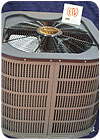
What are the drawbacks of micro-channel coils? Well, the design doesn’t currently work well as an evaporator, because it doesn’t deal well with condensate water. So I didn’t see any of the manufacturers using the coils in heat pump applications. However, that is surely going to change soon, for one manufacturer of micro-channel coil machine tools (a company with an automobile-radiator background out of the Detroit, MI, area) had a micro-channel evaporator on display in its booth. Also, an equipment manufacturer told me privately that it will be offering a line of zinc-clad aluminum evaporator coils, perhaps by the time you are reading this.
Another minor inconvenience of employing micro-channel coils (I was told) is that they use so little refrigerant that it is a challenge to come up with a condenser coil that will create enough refrigerant-holding charge as it comes from the manufacturer. But with the higher costs of refrigerant, a smaller required charge is a great idea.
There were several other interesting new products on display at the Expo, which I will cover in my column next month, so please watch for it.
Looking for a reprint of this article?
From high-res PDFs to custom plaques, order your copy today!