NKBA: Specifying Kitchen Sinks
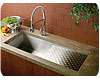
In partnership with the National Kitchen & Bath Association, Supply House Times continues its yearlong kitchen and bath educational series with an overview of considerations for specifying kitchen sinks. This article is excerpted from Kitchen & Bath Products, one of nine books in the NKBA’s Professional Resource Library, and offers a checklist of planning tips from experienced kitchen designers, beginning with an overview of common sink sizes, types and configurations.
In small kitchens (less than 150 square feet in size), it is not uncommon to have one single-bowl sink specified. Single sinks can range from 24 inches to 30 inches wide. Generally, this sink is 24 inches x 22 inches in size. It can fit in a 27-inch wide cabinet. Listed below are other types of sinks:
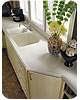
Double, varying depth double, or triple-bowl sinks are more often specified in kitchens larger than 150 square feet.
Special Purpose Sinks
Second sinks in kitchens are often single sinks. Round or other shaped configurations are popular today. Several manufacturers offer elongated “ribbon” shaped specialty sinks.
Apron Panel Sinks
Specially designed sinks featuring an exposed or decorative front apron are available in double and single configurations.
Sink/Counter-Section Combinations
A sink “center” rather than a plain sink is also available in corner configurations and in 36-inch to 60-inch sink/counter combinations. Built-in front towel bars, adjacent drain boards or customized-raised compartmentalized storage areas behind the faucet are available.
Accessories
A variety of sink accessories are also available.
- Plastic-covered wire or stainless steel baskets are
useful for washing and peeling fresh vegetables. They take the place of a
colander.
- Plate racks that fit inside the sink.
- Wire racks.
- Specialized chopping surfaces that completely or partially cover the sink are also available.
These accessories may match the sink color, contrast with the sink color, or be a combination of the sink’s color and stainless steel. They enhance the sink’s function, as well as its appearance. Do not overlook them.
Other Considerations
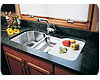
Bowl ArrangementUnless your client is going to wash and rinse dishes in a double sink configuration, demonstrate how a sink with one large compartment and one small compartment functions. This configuration gives you the largest sink for everyday use, and then a smaller - yet usable - compartment for other uses.
Corner Sinks
When placing a sink in a corner, do not push it back more than 2 inches or 3 inches away from the front edge of the countertop. That is the normal installation location and it should be maintained (even in a custom design) so the client has comfortable access to the water source.
Damage
Make sure your client realizes that cast iron, self-rimming sinks are susceptible to damaged edges or to warpage. This is particularly a problem with larger sinks. Make sure you inspect the sink before it goes to the jobsite. Look for chips along the lead edge. The client must accept the possibility of a wide caulking joint connecting the sink to the countertop for large sink configurations. If this will not be acceptable, specify another type of sink. With these self-rimming sinks, also make sure you specify caulking that will either match the countertop or the sink so the joint compound does not become a focal point in the sink area.
Depth
The deeper the sink, the straighter the sides of the sink. The tighter the angle where the sink side and bottom meet, and the flatter the sink bottom, the bigger the interior space is.
Drain Boards
A sink with an attached drain board is an excellent accessory to specify for a client who does a lot of fresh food preparation.
Food Waste Disposer Compartment
Some sink configurations are a single size (24 inches x 21 inches), but have a small, round compartment for the food waste disposer in one back corner. Because the compartment for the food waste disposer is almost too small to use, this is not the most desirable sink configuration.
Holes
Make sure you know how many holes are on the back ledge of the sink and how many holes you need for the faucet and water attachments. If a hot water dispenser, a faucet, a dishwasher air gap, other dispensers and/or water treatment spouts are planned, you may run out of pre-drilled holes. Typically, cast iron sinks have four holes. A fifth hole can be drilled, but it is expensive and the sink may be damaged. Adding extra holes is much easier in a stainless steel sink. In solid surface sinks, the holes are drilled in the countertop deck so the number and placement is flexible.
Overall Size
When specifying a solid surface integral sink, verify what the actual overall dimensions of the sink are. The sink literature may list the interior dimension of the sink, not the overall dimension. This overall dimension will determine your spacing in a standard side-by-side double configuration. You may find it necessary to increase the cabinet size if you are planning to create a “butterfly” corner arrangement with such sinks.
Recycle Center
Some sinks on the market have an opening within the sink that allows access to a chute for a compost container or a waste receptacle below.
Round Shapes
If you are going to specify two round sinks as the primary sink arrangement, make sure your client understands the interior space of these sinks is less than a comparable square model. Also, realize these sinks require deck-mounted faucet locations; therefore, you must specify the faucet location on your plan.
Small Sinks
Avoid small, 12-inch x 12-inch sinks. They have a drain that does not accept a food waste disposer, and are so small there will be a water-splash problem when the cook uses the sink for food preparation.
Strainer
If you are not ordering a food waste disposer to be mounted on the sink, make sure you order a good quality strainer.
Under-mounted Sinks
If you use separate under-mounted sinks in place of a sink manufactured in a double configuration, warn your client that if water is running and the faucet is swung from one sink to the other, water will splash on the countertop. Consider routing down the countertop section that separates the two sinks, or recessing the entire configuration into the counter surfaces 1/4 inch or so in order to eliminate the potential for water to run across the countertop and down to the floor as the spout is moved from sink to sink while water is running.
Helpful Hints From The Pros on Specifying Fittings
-
Positioning the Sink
Holes. Locate faucet holes along the ledge of an under-mounted
sink carefully: they need to clear the sink rim edge. For top-mounted sinks,
lay out the hole drilling carefully, with the faucet on-site. Check hole
spacing if using a two-handle faucet to ensure clearance.
- Overall Depth of
Countertops. Make sure you have enough room behind the sink for
some of the oversized “pro,” more elaborate faucets. Faucets with controls
behind the spout are particularly problematic, and might be better placed
diagonally to the side of the sink.
- Extra Thick
Countertops. Special planning may be needed for oversized, thick
countertops: the shank length of the faucet needs to accommodate the counter
thickness.
- Oversized Sinks. If the faucet does not have a pull-down spray or a side spray, verify that the spout swivel has a wide enough arc to reach all the sink bowls. Two-handle faucets - including bridge-style faucets - may not work with some double bowl sinks.
This article is excerpted from Kitchen & Bath Products, one of the nine books in the NKBA’s Professional Resource Library. Written by recognized industry experts and thoroughly reviewed by top technical editors and peers, the volumes cover design, products, residential construction, mechanical systems, business practices, drawing, project management and more. They are available only through the Association at www.nkba.org or call (800) THE-NKBA.
Looking for a reprint of this article?
From high-res PDFs to custom plaques, order your copy today!